INTRODUCTORY OR TRY-OUT 3 DAYS QI GONG HEALING COURSE.
Leave a reply
(reproduced from http://shaolin.org/answers/sp-issues/training-schedule.html)

Students, expecially at beginners’ level, should include stance-training, including moving in stances, in their daily training schedule
Question
I believe I heard somewhere that you prefer to have a structured, daily schedule. Can you please talk about the importance of having a daily schedule and any tips that may help us successfully implement and stick with our own (especially tips for handling disruptions such as travel or unexpectedly having to work late)?
Chris, USA
Answer
Yes, having a structured daily schedule will help to save much time as well as to get maximum benefits from the practice, both in the practice session itself as well as the general programme of training.
Experience has shown that many students waste a lot of time thinking of what to practice next after they have completed one aspect of their training. Because they lack a clear cut schedule, they often practice haphazardly, spending too much time on what is relatively unimportant, neglecting crucial aspects as well as training redundantly.
For example, many students spend years on practicing kungfu sets, without developing force and practicing combat application, which are the two twin pillars of any kungfu training. Yet, after many years of practicing forms, their forms are not correct because they failed to master the basics like how to co-ordinate their body, feet and hands, and how to move with grace and balance.
Having a structured schedule will overcome these setbacks. But before we attempt to work out our schedule, we must have a clear idea of what the art we are going to practice is, what our aims and objectives of practicing are, and what resources we have to work on. Without such preliminary understanding, many people end up with form demonstration or Kick-Boxing though they originally aimed to practice Shaolin Kungfu or Taijiquan. Some of them, including instructors, have invested so much time and effort in their deviated practice that they even think or argue that form demonstration or Kick-Boxing is Shaolin Kungfu or Taijiquan!
Setting aims and objectives are important when constructing a daily practice schedule. It helps to make your practice very cost-effective. To set aims and objectives wisely, you need to be clear of not just what you wish to achieve but also what the art has to offer. Then you select from within the art the relevant resources for practice that best help you to accomplish your aims and objectives. Arranging this material into some systematic ways for practice makes up your daily practice schedule.
Allot time, say half an hour or an hour, for each training session, and give yourself, say, six months as a package to achieve your objectives. Your daily practice schedule may be the same every day if you have sufficient time in the session to complete the chosen material, or you may vary your daily schedule if you have a lot of material to cover.
Naturally, because of different needs and aspiration as well as developmental stage, different practitioners will have different schedules. Let us take an example of a student who attends regular classes from a Shaolin Wahnam instructor. He aims to have good health and vitality as well as combat efficiency. A good daily schedule is as follows.
Start with about 5 minutes of “Lifting the Sky”. Then spend about 10 minutes on stance training, followed by about 5 to 10 minutes of gentle chi flow. Next, spend about 10 minutes on the Art of Flexibility, alternating with the Art of 100 Kicks on different days, followed by about 5 minutes of chi flow.
Then practice a kungfu set. If he has learnt many sets, he may vary the set on different days. Depending on his needs, aspirations and developmental stage, in his set practice he may focus on correctness of form, fluidity of movements, breath control or explosion of force. This will take about 10 to 15 minutes.
For the next 10 or 15 minutes, he should practice his combat sequences. He may go over all the sequences he has learnt or select those he wishes to consolidate. He will practice them at the level he is at, such as merely going over the routine so that he will be very familiar with them, using steps like continuation and internal changes, or varying them in sparring with an imaginary opponent. He will conclude his training session with 5 or 10 minutes of Standing Meditation where he enjoys inner peace or expands into the Cosmos.

If your objective is to prepare yourself for an Intensive Shaolin Kungfu Course, you should include combat sequences in your daily schedule
Another student who does not have the advantage of learning from a regional Shaolin Wahnam instructor, may have a very different daily schedule. Suppose he wants to attend my Intensive Shaolin Kungfu Course, but could not learn kungfu, even only outward forms, from a local teacher. So he has to learn the forms from my books, and familiarize himself with the combat sequences from my webpages.
His main aim is to prepare himself so that he can qualify to attend the Intensive Shaolin Kungfu Course. He has three main objectives — to be able to perform basic kungfu forms so that he can follow the course, to be familiar with the routine of the 16 combat sequences so that he can focus on developing combat skills instead of wasting time learning the sequence at the course, and to develop some internal force, especially at his arms, so that he can be fit for a lot of sparring. He allots half an hour a day for three months to achieve these objectives.
He should spend the first month focusing on the basics, i.e. the stances and footwork and basic patterns, and the other two months on familiarizing himself with the 16 combat sequences. Force training, including the Art of Flexibility, should be carried out throughout the three months.
He spends about 5 minutes on “Lifting the Sky” which he can learn from my books. He will probably not have any chi flow. For the first two weeks, he focuses only on the stances. He spends about 20 minutes learning how to perform the various stances correctly. At this stage, he needs not, and should not, remain at each stance for any length of time. In other words, this stage is not for zhan-zhuang, or remain at a stance for some time. His task is to be able to perform a stance, for a few seconds, correctly. Within two weeks he should be able to learn the correct positions of the stances quite well. For the remaining 5 minutes, he practices the Art of Flexibility.
For the next two weeks he focuses on moving in stances and performing basic patterns. By now he should be able to move into any stance correctly, though he may not be able to remain at the stance for long. He begins the session with about 5 minutes of “Lifting the Sky”. Then he spends another 5 minutes on performing all the stances correctly. The emphasis is on correct form, and not on remaining at the stance to develop force. Next, he spends about 15 minutes to learn how to move correctly in stances and to perform basic patterns. He should pay careful attention to waist rotation and body weight distribution so that he can move gracefully and without hurting his knees. He concludes the session with the Art of Flexibility. By the end of the month, he should be able to perform basic patterns in proper stances correctly.
For the next two weeks, he focuses on familiarizing himself with the 16 combat sequences as well as developing some internal force. He starts his session with stance training. Now, as the postures of his stances are correct, he focuses on remaining at a stance for as long as he comfortably can. This will take about 5 to 10 minutes. For the remaining 20 minutes, he practices the 16 combat sequences, starting with one and progress to all the others. He needs not worry about force and speed. His concern is to remember the routine of the sequences and perform the patterns correctly.
If he takes three days to learn and practice one combat sequence, he can complete the 16 sequences in 48 days, giving him a few days for general revision. He should learn and practice the sequences progressively, not individually. In other words, by the sixth day, he should be proficient in sequences 1 and 2, and by the ninth day be proficient in sequences 1, 2 and 3, etc.
Hence, if he follows these schedules for three months, he will be well prepared for the Intensive Shaolin Kungfu Course even though he might not have any kungfu experience before. On the other hand, someone who may have learnt kungfu for many years, where he only learns external kungfu forms, is ill prepared. This is a good example of cost-effectiveness. The smart student knows what he wants and plans his practice accordingly, whereas the mediocre student practices haphazardly without direction.
The above is reproduced from Question and Answer Number 1 of the May 2007 Part 2 issue of the Question-Answer Series.
Please e-mail your questions to Sifu Wong Kiew Kit stating your name, country and this webpage for reference. E-mails without these particulars may not be answered.
(reproduced from http://shaolin.org/discussion/academic-excellence.html)
Alex, England Mind training is an essential aspect of genuine chi kung. Here during a review course in Malaysia in December 2004, students entered Zen, where they attained a one-pointed mind, then let their mind expand.
The following discussion is reproduced from the thread Chi Kung and Academic Excellence posted by Alex in the Shaolin Wahnam Discussion Forum on 7th January 2005.
Chi Kung and Academic Excellence
I used to be a slacker but now I’m not.
I would aim for the minimum pass mark at University of D (40%) and often I would fail and have to redo the module.
I would look at other students and think, ‘How can you be bothered to go to the library’ and ‘How can you be bothered to send e-mails to companies to get some information?’ Now I’m the one going to two libraries just to find some help for an answer that’s worth 5%. Now I understand why they do it, it’s because they have the desire to.
Now I look at a question and I can see exactly how I can answer it.
Before I may not have understood a question, now not only do I understand it. I see the faults in it.
Sifu says with Chi Kung we can reasonably expect academic excellence. I still have a way to go to be an A student and if I were to start the degree again I wouldn’t be surprised if I did become one.
My role has changed in the class. I find my friends coming to me for help rather than the opposite.
People at University will understand that you have a lot of time between semesters. The summer holiday is around 5 months. This large break means I can clearly see how my Chi Kung in those months has improved myself.
I would leave my work as late as possible and feel very rushed in the last few weeks. This semester was different. I started as early as I could and even came in extra days. I finished the modules early and had lots of spare time at the end. Only certain classes appealed to me previously, now every class is interesting. Even now I’m looking forward to the next semester in February. A friend said to me ?Don’t you think this is semester is really hard?’ I didn’t know what to say.
My desire to learn and educate myself has increased massively. I now read as much as I can, broadly and deeply. I try and learn as much as I can, filling all the gaps in my education. Even these words are written with my touch typing skills I learnt from a website.
A while ago I thought, I’m not getting smarter, I’m just working harder because we have more work and everyone changes. But my friends are still the same. The B students still get Bs and the D students still get Ds.
Without Chi Kung this post would have been unorganised and brought my points across unclearly. I look at my posts on this forum a year ago and I can see the change I’ve made. Now I understand why the instructors and students can write so clearly.
How long have I been practising Chi Kung?
One year.
(reproduced from http://shaolin.org/answers/sp-issues/chinese-perspective.html)

It may sound ridiculous to many people but according to the chi kung perspective all diseases are caused by energy blockage. Hence, when the blockage is cleared the patient will regain health as a matter of course. High-level chi kung is excellent to generate chi flow to clear blockage.
Further tests and detail examination have failed to identify a correctable cause for my patient’s illness. Sifu’s reply is indeed very much welcome and has restored our hope in helping him.
— Dr Lim, Malaysia
I have many successful cases of helping patients to recover from diseases where conventional medicine could not identify the cause or site. This in fact is common.
If the cause or site of a disease can be identified, and if a remedy is available, conventional medicine is usually more effective, or at least speedier. But when the cause or site is unknown, chi kung provides an excellent alternative.
You would probably have read my explanation on why chi kung can succeed in overcoming such diseases when conventional medicine may not. Nevertheless, I shall explain it again here.
From the Chinese medical perspective, there is only one disease, called yin-yang disharmony. There may be countless symptoms, and conventional medicine names the disease, or its many manifestations, according to its symptoms.
Chinese medicine also names the various manifestations of the one disease, but the names are given not according to its symptoms but to its cause according to Chinese medical philosophy. Hence, while conventional medicine calls such disease manifestations as high blood pressure and bronchitis, traditional Chinese medicine calls them as “rising yang energy from the liver” and “excessive heat in the lungs”.
This difference of perspective gives traditional Chinese medicine a big edge over conventional medicine. When the cause of a disorder cannot be determined, or when there is no known remedy as in the case of viral infections, conventional medicine is quite helpless. It is not a question of conventional medicine being less effective; it is a situation where conventional medicine becomes a victim of its philosophical limitation.
Basically the therapeutic principle in conventional medicine is to define the disorder according to its cause, then prescribe the appropriate remedy. Such a philosophy works well when the cause is known and where a remedy is available. But when the cause is unknown or where a remedy is unavailable, treatment becomes impossible according to this philosophy.
Such problems become irrelevant in traditional Chinese medical philosophy. This is because traditional Chinese medicine (1) defines a disorder by its cause, and (2) all causes are correctable as their reference points involve the known conditions of the patient’s body. The following example may make this philosophical discussion clearer.
Suppose a patient suffering from what in conventional medicine would be referred to as high blood pressure, consults a traditional Chinese physician. After a thorough diagnosis, the physician concludes that his patient suffers from “rising yang energy from the liver”.
Why does he call the disorder “rising yang energy from the liver”? The answer is straight-forward. He finds yang energy rising from his patient’s liver. Had his finding been different, say excessive dampness in his patient’s stomach or insufficient heat in his patient’s gall bladder, he would define the disorder as “excessive dampness in the stomach” or “insufficient heat in the gall bladder”.
Now, when a disorder is defined as high blood pressure, a conventional doctor only knows the symptoms of the disorder; he has no clue to what the cause is or what a possible remedy can be. Hence, he does his best according to his philosophy and training, which is to relieve the high blood pressure.
High blood pressure is actually not the disorder, it is only the symptom of the disorder. The patient therefore has to take medication for life.
When a disorder is defined as “rising yang energy from the liver”, or “excessive dampness in the stomach” or “insufficient heat in the gall bladder”, a traditional Chinese physician knows exactly what the cause of the disorder is and how to remedy it. If he can lower his patient’s rising yang energy at the liver, or reduce dampness at the patient’s stomach, or increase heat at the patient’s gall bladder”, his patient will recover. The physician can achieve these objectives with the use of herbs, acupuncture, massage, chi kung exercises or other means.
Hence there is no such a thing as an incurable disease in traditional Chinese medical philosophy. One major objective in my writing “The Complete Book of Chinese Medicine” is to convey this philosophy to conventional medical scientists, in the hope that it may help them to overcome their present philosophical limitation.
This point is not generally realized. Most conventional doctors today interested in traditional Chinese medicine, only seek to borrow suitable therapeutic techniques from traditional Chinese medicine, such as what herbs, acupuncture points or chi kung exercises may be useful to overcome what disorders. They do not usually appreciate that major break-throughs in conventional medicine can be made by overcoming their philosophical limitation in viewing disease.
There is, however, a big problem traditional Chinese physicians have to face, that is, their diagnosis must be accurate. If their diagnosis is incorrect, such as mistaking “excessive fire in the liver” to be “rising yang energy from the liver”, their treatment logically would be wrong.
Hence, I believe medicine is more of an art than a science. It is the skill of a doctor or therapist in making right judgment and winning the patient’s confidence that are often more crucial than the knowledge of anatomy and pathology he has.
Chi kung does not even have this one big problem. There is no need for diagnosis in chi kung! This is simply because chi kung works on the most fundamental level, the level of energy flow. Other medical or healing systems work on higher levels.
When we define a disorder as high blood pressure or “rising yang energy from the liver”, for example, we operate at the levels of organs or systems. From the chi kung perspective, whatever factors that cause high blood pressure or “rising yang energy from the liver” are intermediate factors. The ultimate factor or cause of disorder is disrupted energy flow.
In other words, to a conventional doctor or a Chinese physician, his patient may have taken too much alcohol or has been exposed to too much anger. Due to his excessive alcohol or anger, he has high blood pressure or “rising yang energy from the liver”.
To a chi kung master, the excessive alcohol or anger may (or may not) have caused the high blood pressure or “rising yang energy from the liver”. But as a result his energy flow is disrupted.
It actually does not matter if the cause of the patient’s disorder may not be alcohol or anger but something else. It is also not relevant, according to this chi kung perspective, whether the patient has high blood pressure, “rising yang energy from his liver”, “excessive dampness in his stomach”, viral attack in his spleen, certain chemicals lacking in his system, or other pathogenic factors. All these are intermediate causes. The crucial point is that one, some or all of these intermediate causes result in his energy flow being disrupted.
In other words, a chi kung master has only one consideration, that is, whether the energy flow in his patients or students is harmonious. Harmonious energy flow is a Chinese medical jargon. In simple language it means the energy that flows to all the cells, tissues, organs and systems is making all the cells, tissues, organs and systems working the way they are supposed to work.
This energy flow may be interrupted by intermediate factors like excessive alcohol, anger, virus, inadequate chemical supplies, etc and the disruption or blockage may occur at the liver, blood system, a minute cell deep inside the body, or anywhere else. But irrespective of the intermediate causes and sites, once the energy flow is restored to be harmonious, all the cells, tissues, organs and systems will work the way they are supposed to work, which means the person will regain his good health.
How does the energy flow know the blockage is at the liver and not at the stomach, or in one particular cell or not in another? It is a natural characteristic of energy flow, like water flow, to flow from high levels to low levels. Areas of energy blockage are areas of low or no energy levels. If one practices chi kung sufficiently and regularly, energy flow will clear all areas of blockage, starting with the most serious areas (lowest or no energy levels), then the next, and so on.
This takes time, and the energy flow generated must be adequate. This explains that chi kung is not suitable for acute illness, but excellent for chronic disorders where the cause or sites may not be known.

Practicing chi kung and kungfu generates a lot of chi flow. Hence chi kung and kungfu practitioners exemplify good health.

Grandmaster Wong Kiew Kit
Question
Meditation offers a variety of benefits. For example, it cultivates greater concentration and calm. But perhaps if too much attention is brought to studying the mental and physical benefits, the profound significance of meditation and practices may not be realized. How do we take the next step to the true wakening of spiritual consciousness?
Answer
Before answering the question, it would be fruitful to have a clearer understanding of the term “meditation”. It is derived from the verb “to meditate”, which implies thinking and intellectualizing.
Thinking and intellectualizing are in fact the very factors many schools of meditation, including the one I am most familiar with, advice their practitioners not to be involved in. In other words, if you wish to be successful, during your meditation you should not think and intellectualize!
Then, why is the practice called “meditation”? It is because of over-generalization as a result of mistaken translation due to insufficient understanding.
As “meditation” is a Western term, logically it originated from Western culture, referring to a practice employed by early Christian monks in their spiritual cultivation. It involved four processes, namely reading scriptures, praying to God, pondering over God’s words in the scriptures, and reflecting the Truth.
This morphological background is of much significance. It gives assurance to those persons who mistakenly believe that practicing meditation is against Christian culture, that early Christian monks practiced meditation to reflect on God.
Later, various other practices to reflect on God or on Cosmic Reality spread from the East to the West. Although internally they were different, externally they looked similar. Hence, the term “meditation” was used for all these practices.
It was also discovered that those who practiced meditation regularly had many mundane benefits, like reducing anxiety and improving metabolic processes. Soon scientific research proved that meditation enhanced physiological and psychological functions.
This background information enables us to look at both the question and answer with better insight.
We can better understand that if too much attention is brought to studying the mental and physical benefits, like greater concentration and calm, not only we may miss the profound significance of meditation, but also we may deviate from its original aim.
Indeed, this deviation or degradation has begun and has resulted in adverse effects on many practitioners often without their own knowing. Meditation is a training of mind or spirit, and thus mental and physical benefits like improved psychological and physiological functioning, are its bonus, not its goal.
However, not only many practitioners have neither obtained its goal or bonus despite practicing for many years, but instead they have obtained adverse effects! The first requirement as well as the first benefit of meditation is to be relaxed, yet many meditation practitioners have become more stressful the more they practice! Another tell-tale benefit of successful meditation is to be happy and free, yet many practitioners have become more gloomy and depressed!
Meditation, being a training of mind or spirit, is by itself non-religious. In other words, the same meditation exercise can be beneficially practiced by persons of different religions or of no official religion. Its successful practice will make its practitioners more devoted to their own religion, regardless of what religion it is, or more spiritually uplifted if they do not profess a religion.
Why is this so? Why is it that the religious will become more devoted to their religion, and the non-religious will be more spiritually-uplifted? It is because meditation enhances practitioners’ spirit. As all religions deal directly with the spiritual, the religious practitioners will find the teachings in their own religions come alive, whereas those who do not profess a formal religion will have their spirit enhanced. Hence, they become more caring, more compassionate besides becoming happier and more free.
Notwithstanding this, while we become more aware of the goal of meditation, which is the training of the spirit, it does not mean that we will neglect its more mundane benefits, like great concentration and calm, and better physiological and psychological functioning. These are desirable bonuses.
Why do so many practitioners become stressful and depressed when meditation is meant to make them relaxed and happy as bonuses? It is because they fail to realize that meditation is a cultivation of the spirit. Too much focus on studying the mental and physical benefits, ironically aggravates the problem because it further alienates practitioners from cultivating the spirit.
How does meditation, being a training of the spirit, bring physical, emotional and mental benefits? In other words, how does a meditation practitioner, for example, normalize his high blood pressure, overcome his aggressiveness or reduce his mental confusion by cultivating his spirit?
The real person is his spirit, not his body. It is his spirit that has a body, not his body that has a spirit. His spirit is the same throughout. His body, with its physical, emotional and mental manifestations, is changing all the time. Literally millions of his physical cells are disposed off from his body when he breathes out, and millions of new physical cells are born when he breathes in. He may be calm now, and agitated the next moment. Countless thoughts are going through his mind all the time.
When his spirit is well, it is manifested in a healthy body. If his spirit is sick or weak, it is manifested in his body too – physically, emotionally or mentally. To be well is the norm. It is natural to be healthy. To be sick is not. Hence, there is actually nothing fantastic in overcoming high blood pressure, aggressiveness and mental confusion. It is just restoring normalcy, returning to the natural state.
An important principle in traditional Chinese medicine is that all healing starts from the heart. In Chinese the “heart” includes the emotional, mental and spiritual dimensions. The physical dimension is the body.
I have applied this principle in helping thousands of people overcome so-called incurable diseases like high blood pressure, diabetes, asthma, cancer, depression, phobia and serious viral infection. I do not have to use formal meditation. I use qigong practice and qigong healing, both of which include meditation.
In the same way, when a person is sick, he does not have to do formal meditation which will take a longer time for him to recover. He should see a doctor. By rectifying the bodily disorder, he can restore his spiritual health.
When a person is healthy – physically, emotionally and mentally – he is in a better position to aim for true awakening of spiritual consciousness.
This was in fact what Bodhidharma, the First Patriarch of the Shaolin arts, did at the Shaolin Monastery in the 6th century. He found the Shaolin monks sick and weak, so he taught them the Eighteen Lohan Hands and Sinew Metamorphosis to make them healthy and strengthen them so that they could better practice meditation to attain Enlightenment.
This is also what we do in our school, Shaolin Wahnam. We practice Shaolin Kungfu, Taijiquan or qigong to be healthy and strong so as to enhance our daily work and play as well as for true awakening of spiritual consciousness.
Awakening of spiritual consciousness has a very extensive range, but may be classified into three broad levels as follows.
At the lowest level, it is nurturing the spirit so as to be healthy in all the physical, emotional, mental and spiritual dimensions.
At the middle level, it is to strengthen the spirit to have mental clarity and internal force to attain peak performance in our work and play.
At the highest level, it is to expand the spirit into the Cosmos so as to attain spiritual joys and freedom, and eventually when we are ready to return to our Original State, called variously as Enlightenment, Returning to God’s Kingdom, Attaining the Tao or Union with the Supreme Reality.
But what should you do to take the first step to the true awakening of spiritual consciousness if you were not with Bodhidharma at the Shaolin Monastery or not learning from us in Shaolin Wahnam?
The first step is right understanding. You should understand what awakening of spiritual consciousness is and how to go about it. The second step is to set your aims and objectives. Then you should spend some time and effort to search for the best available teacher within your resources who can help you attain your aims and objectives. The fourth step, which usually takes the most time, is to respectfully practice according to what you teacher teaches. You should also periodically access your progress with reference to your aims and objectives. If you follow these five steps, you will be able to attain the best benefits in a relatively short time.
As mentioned above, awakening of spiritual consciousness has an extensive range. You should set your aims and objectives according to the level you are currently at, and progress accordingly.
If you, like many people today, are stressful, you should first nurture you spirit so that you can be physically and mentally relaxed. If, for example, you are still not satisfied with your work or family life, you should first develop mental clarity and internal force to improve your work and family life.
If you plunge straight to the most advanced level and hope to be enlightened over a summer vacation in an exotic land, not only this is unreasonable and unrealistic, but also you may aggravate your personal, work or family problems instead of enriching your life and the life of other people as spiritual cultivation is meant to be.
The above extract is reproduced from “Your True Nature: Wisdom of Living Masters” by Natalie Deane and Damian Lafont.

Grandmaster Wong Kiew Kit
Question
In the West, we spend our lives rushing around and looking outside, not within. Everything favours what the Buddhist call the “monkey mind.” How do we best break the cycle of stimulation and attraction to the outside world and turn our attention inward?
Answer
This is a problem not only with people in the West but with people all over the world who have been exposed to Westernization, which actually means most people living in our modern world.
It is important to note that this does not mean Westernization is harmful. Indeed, Westernization has brought incredible and unprecedented benefits to us. Without Westernization we would be unable to access information from the internet, view events of the world live over television, talk to friends across the globe over telephone, or even enjoy daily facilities we take for granted like tap water and electricity.
Westernization has made our world a golden age, against which the golden age of the Han Dynasty in China or of the Maurya Empire of India pales in comparison. We have to thank the West for all these benefits.
One prominent feature of Westernization is the worship of the intellect. Intellectuals are respected. It becomes desirable, even fashionable, to intellectualize. It becomes habitual for many people to intellectualize without their conscious knowing, and often without control and purpose.
Let us take an example of a person walking down a path in a park. When he sees some trees he starts his chain of thoughts as follows.
Ah, the trees are beautiful. The leaves are full and green, and flowers are in blossom. The last time I was here there were no flowers. No, not even leaves. It was winter. Pretty cold. But I had my warm clothing. Where did I buy that heavy overcoat? Was it in Paris where I brought the family for a holiday? No, not in Paris. It was a lovely holiday. Must start to plan another one. This time we should go somewhere else. Perhaps to the East. Or may be to Australia. Is Australia in the East? Hei, wait a minute, what am I doing here in the park? Ah yes, I am supposed to go through the park to the subway.
You may not have the same thoughts when walking through a park or going about your daily activities, but if you are like most people, you would have a chain of thoughts, often without your control and without purpose.
This involuntary habit of having uncontrollable, purposeless thoughts going in your head, regardless of whether you are rushing about looking outside or sitting quietly looking within, is not a result of Westernization, though its feature of worshipping the intellect may have aggravated it. Long before Westernization, the Buddha taught his followers to tame the “monkey mind”, and Chinese masters talked about the “mind like monkeys and intentions like horses”.
Before examining methods to break this cycle of stimulation and attraction, let us ask why we do it. It is wise to ask before embarking to pursue the methods. Literally millions of practitioners all over the world have wasted a lot of time, in matter of years, because they never asked this important question before they pursued meditation, qigong, internal kungfu or any course of spiritual cultivation and mind-body awareness.
We can even do better by going back further by asking why the Buddha taught his followers to tame their “monkey mind”, and why Chinese masters talked about the mind being monkeys and intentions being horses.
The Buddha taught his followers to tame the “monkey mind” so as to achieve the highest and most supreme attainment any being can ever attain, called Nirvanna or Enlightenment in Buddhist terms, or returning to God the Holy Spirit, attaining the Tao, union with the Supreme by people of different linguistic, cultural and religions background. It is the same most supreme achievement.
Why is taming a mind full of wandering thoughts necessary for this supreme achievement? It is because in Enlightenment, there are no thoughts. Once there is a thought, it would start the chain of processes to transform the transcendental Cosmic Reality to the phenomenal world.
In Christian terms, the transcendental Cosmic Reality is referred to as God the Holy Spirit, where there is nothing else but God. If there is something else, such as thought, the transcendental will be transformed into the phenomenal.
Interestingly, the latest science is saying the same Truth. Transcendental Cosmic Reality is an undifferentiated spread of energy or consciousness. It is mind, which creates thoughts, that transforms the transcendental into the phenomenal.
The word “phenomenal” means “of appearances”. Our phenomenal world appears to us the way we conceptualize it. For example, an electron, which makes up everything in the phenomenal world, will turn out to be a particle no matter how it is tested if the scientist testing it conceptualizes it as a particle; it will turn out to be a wave if he conceptualizes it as a wave.
The Chinese masters were saying the same thing, i.e. the mind is full of wandering thoughts, when they said that the mind was like monkeys and intentions like horses. Different masters might have different goals in taming these monkeys and horses, but all of them can be divided into two main categories, namely the supra-mundane and the mundane.
At the supra-mundane level, the supreme aim, like what the Buddha taught, was to attain transcendental Cosmic Reality, called by the Chinese as attaining the Tao or attaining Buddhahood.
At the mundane level, the primary aim was to attain a very high level of mindfulness so as to have better results in whatever they did. For these masters, the more immediate purposes lied in the scholarly arts and the martial arts, ie. to be better scholars or better warriors.
Understanding this legacy passed on to us by the Buddha and past masters, we are better set to find out the benefits and the methods of breaking the cycle of stimulation and attraction to the outside world.
If you are prone to uncontrollable, countless thoughts wandering in your mind, you become very stressful.
It will also sap off a lot of your energy, making you mentally tired.
The countless thoughts will distract you from focusing on any topic. You are mentally confused. Hence, your ability to think clearly will be much affected.
If you can control or eliminate these unwanted thoughts, not only you will overcome the above weaknesses, but also you will have their corresponding benefits.
Thus, you will be mentally relaxed, instead of being stressful. You will be mentally strong and fresh, instead of being worn-out and mentally tired.
You will have mental clarity and focus, instead of being mentally confused and distracted.
All these will enable you to do better no matter what you do. Take a minute to reflect on this. If you can clear the monkeys and horses from your mind, you will do better no matter what you do. When you eat your breakfast, you will enjoy better. When you read a book, you can comprehend better. When you present a proposal to your board of directors, you can achieve your objectives better.
There are many methods to tame the “monkey mind”, from which you can choose the best for your needs. But all these methods employ just one of two approaches, namely to reduce the mind to one, or expand the mind to zero.
An effective method is to use a qigong exercise called “Lifting the Sky”. If you do not know “Lifting the Sky”, you may use any dynamic (not static) qigong exercise, or any gentle physical exercise.
As you perform the exercise with its appropriate breathing, gently be aware of your breathing. When you breathe in, just be gently aware of your breathing in. When you breathe out, just be gently aware of your breathing out.
If you are not familiar with its breathing procedure, or if regulating the breath is not necessary in the exercise, then just be gently away of your movement. When you lift your hand, for example, be gently aware that you are lifting your hand. When you lower it, be gently aware that you are lowering it.
You may use the same approach, i.e. reducing the mind to one, sitting in a lotus or semi-lotus position, or simply sitting comfortably on a chair. Gently focus your mind on an object, which may be real or imaginary, inside or outside you.
For example, you may gently focus on your abdominal energy field inside your abdomen, or on an imaginary flower. Or you may place a real flower in front of you and gently focus on it.
Instead of focusing on an object, you may repeatedly recite, without thinking of its meaning, a mantra, a phrase from your scripture or any series of sounds. Or you may mentally count from 1 to 10 and keep repeating the process.
For example, you may repeatedly recite “a mi tor for” (which is the Chinese pronunciation for Amitabha Buddha) or “the quick, brown fox jumps over a lazy dog” (which some of you used when you learned how to type).
The underlying principle of this reducing-to-one approach is to gently focus your mind on one thought to keep out all other thoughts.
The other approach, expanding the mind to zero, is more simple and direct, but is usually more difficult for most people.
You can adopt any comfortable position. Standing upright and be relaxed, or sitting in a lotus or semi-lotus position is excellent for formal practice. Then just keep your mind free from any thoughts. As soon as a thought comes into your mind, gently throw it out without fuss and without question.
Many people are in the habit of saying they can’t do it. What they actually mean is that they are too lazy to give it a try.
It is simpler not to think of anything than to think of anything. You just don’t do it. If you are in the unconscious habit of having countless wandering thoughts in your mind, this may not be easy, though it is simple, but it certainly can be done.
Suppose you are at one side of a busy street. Which is simpler, to cross the street or not to cross the street? You are at the bottom of a talk tree. Which is simpler, to climb the tree or not to climb? Of course, not to cross or climb is simpler, and in these two cases it is also easier, than to cross or climb. Not to do anything is simpler than to do anything.
It is the same with thinking. Not to think is simpler than to think.
It is also important to explain further this skill of not thinking. Some people have the mis-conception that if they don’t think, they may become a moron! This is certainly not true, and may be due to the influence of the worship of the intellect in Western culture.
Not to think is categorically different from the inability to think. Here, one chooses not to think, not that he is unable to think. In fact, when he has this skill of not thinking by choice, when he wants to think, he can think more efficiently.
When a person is troubled by many thoughts, he is mentally confused. When he clears his mind of all thought, he attains mental clarity. Definitely a person with mental clarity thinks more efficiently than one with mental confusion.
Similarly, when we have the skill of clearing our mind of all thoughts, i.e breaking the cycle of stimulation and attraction to the outside world and turning our attention inward, it does not mean that we would ignore the outside world, or regard the inside world as more important than the outside. In Zen terms, we should not be dualistic, thinking that if one side is black the other side must be white.
If your wife or girlfriend has dressed up beautifully for you, for example, it is for your interest and hers, that you should pay attention to the outside world. You should not turn inside, and say, “No, no beautiful woman. I must clear her from my mind!”
The wonderful skills of attaining a one-pointed mind or of expanding into the Great Void, like all other skills, must always be used for good – for your own good as well as the good of other people.
The above extract is reproduced from “Your True Nature: Wisdom of Living Masters” by Natalie Deane and Damian Lafont.
Lifting the Sky is a wondrous exercise in Shaolin Wahnam.
(sourced from http://shaolin.org/answers/ans15a/mar15-3.html)
New Chi Kung and Kung Fu Classes are now being conducted at Cyberjaya starting April 2015
Classes are held every Saturday morning 8am to 11am and Sunday morning 8am to 11am.
Please read Chi Kung, Kung Fu Class for Adults and Kung Fu Class for Children for more details.
If the patient does not wish to get well in the heart, even though he or she may not realized it, then the patient will not get well.
One of the keys that makes chi kung so successful and effective in treating illnesses is because of one little easily overlooked fact: When doing any chi kung patterns such as lifting the sky, carrying the moon pr pushing mountains, it is very important to always start off with Smiling From the Heart.
I am not being trite. As my own Sifu said in his excellent book “Chi Kung For Health and Vitality“;
Give yourself a few seconds to feel relaxed. Then smile from your heart. Don’t worry how you do it; just do it. Just smile from your heart and feel, really feel, how relaxed, cheerful and happy you are. It is a big mistake to think I am being farcical. But I can tell you, in my capacity as a chi kung grandmaster, that this feeling of relaxation and cheerfulness from your heart may possibly be the best benefit of this exercise.
This is the very same reason why some patients overcome the odds and get well. Their rational minds may say that it is near impossible, but their heart wants to get well. And from this their heart of confidence blossoms.
There will be some bumps along the journey to full recovery. It is very important for the patient to get the necessary support and encouragement from friends, family and the healer so that their heart of confidence continues to thrive.
Remember to wake up your day with a nice, big Smile from the Heart.
Happy holidays!
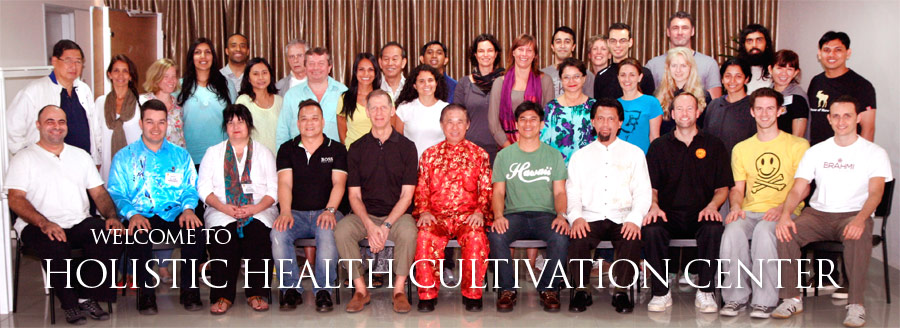
Grandmaster Sifu Wong‘s talk on Chi Kung, Health and Vitality at the Holistic Health Cultivation Center (HHCC), Kuala Lumpur, May 2012, with live demonstration and application of Chi Kung and Chi Flow on the audience. Very enlightening, very inspiring. Thanks to Damian- Roseline Kissey for excellent recording.
 Shaolin Wahnam Kuala Lumpur