Tag Archives: Lessons

SMILING FROM THE HEART

(reproduced from http://shaolin.org/discussion-2/santiago04.html)

smiling from the heart

Smiling from the Heart


Santiago

Shaolin Wahnam Spain

17th March 2015

“We shall never know all the good that a simple smile can do.” – Mother Teresa

Everything started when Sije mentioned in one of her classes: How many of you Smile from the Heart in the morning just before opening your eyes? I could not answer “yes” to that question. That made me realise a lot of things. If I always smile just at the very start of my practices and it is so beneficial, why not starting my day with a beautiful Smile from the Heart?

Smiling from the Heart is a simple but incredibly profound skill that brings me enormous and various benefits. I must confess that I sometimes forget this fact and it is not always easy for me to practice it at the very start of my day. When that happens I just take a couple of seconds and try gently for some more times. Then the miracle happens. I find it there, just in the heart, bring it out and share it with the world.

I never regretted commencing my day with a Smile from the Heart. It totally changes the entire day. This practice really boosts my energy, relaxes me, opens my heart and makes my life much more joyful.

As I was progressing in this practice and getting more and more benefits I decided to implement it to the rest of my day. For that, every time that I realised that I wasn’t Smiling from the Heart I was taking a deep breath, closing my eyes (when possible) and searching for an honest smile that came from the heart.

It is so beneficial that Smiling from the Heart is becoming very natural in my life. I am more aware than ever when I am not Smiling from the Heart. It is amazing how much the heart can close during the day. I totally understand now why I was feeling always so sad and depressed.

Whenever I am working and feel stressed I stop and Smile from the Heart. I realise then how much I was tensing as I feel that tension disappearing with the smile.

It is so simple, so profound and it has so many benefits that I cannot thank enough for this wonderful gift.

In fact, I think that it is impossible for me to worry or intellectualise when I am Smiling from the Heart. Smiling from the Heart connects me with God and refreshes my whole body, energy and spirit.

Adding to that, I have noticed that my practice has improved a lot since I Smile from the Heart more often as it instantly takes me to a Chi Kung State of Mind.

Many months have passed and many lessons have been learned by bringing alive this simple but profound practice.

Smiling from the Heart hasn’t always been easy. In fact, one day I was looking at my pictures over the past 10 years and I decided to destroy most of them as I looked incredible sad, upset and locked up. I didn’t want to keep such a terrible memory of myself. It was time for a fresh start, for a second opportunity.

It is inspiring to see how different my pictures look now. That shows me how profound these arts are and how much I have progressed since I practice them. Without realising, the change has been so enormous and meaningful that it is hard to believe.

I once heard that “a smile is the shortest distance between two people”. I have understood by direct experience that an honest smile coming from the heart opens the door to the wonders hosted in people’s hearts. A smile is the best way that I know to connect and bring the best out of me and people.

In fact, it was Sifu’s smile that opened my heart. It connected my heart with his and heart to heart transmission happened.

The more I walk this path the more respect I have for these beautiful arts. Having such meaningful lessons and teachings keep me really humble as I can see the limitless power of God reflected in every one of them.

Santiago


The above discussion is reproduced from the thread The Shaolin Journey posted on 17th March 2015 in the Shaolin Wahnam Discussion Forum.

SELECTION OF QUESTIONS AND ANSWERS MAY 2015 PART 1 BY GRANDMASTER WONG KIEW KIT

(reproduced from http://shaolin.org/answers/ans15a/may15-1.html)

internal force and charisma

Internal force provides charisma

Question 1

Sigung has attracted thousands of people around the world to build Shaolin Wahnam into one of the most successful and biggest martial arts school today. I believe this is in part due to Sigung’s tremendous internal force, sincerity and charisma.

Charisma is a great asset to have in order to advance oneself professionally in the business world, and I believe the underlying factor is having a lot of energy.

Could Sigung kindly share some techniques to increase one’s personal charisma using internal force or chi?

— Stephen Chang, USA

Answer

Thank you for your kind works.

Yes, internal force, sincerity and charisma are important factors for the success of our school. There are also other important factors, two of which are the wonderful benefits of our arts, and our dedication in preserving them.

Although they are not the same, internal force, sincerity and charisma are related. A person may have internal force and sincerity but not charisma. On the other hand, having internal force and sincerity strengthens a person’s charisma.

The following aspects increase one’s charisma:

  1. Good health and vitality.
  2. Confident posture.
  3. Assuring voice.
  4. Benefit and interest.
  5. Sincerity.

Good health and vitality are necessary to be charismatic to people. No people will find a person charming if he is sick or feeble. A charismatic person must poise himself confidently to his listeners. His voice should also be assuring. A person who mumbles or whose voice is hard to be heard is never charismatic. What a charismatic person says is beneficial and interesting to his audience. His body expression and voice should convey sincerity.

All these five aspects are the direct and indirect results of developing internal force. Internal force directly gives a person health and vitality, confident posture and an assuring voice. Health is a direct result of harmonious chi flow, vitality a direct result of vigorous chi flow, confidence a direct result of chi strengthening the gall bladder, and good posture a direct result of chi strengthening bones. All these are the direct results of increasing internal force.

It is worthy of note that these attainments are intrinsic. In other words due to the increase of internal force, these attainments naturally happen. There is no need for practitioners to worry about how to have good health when their chi flow is harmonious, etc. Good health naturally occurs when chi flow becomes harmonious. These worries or questions are academic, i.e. they occur to people who have no internal force. Those who have internal force will experience these intrinsic results.

In the same way there is no need for people to worry about how to increase their purchasing power when their cash flow increases. Due to the increase of their cash flow, their purchasing power will naturally increase. Asking how an increase of cash flow will increase purchasing power is an academic question, i.e. it occurs to people who have no increase of cash flow. Those who have an increase of cash flow will experience the intrinsic result of an increase of purchasing power.

The fourth aspect, making his interaction with others beneficial and interesting to them, has to be learned, and having internal force gives him the mental clarity to accomplish the learning task more efficiently.

Which one of the following three statements is most beneficial and interesting to your audience?

  1. I wish to start a chi kung class.
  2. I shall teach genuine chi kung which is rare today.
  3. Practicing genuine chi kung gives you good health and vitality.

Those with little mental clarity will have to learn, sometimes the hard way, that the third statement is the most beneficial and interesting to their audience. With mental clarity you will learn it quickly.

Sincerity, the fifth aspect, is also much enhanced by internal force, though some people with some internal force may be insincere, especially when they lack moral cultivation. When your bones are strengthened by chi as an indirect result of developing internal force, you will not only have good posture but also be sincere.

If a chi kung teacher tells his students that practicing genuine chi kung will give them good health and vitality, but he is actually more interested in starting a class, he will be less charismatic than another teacher who is sincere in helping his students attain good health and vitality.

Our school is very special, probably unprecedented in the whole history of chi kung and kungfu, in the extensive range of techniques to develop internal force. We are also probably unprecedented in cost-effectiveness. You can choose any one or more of the following techniques, but more important than the techniques are the skills involved.

  1. Lifting the Sky
  2. Pushing Mountain
  3. Reverse Hanging of Double Hooks
  4. One-finger Shooting Zen
  5. Three-Circle Stance
  6. Golden Bridge
  7. Lifting Water
  8. Grasping Sparrow’s Tail
  9. Triple Stretch
  10. Iron Wire

Internal force will provide you with the essence, or foundation, which is most important.

You may also apply the following specific techniques:

  1. Stand upright and be relaxed.
  2. Face your audience at a comfortable spacing.
  3. Talk to your audience, not to a wall, pillar or floor.
  4. Let your voice come out from your dan tian, but do not strain your vocal cords.
  5. Believe in what you say.

Question 2

I had a couple of days when I was completely charged with chi and I just ‘knew’ that practicing chi kung could make me healthy, and that kung fu could overpower any other martial arts, and streetfighters.. I felt no aches and pains in my body, no tiredness, no stress, which is not typical for me, and instead I felt blissfully happy and had the sensation that anything is possible.

I also had a couple of combat experiences where I simply allowed myself to relax and flow. On one occasion I subdued two opponents using moves I had never actually learned.

When I have had the experience, it felt like this mental, physical and energetic state would last forever, but it never did. I tried to repeat whatever I was doing when it happened in the hope of reviving the experience. For example: when it happened on courses with you, I tried to do more courses. Sometimes it happened when I had been training things like stances intensively, so I practiced more and more stances to try and repeat the experience, but without success. Sometimes it was the opposite, and happened during a period when I only trained lightl, so I tried to keep training lightly to revive the experience, but again without success.

Sifu, I feel as if I have had these glimpses of something marvelous. Is there a way to keep my practice at a level where I will experience this all the time? Do I need to train more, train less or rain differently, or should I treat these as glimpses provided by heaven to remind me to keep training normally until one day I reach the level where I have this fantastic physical, mental and energetic state all the time?

— Paul, Ireland

Answer

Your experiences are not uncommon with some of our students.

The best approach is to follow the three golden rules of practice as follows:

  1. Don’t worry.
  2. Don’t intellectualize.
  3. Enjoy your practice.

This means you should not worry whether these experiences will happen again to you or how you can make them happen again.

You don’t intellectualize why they happen or don’t happen, and what must you do to make them happen.

Just practice, and enjoy your practice. You can practice in whatever ways you like. You don’t worry about or intellectualized on how you should practice. Just practice and enjoy it.

You also don’t worry about or intellectualize on whether it is heaven’s reminder for you to train. Irrespective of whether it is heaven’s intention, you train and enjoy your training. If you follow the training you have learned from me, you will certainly be a good martial artists, including be able to handle our martial artists in sparring or fighting. More importantly, you will be happy and healthy

Xingyiquan

Xingyiquan at UK Summer Camp

Question 3

I am training Xingyiquan as my main training. Also our core from our Shaolin Kungfu, mainly footwork and our core sequences.

I have a problem with the Santi Stance. In Santi Stance, with the right arm outstretched, force automatically flows up to the right side of my hand and base of the middle, ring finger and pink fingers. This hurts very badly.

It also makes me aggravated, so that I have a hard time relaxing. Usually I need to stop and step out of the stance, or I’ll ruin my practice session altogether.

In Santi Stance in the left arm, the force is at the palm, and everything is in harmony. I can either expand or let it flow or both. My arm is also fully stretched and my stance is good.

— Tim, Belgium

Answer

This is not usual. Probably you did something wrong, or there was already something wrong inside you, and the strong chi flow is clearing out the blockage.

But whatever it is, you need not worry. Just follow the three golden rules of practice of not worrying, not intellectualizing and of enjoying your practice.

This is one of the best advantages in our school, which is not available in other schools, and which causes some people, especially Chinese, afraid to train internal arts.

In other schools, if something goes wrong and practitioners do not know what it is, or do not know hoe to remedy the problem, they may be in big trouble, especially if the force training is powerful.

This is also the reason why many Chinese dare not train internal arts. They are afraid of deviation, which is given a frightening name in the Chinese language, namely “chow fo yap more”, or “escaping of fire and entering of monster”.

But this is not a problem in our school! It is almost ridiculous, but true. Deviation is not a problem because of our chi flow. Our chi flow will wash away any deviation unwittingly caused, and still give our students a bonus. Because of our cost-effectiveness, the bonus is quite substantial. Students of other schools do not have this great advantage of chi flow.

Question 4

With my problem in the right arm, it get’s better if I don’t make my arm fully stretched. This way I can have more control.

Sifu, is that okay? I have a mental blockage wanting to do everything right from the start, but it’s so powerful sometimes that I get aggravated. I actually still feel good afterwards, but hot tempered.

Answer

Yes, it is okay. You don’t have to worry and don’t have to intellectualize. Just enjoy your practice.

You can easily clear your mental blockage. You don’t have to do everything right from the start. Our training is so powerful and cost-effective that even if you attain only 30% of the potential, you still have good results. If you attain 100%, it would be over-training. As I have said, it is ridiculous but true.

Mistakes here which result in you having only 30% of the potential benefit are due to carelessness or forgetfulness. It is not purposefully going against instructions, which of course is foolish.

Drunken Eight Immortals

Tim performing the Drunken Eight Immortals

Question 5

I am practicing my Kungfu now every day from now on, especially combat sequences. I focused some time on just Chi Kung, but got cleansing symptoms, rashes, that didn’t go away. I foolishly though to postpone Kungfu untill everything got cleared but the cleansing just kept coming. Even when working or doing activities the cleansing stayed.

Now that I practice sequences much more, the rashes actually went away in just a couple of days! I can’t believe how foolish I was. Sifu told us all this time, and still I was so foolish to keep on doing only light chi kung.

Answer

Chi kung students are advised to practice for only 10 to 15 minutes per session, whereas kungfu students may practice for an hour although the chi kung exercises in kungfu are more powerful.

This is because of the dynamic nature of kungfu training, like in set practice and combat sequences. These mobile aspects of kungfu training spread the force developed in static training, like in zhan zhuang. Unless he has progressed gradually, if a person were to practice just zhan zhaung for 15 minutes, it would be over-training.

Question 6

Sifu, my main point of focus is still our basics, our core sequences and footwork, and Xingyiquan, but I’m very curious what would be the best for me to specialize in, of the material I have learned so far.

I like Xingyiquan a lot, and also the Drunken Eight Immortals and the Triple Stretch. But I also like Baguazhang very much. I would like to train Baguazhang at times together with the Wudang Sword. All these styles and sets I would like to become good at.

Sifu could I ask what would be best for me to specialize in?

Answer

The basics are very important. When you are good at your basics, you can specialize in any of our arts. Again we are unprecedented. No schools in the whole history of kungfu and chi kung provide such a wide range of arts for specialization as we do.

You can choose to specialize in Xingyiquan, Drunken Eight Immortals or Triple Stretch. Personally I feel that Drunken Eight Immortals would be your best choice for specialization. You can practice Xingyiquan and Triple Stretch as supplementary arts, and the other arts like Baguazhang for fun.

This does not mean that the other arts have not been useful. They give your breadth and depth. As I mentioned in one of the courses on our selective arts, even if a student in our school were to attend just a course on a selective kungfu style, and then totally forget about it, that kungfu style will still tremendously enhance whatever other styles he chooses to practice or specialize in.
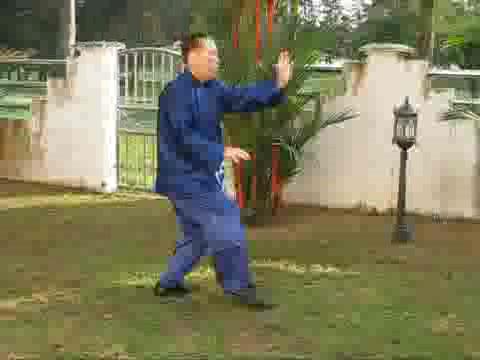
Explode Force of Zhang San Feng

Explode Force of Zhang San Feng

Question 7

What would be the most cost effective force training method for me? I learned the 18 Lohan Arts, our core stances, the Triple Stretch Set, Santi Stance, and the Iron Wire which I learned from two of my sihengs.

Answer

It is simply amazing that we have a very extensive range of internal force training methods, ranging from the very soft Yang Style Taijiquan to the very hard Iron Wire. This is unprecedented in kungfu history. Most schools have only one or two force training methods.

They are not just ordinary force training methods. All the force training methods we have are legacies from great masters.like:

  1. Sinew Metamorphosis of Bodhidharma,
  2. Flowing force of Bai Yi Feng (the founder of Wuzuquan),
  3. Crushing force of Yue Fei (found in Xingyiquan),
  4. Eighteen-Lohan Art of Northern Shaolin,
  5. One-Finger Shooting Zen of Southern Shaolin,
  6. Exploding force of Zhang San Feng,
  7. Double Worshipping of the Buddha of Ng Mui,
  8. Triple stretch of Hoong Hei Khoon
  9. Iron Wire of Thiet Kiew Sam

On top of this, we believe we have followed the training methods correctly. How do we know? We may not know for sure whether the way we train is exactly the way the past masters trained, although the methods are the same, but we know the results are the same, or at lease similar, even though we may not be at their levels. Most importantly, the internal force derived from training these methods gives us good health, vitality, longevity, mental clarity, peak performance and spiritual joys.

You can choose any one of the methods you have learned as the main method, and other methods as secondary. If you intend to specialize in Drunken Eight Immortals, an excellent choice is the flowing force of Wuzuquan. If you have not practiced Wuzuquan, you can substitute with the flowing force of Taijiquan. If you have not practiced Taijiquan too, you can use One-Finger Shooting Zen.

Suppose you are not familiar with One-Finger Shooting Zen. You can then choose an exercise from Sinew Metamorphosis or Eighteen-Lohan Art. Even if you had made what to other students of other schools the worse choice, Iron Wire, your result will still be many times better than other students making their best choice, which often is their only choice.

Other people, as I have often mentioned, may think I am arrogant for making these statements, and that is their business, but I am stating the truth which any member of our Shaolin Wahnam Family can readily verify from his own experience. How many other kungfu students, for example, have your internal force that enables you to enjoy your work and play wholesomely? Indeed, and it is actually sad, most other students would be lucky if they do not suffer silently in pain and anguish from their deviated training and perverted views.

Why is it that even if you had chosen the worst method (to most people in general) in your training, you still have better result than other people who have chosen the best method? It is important to note that “worst” and “best” here are relative.

In this case, using the Iron Wire method to develop internal force for application in Drunken Eight Immortals is a worst method to most other people, but it is still a very good method for us. On the other hand, without meaning to be vain, the “best” methods used by other people are bad methods to us!

Why is this so? Why the “worst” method is still a very good method to us, and why other students’ “best” method are bad?

A “worst” method can still be a very good method to us because of the magic of chi flow. We can readily employ chi flow to convert the consolidated force in Iron Wire training to flowing force in Drunken Eight Immortals application. Most other people can’t do this. The consolidated force they have will be a deterrent in their Drunken Eight Immortals application.

The “best’ method of other students are bad because it brings adverse effects. Even when it works correctly for a small percentage of these students, it takes them a long time to develop some internal force. How many students, for example, have internal force? Many of them have internal injury instead.

One suggestion is to practice your main training method on Monday, Wednesday and Friday. On the other days, practice the other force training methods you have learned on rotation. You can have other arrangement if you like. As long as you train, you will have wonderful benefits.

But don’t over-train. Indeed, a common advice in our school nowadays is not to train more, but to train less. Our training is to enrich our life, not to enslave us. Use the extra time as well as mental clarity and enrgy to get yourself a good wife.

Question 8

May I also ask how I could include in the best way the Small Universe and Big Universe in my training please?

My chi flow usually ends or slows down with Big Universe flowing spontaneously. I was wondering how to include the practice without overtraining. I’ve heard some say it is best to practice the Small Universe every day, and others say it is too powerful to practice it every day.

Answer

The Small Universe and the Big Universe are real treasures, more valuable than gold. The Small Universe will enable you to live beyond a hundred years. The Big Universe will enable you to realize that you never die!

All people never die but most people do not realize this cosmic truth. Our body may change and decay, but our spirit, our real self, lives forever until we return to transcendental Cosmic Reality, called by different names by different peoples.

Most other people may think I talk non-sense. It needs some cosmic wisdom to understand what I say. You and all other members of our Shaolin Wahnam Family understand the truth of my statements. The Big Universe enables us to directly experience, not just read about, our spirit expanding beyond our physical body.

Both statements that the Small Universe should be practiced everyday and that it is too powerful to be practiced everyday, are true. It depends on various factors like the development stage of the practitioner, his needs, his aspirations and sometimes his whims and fancies.

For you and all other students and instructors in our school, it is not necessary to practice the Small Universe everyday, though you can do so if you want to.

It is not necessary because we have so many other arts that give us wonderful benefits. Although the other arts may not have the specific benefit of enabling practitioners to live beyond a hundred years, most of our Family members have not reached 60. When they reach 60 they can reconsider their training schedule.

“Not necessary” does not mean “not beneficial”or “not desirable” . It is not necessary to earn a million euros to live happily, but it is beneficial and desirable to earn a million euros. Obe notable benefit which many students have reported to me, and which is not mentioned in chi kung classics, is that practicing the Small Universe brings good luck in both their personal and professional life. This should be no surprise to us, as the Small Universe is excellent in ensuring a good circulation of energy, and a “good circulation of energy” is “hou yun qi” in Chinese, which means having good luck.

Practicing he Small Universe the way we do may be too powerful to some other people. But for those in our Family who have been invited to learn this art, it is not too powerful even when they practice daily.

A good procedure when you practice various arts is to practice the Small Universe at the end of your training session. Even if you do not practice the Small Universe formally, it is often that your energy will flow in a small universal pathway when you have completed other exercises. The small universal chi flow at normal times without special practice is a clear indication of radiant health and vitality, and promising longevity. If you energy flow takes the big universal pathway, it is even better.
THE IMPORTANCE OF PICTURE PERFECT FORM

(reproduced from http://shaolin.org/video-clips-8/baguazhang/glimpse/chris.html)

baguazhang, pakua palm

Grandmaster Wong helping Chris to attain picture perfect form


What a great course. I’ve had the pleasure of attending the past few summer camps and again Si Tai Gung has taken his teaching to a new level.

As my brothers have said on day one alone we learnt enough content to take away for at least the next six months. This included the Eight Mother Palms, Circle Walking, and force building.

In the context of the course there are always simple instructions to follow, simple but with deep meaning. If these are followed and taken home our Kung Fu, Tai Chi and Baguazhang will greatly improve.

Si Tai Gung mentioned a number of times picture perfect form and highlighted its importance

Question: Why do we use the patterns and techniques we practice in our training?

Answer: Because of the advantage they give us in combat not only to help us win but also to help us in not handing defeat to our opponent.

When you have picture perfect form the chi flows correctly and this is how Kung Fu practitioners can spar for long periods of time. Not only will they not get tired but actually have more energy than when they started. This is so true today.

We had two great sessions going over and over in detail the form of the combat applications in the Baguazhang set. I have never felt so charged at the end of a full day training.

At one point after having a small chi flow we were ask to go through the patterns we had just practiced. I was so focused from this set that it actually felt as if rather than having two eyes I had one single point of focus, the force and flow were amazing word just don’t do it justice.

I know there are many points that I will take home and would like others to share. Take the time to make sure your form is perfect, slow down you training to make sure pattern by pattern its 100% correct then add the pieces together say three at a time then as you build your set make sure no form is lost, then when the form is correct and you know the set well move to the next level.

Take out the false stops and flow between movements. Again start with just three patterns and build up. if you find that the form is not picture perfect, stop and go back to get it right, then move to flow again. When you have perfect form and correct flow only then add in some force.

Using these methods will give you the best results and deliver Kung Fu that can be used for combat/competitions while also working on many other levels like good health and vitality. If this course is held again make sure you’re on it I can’t wait or day three!!

Chris
Worthing, England
19th June 2012

baguazhang, pakua palm

Having picture perfect form gives practitioner the best technical advantage in sparring


The above is reproduced from the thread Baguazhang at UK Summer Camp in the Shaolin Wahnam Discussion Forum

Glimpse of Baguazhang at UK Summer Camp

ON FORGIVENESS

(reproduced from http://shaolin.org/discussion-2/christina02.html)

Christina Didyk

Sifu Christina Didyk


Sifu Christina Didyk

Instructor, Shaolin Wahnam USA

23rd December 2012

On Forgiveness

Since our Festival in St Pete, I continue to receive reports from many of my patients and students who attended on how profound their experience was during one of the sessions in which Sifu asked us all to forgive.

I myself have experienced how amazing this can be at many courses but now it seems I am experiencing it from all these new eyes and once again it has touched me deeply.

At the course itself there were multiple folks in tears after the forgiveness exercise, but amazingly as I looked around they were all clearly tears of joy. Many people came up to me to give a hug after – in particular one of my patients and my good friend from Europe. I didn’t know what either of them had forgiven but I did know that they both were radiating love and happiness and a sense of weightlessness that made my heart feel lighter and full of joy.

This post is being written because at least for my patient that single act of forgiveness in class has led to some amazing real life results. She gave me permission to relay the result here.

Mrs M. had a long and incredibly destructive relationship with her long time boss. She felt she had been passed over for promotion many times because her boss disliked her even though her performance was always top notch. She felt angry and unsatisfied every morning going to work and every evening coming home. In retrospect she realized that her relationship at home with her husband suffered because of her anger and her many illnesses may have been a way to get out of going to work.

She told me that during the class with Sifu when he asked her to forgive her boss immediately flew into her mind and for a moment she felt all of her anger and hatred for this man fill her up until she felt like she would throw up. All at once she decided to just follow Sifu’s instructions and let go, forgive, release all that pent up anger. She stated that it was if in a moment she had lost 100 lb weight that had been sitting on her heart. She felt filled with peace.

Mrs M said the last few weeks she has been able to be friendly and cordial with her boss and even enjoyed going to work each day. Just two weeks ago her boss came to her and let her know that she would be up for promotion soon and that he intended to help her get it!!

Perhaps most amazingly Mrs. M has decided to forego her promotion and in fact is resigning from her job to become a full time painter instead. She told me that painting is what saved her time and again from her anger and is her greatest joy in life. She has already landed a large commission for a group of paintings and will be making more from them than her promotion would have given her!!! Astounding!

It never ceases to amaze me how profound the lessons Sifu gives us can be if we relax, don’t worry, don’t intellectualize and just follow his instructions!

Not only did Mrs M forgive, release her potentially illness causing anger and create a better relationship with her boss. She also gained the courage to realize that she is in control of her destiny and there is no one but herself who can stand in her way!

I am constantly amazed at the students of Shaolin Wahnam and eternally grateful to be a part of such a courageous and loving family.

From the Heart.

Christina.


Chris and Christina

Sifu Christina Didyk and her husband, Sifu Chris Didyk


The above discussion is reproduced from the thread On forgiveness in the Shaolin Wahnam Discussion Forum.

THREE LEVELS OF SPIRITUAL FULFILLMENT

(reproduced from http://shaolin.org/general-2/wisdom-of-living-masters/wisdom06.html)

Grandmaster Wong Kiew Kit

Grandmaster Wong


Question

How would you define spiritual fulfillment?

Answer

Spiritual fulfillment is self-explanatory. It is fulfilling spiritual needs.

The difficulty faced by many people in understanding what spiritual fulfilment is, therefore, lies not in its definition but in what actually is meant by spiritual. Spiritual is non-physical, it has no form. Your spirit is the real you. The real you is not your body.

Your spirit may grow and develop, but it does not change. Your body is changing all the time, though the countless changes, like the constantly changing cells that make up your flesh and bones, are so minute that you normally do not see them with your naked eyes.

Indeed, scientists have estimated that the body you have now is totally different from the one you had just seven months ago. Then why do you look the same? It is because the changing cells that constitute you body maintain the same appearance of the previous cells they replace. It is like a flowing river. The water in the river is changing all the time, but it maintains the same appearance.

Depending on various factors, like different education, environment and developmental stage, different people have different spiritual needs to be fulfilled. But all our spiritual needs may be classified into three levels:

  1. To be happy, peaceful and free here and now.
  2. To go to heaven in the afterlife.
  3. To eventually return to our Source, called variously by different peoples as God, Tao, Buddhahood or Supreme Reality.

If these needs are not fulfilled, your spirit, i.e. the real you, will not be at ease, and may be manifested in your physical body. The process works both ways. If your body is dis-ease, you will not be well.

For example, at the fundamental level if a person’s spirit is frustrated, agitated or restricted for a prolonged period of time, he may become unwell and it may be manifested as cancer, cardiovascular disorders and depression. On the other hand, if harmful micro-organisms attack his body, it can also make his spirit unwell, manifested as being gloomy, stressful and depressed.

Hence, to fulfill the needs of his spirit so that he can be happy, peaceful and free again, he has to overcome the causes that bring about the dis-ease of his spirit. If he just removes the symptoms manifested on his body, like taking out the cancerous parts, rectifying the cardiovascular disorders or taking pills to neutralize his depression, he can only succeed in temporary relief. As his spirit is still dis-eased, its symptoms would surface again.

On the other hand, if spiritual dis-ease is caused by physical factors, like harmful bacteria attacking his body, he can regain his spiritual well-being by overcoming the physical cause, like taking appropriate antibiotics.

At the intermediate level, people aspire to go to heaven in their afterlife. This is actually simple, though it may not be easy for some people. Avoid evil and do good. If you avoid evil and do good, you will be sure to go to heaven. This is taught in and guaranteed by all the greatest teachers of all the world’s known religions.

If a person did a lot of evil things in his past in this present life or his previous lives, even he does good now, he may not go to heaven in his immediate afterlife. But as long as he starts to avoid evil and do good, no matter how much evilness he did in the past, he will still inevitably go to heaven.

Is heaven real? It is like asking is the world we now live in real. The answers are the same. Yes, heaven and our phenomenal world are real – relatively real but not absolutely real. Heaven and earth are real relative to our mind. In other words, how that tiny part of Cosmic Reality we currently exist in will appear to us, depends on our mind. At the present stage when we exist in this world, how this world appears to us depends on how we perceive it. That is why it is called our phenomenal world. The adjective “phenomenal” comes from the noun “phenomena” which means “appearances”.

After leaving this world, how the afterlife appears to us, whether it is heaven or hell, also depends on our mind. If a person has avoided evil and done good, he has cultivated his mind with good thoughts, often described as having good karma. He will experience his afterlife as heaven. If he has done a lot of evil, described as having very bad karma, he will experience his afterlife as hell.

Heaven and hell, as well as the world we now live in, are in the phenomenal realm. How we experience our living in it depends on our karma. Its reality is relative to how our mind perceives Cosmic Reality, and is conditioned by karma. If we can break down these conditions and go beyond karma, we go beyond the phenomenal and realize transcendental Cosmic Reality. This is the most supreme and noble of all spiritual cultivation, described differently by different peoples as returning to God, attaining the Tao and seeing the Original Face.

Although our spirit, not our body, is our real self, while our spirit is housed in our body it is important to keep our body healthy and strong. When a person’s body is sick or weak, he may overcome his sickness or weakness by cultivating his spirit, but it is faster and more effective by working on his body directly. An effective way is through the practice of chi kung, spelt as “qigong” in Romanized Chinese. Chi kung is the cultivation of energy, or life force, which links the body and the spirit. In our school, Shaolin Kungfu and Taijiquan is also chi kung, as they also cultivate energy besides the body and spirit.

When a person’s body is healthy and strong, he is more efficient in cultivating his spirit. There are many different methods of spiritual cultivation. The following are some of the methods we use in our school, Shaolin Wahnam, and they have been proven to be very effective.

To be happy, we smile from our heart, which is a skill we practice every time we start an exercise. To be peaceful we stand in meditation and enjoy the stillness and experience inner peace. To be free we expand our spirit using techniques like Separating Water and Flicking Fingers.

A sure way to go to heaven is to avoid evil and do good. We aspire to this high moral living by following our Ten Shaolin Laws, which is an essential requirement for anyone who wants to learn from us. .

We are not in a hurry to return to our Source yet. We know the world we now live in is phenomenal, and we ensure our time here is well spent – for ourselves as well as for other people. We often have a glimpse of our Source while in deep meditation in such advanced arts like Cosmic Breathing and Expanding into the Cosmos. When we are ready, we can cultivate to return to our Source, using methods like Zen and Taoist meditation.

In all the arts practiced in our school, chi kung, Shaolin Kungfu and Taijiquan, we are keenly aware of triple cultivation, namely cultivating jing, qi and shen, which means body, energy and spirit. We do not merely talk about spiritual cultivation, not even just practice spiritual cultivation, but ensure we have spiritual fulfillment, i.e. enjoying the benefits of spiritual cultivation in our daily life.


The above extract is reproduced from “Your True Nature: Wisdom of Living Masters” by Natalie Deane and Damian Lafont.

You can order this book from here or here.

DECEIVING HEAVEN TO CROSS SEA

(reproduced from http://shaolin.org/discussion/36-strategies/strategy09.html)

Xie Ren Gui

A picture of the famous Tan general, Xie Ren Gui, reproduced from http://people.chinese.cn/en/article/2010-11/23/content_192809.htm


Question Which of the Thirty Six Strategies do you personally find the most beneficial and effective in term of profundity in simplicity, in order to enrich private and business life?

Sifu Roland Mastel


Answer

The strategy I find most beneficial and effective is the first one, Deceive Heaven to Cross Sea. It is simple. Basically it consists of making a feint move to accomplish a desired result. Actually all other strategies are covered in this strategy. All other strategies consist of making feint moves to accomplish desired results. Hence it is very profound.

A special feature of this strategy is that the deception does not appear to be very special. In fact it looks common, so that the enemy will not suspect the deception. Kungfu classics are a good example. A lot of secrets are hidden in the open, but unless they are initiated, people will not realize these secrets.

Hiding secrets in the open is found not just in classics but also in practice. Wuzuquan and Xingyiquan are good examples. When I first learned Wuzuquan more than 40 years ago I did not know how to use its patterns for combat. I believe many Wuzuquan practitioners today, despite having practiced for many years, are in a similar situation. But I am sure those who attended the recent Wuzuquan course in Penang are amazed that the patterns from San Zhan, the fundamental set of Wuzuquan, can be used to counter any attack! It is an excellent example of profundity in simplicity.

Another excellent example of profundity in simplicity is Xingyiquan, known to be the kungfu for generals. I knew for a long time that of all the kungfu styles, Xingyiquan is the closest to Western Boxing, and thus will be very helpful to those who want to win free sparring competitions as most competitors today fight like Boxers and also that most competitions follow rules closely related to Western Boxing.

But in terms of techniques, I did not know what a Xingyiquan practitioner would do if an opponent went beyond the simple techniques found in Boxing and Kick-Boxing and used sophisticated techniques like those found in the Shaolin Seventy Two Chin-Na Techniques or the little know felling techniques of Taijiquan. I reckon that the Xingyiquan practitioner would compensate his lack of extensive techniques with his tremendous force, for which Xingyiqaun as well as Wuzuquan are famous. (In my case, it was not a big concern because I could always fall back on my Shaolin and Taijiquan counters.)

Yet, as in the case of Wuzuquan earlier, when I went deeper in both the practice and philosophy of Xingyiquan in preparation for teaching the course at the UK Summer Camp, I found to my delight that even leaving aside internal force, simple looking Xingyiquan techniques do have counters for sophisticated attacks! Xingyiquan is not just bulldozing into opponents, as many people mistakenly think, but incorporates covering opponents adequately in its apparently straight-in advance. It was an aha experience for me to discover why this simple-looking style is regarded as kungfu for generals.

I am not sure whether the early Wuzuquan and Xingyiquan masters used this strategy of Deceiving Heaven to Cross Sea to hide secrets in the open. Personally I do not think so. The profundity in the apparently simple-looking arts evolved spontaneously. But I am sure that knowing this strategy by reading the answer here, or better still attending the course in Ireland, will enhance our ability to go deeper and obtain more benefits not just in kungfu and chi kung but in whatever we do when most other people merely skim the surface.

There is a lot of depth and benefit in the kungfu and chi kung we practice. For those who have not practiced Wuzuquan or Xingyiquan, let us take an example of Single Tiger Emerges from Cave from Shaolin Kungfu and Immortal Waves Sleeves from Taijiquan, and Lifting the Sky from chi kung.

The form is simple, and most other people merely practice their form. Any benefit they get is incidental. For us in Shaolin Wahnam, not only we know that the form is only a means to obtain benefit, but we get benefit deeper than what its surface suggests.

Single Tiger Emerges from Cave or Immortal Waves Sleeves is not only a counter where we can use minimum force against maximum strength, but is also applicable against any attack, be in striking, kicking, felling or chin-na! Lifting the Sky not only generates an energy flow, but gives us benefit ranging from just being relaxed to expanding into the Cosmos.

The past masters did not use the strategy, Deceiving Heaven to Cross Sea, but understanding the strategy enables us to see depth beyond surface.

An American businessman used this strategy to save a lot of money, as well as make a lot of money – legally. He probably had not heard of Deceive Heaven to Cross Sea, but what he did was applying its philosophy.

To protect local industry, the United States imposed a lot of tax on foreign imports. A lot of American women loved elegant French gloves but they were expensive because of heavy import tax.

A smart American businessman thought of a way to save a lot of tax and also make a lot of sales. He bought 100,000 pairs of these expensive, elegant gloves from France. But he did a strange thing. He unpacked them and sent only the left gloves to the United States, with a clear indication they were left gloves.

When the 100,000 pieces of left gloves arrived at United States, he did not claim them from the customs and therefore did not pay any import tax. As it was the practice, unclaimed items after some time were auctioned away. No one would bid for only left gloves without the right gloves. So this businessman could buy back his left gloves at a very low price.

The customs officials were alerted. They kept a close track on this businessman. They paid special attention to any future consignment of right gloves. Soon a consignment of 50,000 pairs of gloves arrived. They were normal, with left and right gloves. But the custom officials were careful. They still checked the consignment thoroughly to see if any right gloves were hidden. But they found nothing wrong. The businessman dutifully paid the tax and claimed the gloves.

The businessman sold the expensive, elegant French gloves below normal price. As it was a bargain, many people bought the gloves and the businessman made a fortune.

The customs officials continued to look out for any consignment of right gloves. The police and immigration also helped to ensure that no right gloves were smuggled in. But nothing of that sort happened.

Did the businessman get the right gloves, and if so, how did he get them? I would let you have fun working out the answer, which will be provided later.


Xingyiquan, Hsing Yi Kung fu

Xingyiquan looks simple, but is very profound


The above discussion is reproduced from the thread 10 Questions on the 36 Strategies in the Shaolin Wahnam Discussion Forum.

HOW TO PLAN A TRAINING SCHEDULE

(reproduced from http://shaolin.org/answers/sp-issues/training-schedule.html)

Combat Sequence

Students, expecially at beginners’ level, should include stance-training, including moving in stances, in their daily training schedule

Question
I believe I heard somewhere that you prefer to have a structured, daily schedule. Can you please talk about the importance of having a daily schedule and any tips that may help us successfully implement and stick with our own (especially tips for handling disruptions such as travel or unexpectedly having to work late)?
Chris, USA
Answer
Yes, having a structured daily schedule will help to save much time as well as to get maximum benefits from the practice, both in the practice session itself as well as the general programme of training.

Experience has shown that many students waste a lot of time thinking of what to practice next after they have completed one aspect of their training. Because they lack a clear cut schedule, they often practice haphazardly, spending too much time on what is relatively unimportant, neglecting crucial aspects as well as training redundantly.

For example, many students spend years on practicing kungfu sets, without developing force and practicing combat application, which are the two twin pillars of any kungfu training. Yet, after many years of practicing forms, their forms are not correct because they failed to master the basics like how to co-ordinate their body, feet and hands, and how to move with grace and balance.

Having a structured schedule will overcome these setbacks. But before we attempt to work out our schedule, we must have a clear idea of what the art we are going to practice is, what our aims and objectives of practicing are, and what resources we have to work on. Without such preliminary understanding, many people end up with form demonstration or Kick-Boxing though they originally aimed to practice Shaolin Kungfu or Taijiquan. Some of them, including instructors, have invested so much time and effort in their deviated practice that they even think or argue that form demonstration or Kick-Boxing is Shaolin Kungfu or Taijiquan!

Setting aims and objectives are important when constructing a daily practice schedule. It helps to make your practice very cost-effective. To set aims and objectives wisely, you need to be clear of not just what you wish to achieve but also what the art has to offer. Then you select from within the art the relevant resources for practice that best help you to accomplish your aims and objectives. Arranging this material into some systematic ways for practice makes up your daily practice schedule.

Allot time, say half an hour or an hour, for each training session, and give yourself, say, six months as a package to achieve your objectives. Your daily practice schedule may be the same every day if you have sufficient time in the session to complete the chosen material, or you may vary your daily schedule if you have a lot of material to cover.

Naturally, because of different needs and aspiration as well as developmental stage, different practitioners will have different schedules. Let us take an example of a student who attends regular classes from a Shaolin Wahnam instructor. He aims to have good health and vitality as well as combat efficiency. A good daily schedule is as follows.

Start with about 5 minutes of “Lifting the Sky”. Then spend about 10 minutes on stance training, followed by about 5 to 10 minutes of gentle chi flow. Next, spend about 10 minutes on the Art of Flexibility, alternating with the Art of 100 Kicks on different days, followed by about 5 minutes of chi flow.

Then practice a kungfu set. If he has learnt many sets, he may vary the set on different days. Depending on his needs, aspirations and developmental stage, in his set practice he may focus on correctness of form, fluidity of movements, breath control or explosion of force. This will take about 10 to 15 minutes.

For the next 10 or 15 minutes, he should practice his combat sequences. He may go over all the sequences he has learnt or select those he wishes to consolidate. He will practice them at the level he is at, such as merely going over the routine so that he will be very familiar with them, using steps like continuation and internal changes, or varying them in sparring with an imaginary opponent. He will conclude his training session with 5 or 10 minutes of Standing Meditation where he enjoys inner peace or expands into the Cosmos.

Combat Sequence

If your objective is to prepare yourself for an Intensive Shaolin Kungfu Course, you should include combat sequences in your daily schedule

Another student who does not have the advantage of learning from a regional Shaolin Wahnam instructor, may have a very different daily schedule. Suppose he wants to attend my Intensive Shaolin Kungfu Course, but could not learn kungfu, even only outward forms, from a local teacher. So he has to learn the forms from my books, and familiarize himself with the combat sequences from my webpages.

His main aim is to prepare himself so that he can qualify to attend the Intensive Shaolin Kungfu Course. He has three main objectives — to be able to perform basic kungfu forms so that he can follow the course, to be familiar with the routine of the 16 combat sequences so that he can focus on developing combat skills instead of wasting time learning the sequence at the course, and to develop some internal force, especially at his arms, so that he can be fit for a lot of sparring. He allots half an hour a day for three months to achieve these objectives.

He should spend the first month focusing on the basics, i.e. the stances and footwork and basic patterns, and the other two months on familiarizing himself with the 16 combat sequences. Force training, including the Art of Flexibility, should be carried out throughout the three months.

He spends about 5 minutes on “Lifting the Sky” which he can learn from my books. He will probably not have any chi flow. For the first two weeks, he focuses only on the stances. He spends about 20 minutes learning how to perform the various stances correctly. At this stage, he needs not, and should not, remain at each stance for any length of time. In other words, this stage is not for zhan-zhuang, or remain at a stance for some time. His task is to be able to perform a stance, for a few seconds, correctly. Within two weeks he should be able to learn the correct positions of the stances quite well. For the remaining 5 minutes, he practices the Art of Flexibility.

For the next two weeks he focuses on moving in stances and performing basic patterns. By now he should be able to move into any stance correctly, though he may not be able to remain at the stance for long. He begins the session with about 5 minutes of “Lifting the Sky”. Then he spends another 5 minutes on performing all the stances correctly. The emphasis is on correct form, and not on remaining at the stance to develop force. Next, he spends about 15 minutes to learn how to move correctly in stances and to perform basic patterns. He should pay careful attention to waist rotation and body weight distribution so that he can move gracefully and without hurting his knees. He concludes the session with the Art of Flexibility. By the end of the month, he should be able to perform basic patterns in proper stances correctly.

For the next two weeks, he focuses on familiarizing himself with the 16 combat sequences as well as developing some internal force. He starts his session with stance training. Now, as the postures of his stances are correct, he focuses on remaining at a stance for as long as he comfortably can. This will take about 5 to 10 minutes. For the remaining 20 minutes, he practices the 16 combat sequences, starting with one and progress to all the others. He needs not worry about force and speed. His concern is to remember the routine of the sequences and perform the patterns correctly.

If he takes three days to learn and practice one combat sequence, he can complete the 16 sequences in 48 days, giving him a few days for general revision. He should learn and practice the sequences progressively, not individually. In other words, by the sixth day, he should be proficient in sequences 1 and 2, and by the ninth day be proficient in sequences 1, 2 and 3, etc.

Hence, if he follows these schedules for three months, he will be well prepared for the Intensive Shaolin Kungfu Course even though he might not have any kungfu experience before. On the other hand, someone who may have learnt kungfu for many years, where he only learns external kungfu forms, is ill prepared. This is a good example of cost-effectiveness. The smart student knows what he wants and plans his practice accordingly, whereas the mediocre student practices haphazardly without direction.


The above is reproduced from Question and Answer Number 1 of the May 2007 Part 2 issue of the Question-Answer Series.

Please e-mail your questions to Sifu Wong Kiew Kit stating your name, country and this webpage for reference. E-mails without these particulars may not be answered.

CHI KUNG AND ACADEMIC EXCELLENCE

(reproduced from http://shaolin.org/discussion/academic-excellence.html)

Alex, Englandstanding meditation Mind training is an essential aspect of genuine chi kung. Here during a review course in Malaysia in December 2004, students entered Zen, where they attained a one-pointed mind, then let their mind expand.


The following discussion is reproduced from the thread Chi Kung and Academic Excellence posted by Alex in the Shaolin Wahnam Discussion Forum on 7th January 2005.


Chi Kung and Academic Excellence

I used to be a slacker but now I’m not.

I would aim for the minimum pass mark at University of D (40%) and often I would fail and have to redo the module.

I would look at other students and think, ‘How can you be bothered to go to the library’ and ‘How can you be bothered to send e-mails to companies to get some information?’ Now I’m the one going to two libraries just to find some help for an answer that’s worth 5%. Now I understand why they do it, it’s because they have the desire to.

Now I look at a question and I can see exactly how I can answer it.

Before I may not have understood a question, now not only do I understand it. I see the faults in it.

Sifu says with Chi Kung we can reasonably expect academic excellence. I still have a way to go to be an A student and if I were to start the degree again I wouldn’t be surprised if I did become one.

My role has changed in the class. I find my friends coming to me for help rather than the opposite.

People at University will understand that you have a lot of time between semesters. The summer holiday is around 5 months. This large break means I can clearly see how my Chi Kung in those months has improved myself.

I would leave my work as late as possible and feel very rushed in the last few weeks. This semester was different. I started as early as I could and even came in extra days. I finished the modules early and had lots of spare time at the end. Only certain classes appealed to me previously, now every class is interesting. Even now I’m looking forward to the next semester in February. A friend said to me ?Don’t you think this is semester is really hard?’ I didn’t know what to say.

My desire to learn and educate myself has increased massively. I now read as much as I can, broadly and deeply. I try and learn as much as I can, filling all the gaps in my education. Even these words are written with my touch typing skills I learnt from a website.

A while ago I thought, I’m not getting smarter, I’m just working harder because we have more work and everyone changes. But my friends are still the same. The B students still get Bs and the D students still get Ds.

Without Chi Kung this post would have been unorganised and brought my points across unclearly. I look at my posts on this forum a year ago and I can see the change I’ve made. Now I understand why the instructors and students can write so clearly.

How long have I been practising Chi Kung?

One year.

GRANDMASTER WONG KIEW KIT’S SELECTION OF QUESTIONS AND ANSWERS APRIL 2015 PART 3

(reproduced from http://shaolin.org/answers/ans15a/apr15-3.html)

Bodhisattva Guan Yin

A beautiful statue of Bodhisattva Guan Yin, a gift to Grandmaster Wong from Gloria of Madrid

Question 1

You said that past masters took years to attain chi flowing at various levels. Why is it that we could achieve this in just a day?

— David, UK

Answer

It is just ridiculous but true that past masters took years to attain chi flowing at various levels, but our students can achieve the same result in just one day! It is understandable of others do not believe what we way, but there is no doubt that all the students present today (9th June 2014) on this Bone Marrow Cleansing Course know this is true.

How do we know it is true? It is like someone asking you how do you know you are now sitting on a chair. In both cases, you know from direct experience. You know you are sitting on a chair because you are sitting on a chair. You know you can direct chi to flow at the levels of your skin, muscles, meridians, organs and bone marrow, because you can clearly feel chi flowing at all these levels.

Now the question. Why did past masters took years to attain these skills whereas you take only just one day? There are a few reasons, like we understand the underlying philosophy of the art, we are generous to teach it, and our methodology is very cost-effective, but the most important reason is that I transmit the skills to you from heart to heart.

An analogy is becoming a millionaire. If you work to become a millionaire, you will take many years to succeed, if you ever will. But if a benefactor transmits the money to you, you become a millionaire immediately. If you train to have chi flowing at five levels, you will need many years to succeed, if you ever will. But if master transmits the skill to you, you have the ability to have chi flow at the five levels immediately.

On the other hand, when past masters as students learned chi kung they had to practice appropriate techniques for many months or a year or two to develop the necessary skills. Normally they were unaware of the skills though they had developed the skills through dedicated practice. With the skills chi first flowed at their skin level. This development was spontaneous.

As they continued their dedicated practice for many more months or another year or two, chi next flowed at their muscle levels. In the same way, after may years chi flowed at the levels of their meridians, organs and bone marrow.

It should also be noted that these students did not learn these advanced techniques of chi flow at various levels at the start of their learning career. It was only after a few years when they had won the trust of their masters that their masters taught them the appropriate technques.

Secondly, not all those who learned the techniques would developed the skills and eventually succeeded in the art. Only a small percentage, probably less than 10%, would succeed and eventually became masters themselves.

Question 2

I remember reading some years back a Taichiquan book that stated whilst practicing you must concentrate on breathing, body weight, points on the body and the self defence aspect.

— Wiliem, Zimbabwe

Answer

It is helpful to know that different advice is applicable to different people or to the same person at different stages of his development.

If you practice on your own without a teacher’s supervision, it is best for you not to worry about breathing, body weight, points on the body, and self-defence aspects. Just practice whatever you can in a relaxed manner without any intellectualization.

It is unbelievable but students at this one-day Bone Marrow Cleansing course can direct chi to flow at different levels of their body

Question 3

I am from a small town in Zimbabwe, have tried some Karate which is not for me and am looking for some simple, practical exercise to do as my work involved sitting by a computer all day. I found a detailed simple 18 form Shibashi Taichi exercise which I am learning at “Everyday Tai Chi” and was wondering if you have some advice on application. I have included the chart.

Answer

“Taiji Shibashi” means “Taiji 18 Forms”. It is a set of chi kung exercises invented by a modern chi kung master from China, Sifu Lin Hou Sheng, in the 20th century. For a time, it was widely practiced n Southeast Asia. One could find Taiji Shibashi groups in most public parks, and any person could just walk in to join a group to practice. Instructors taught without charging fees.

Despite its name “Taiji”, these exercises are not related to Taijiquan or even to Taiji dance. In fact, Sifu Lin Hou Sheng practiced Shaolin wushu before. I guess that the term “Taiji” is used because the exercises are meant to be performed flowingly in a relaxed manner like what Taijiquan should be performed.

As a type of chi kung, Taiji Shibashi works on a physical level to generate energy flow. Students have to performs many forms for a long time, usually about an hour. However, most students perform Taiji Shibashi as gentle physical exercise, and not as chi kung. Like most other chi kung practitioners, they do not realize this fact because they do not know the difference between chi kung and gentle physical exercise.

Taiji Shibashi was not meant to be a martial art. Hence when Sifu Lin Hou Sheng invented the exercises, he did not have self-defence aspects in mind. It is therefore unwise of you to try to find combat application in these exercises where combat application was not there in the first place. You would have done extremely well if you could perform Taiji Shibashi as chi kung, which would then place you at the top 20% of Taiji Shibashi practitioners anywhere in world, even better than most Taiji Shibashi instructors. You would have a chance to achieve this feat if you follow my advice of performing Taiji Shibashi exercises in a relaxed manner without any intellectuzlization.

However, a genuine kungfu practitioner may still be able to use the Taiji Shibashi exercises for self-defence, although these exercises will not be his first choice for the combat purposes. For example, “Rase Arms” in Exercise 1 may be used to release grips on his wrists, “Open Chest” in Exercise 2 may be used to release a body-lock, and “Paint a Rainbow” in Exercise 3 may be used to deflect a shoot from a arestler.

If you want to learn self-defence, you should learn it from a competent teacher. Like most other people, you will probably be surprised that genuine arts of self-defence are rare today. Most martial artists today, including black belts, do not know how to defend themselves. They just hit and kick each other in free sparring. Worse, and usually without their conscious knowing, their training is detrimental to both their physical and emotional health.

Question 4

Next I am contemplating a 36 sword form to compliment my tonfa katas.

Answer

Frankly I believe you would spend your time better by taking your wife out for a walk, or getting a wife if you haven’t one yet.

But if you still want to learn a sword set, perform it in a flowing and relaxed manner. Remember that performing with a sword is different from performing with a tonfa. They have different nature and characteristics..

Taiji Shibashi

Taiji 18 Forms is not a martial art but a master can use any of its patterns for combat

Question 5

I had an experience today I would be gracious for your feedback. I was riding in a car with a friend and her young child. Upon thinking of the child, I saw in my mind a red energy flow linking us together. This energy flow ran from my lower back and to the child. Upon observing the flow, I became aware that I could use this flow to direct energy from me to the child, or draw energy from the child to me. I could also direct blockages to or from the child in the same way. My initial reaction to this awareness was concern over the ability to potentially cause harm, as the last thing I would want to do is harm the child. So I did my best to let go of my focus on the energy flow.

Shortly after, I was driving home by myself several miles from the child and became aware of the energy flow connecting us again. This time, I felt the energy pressing into my lower back as if it wanted to flow into me. I resisted the flow and did my best to let it go (worried that I might be inadvertently taking his chi), but ultimately felt that I should stop resisting it. When I did this, I sensed energy flowing into me and instantly felt sick. I immediately began coughing out bad chi. However, after absorbing the energy the tension in the flow disappeared and it returned to the usual loving, positive feeling I always have toward the child.

During both moments of sensing this energetic connection with the child, I had a sense that the energy flow was a karmic connection. It felt very similar to when I sense chi blockages in myself; emotionally overwhelming and turbulent. I believe that in my becoming aware of this karmic connection, I may have unknowingly drawn bad chi out of the child and into myself as a sort of karmic balancing/cleansing between the two of us. I have felt the blockage in my lower back periodically throughout the rest of my day, and have also coughed out some more bad chi. But overall I feel fine, and the blockage seems significantly diminished after doing chi kung this evening.

— Ryan, USA

Answer

Chi, or energy, is connecting all of us. Everything is connect is not just poetically but factually true, but most people are unaware of it, and their mind power is not strong enough to cause much difference.

However, some rare people with miraculous abilities, like you having practiced high-level chi kung from our school, may see this connection and have influence on it. As I mentioned in my previous reply, you must also use this miraculous ability with great responsibility. We do so due to righteousness.

Even if we leave out righteousness and consider only self-interest, it is also to your self-interest that this miraculous ability must never be abused. Goodness always bring goodness, and evilness always results in evilness, is a universal truth. Many psychics leading miserable lives is clear evidence of this truth.

On the other hand, there are what are called in metaphysical circles as “heaven secrets”. You should not reveal or interfere with these heaven secrets indiscreetly. For example, at your mortal level, you may think that clearing somebody’s blockage is doing a service for him. But at a cosmic level, which most mortals do not realize or understand, this action may be a big disservice.

Then, what about patients seeking treatment from chi kung healers, who help their patients to clear blockage? Can that be doing a disservice to the patients? This is a different issue, and here heaven secrets are not involved. Here, helping patients clear their blockage and restore good health is certainly a blessing.

Here the patients ask for help. It would be different if the patients did not ask for help but the healers impose their healing on them.

What you did in the case of the child, i.e. to let go, was correct. When you feel some bad energy entering you, like in the case of the child, you can direct it to a plant or tree instead of taking it in. What is bad energy to the child or to you, is good energy to the plant or tree. Similarly, when you enter a cave and feel the energy there detrimental to you, the same energy is beneficial to other creatures like bats and insects.

Question 6

I had one other experience similar to this several weeks ago with our family pet dog. I had a sense of “something wrong” with the dog (which was sitting near me as I practiced chi kung), then felt negative chi pushing into me from the dog which in that case I resisted the entire time. I also had a sense that it was a karmic connection between myself and the dog, and that the experience was somehow related to karmic cleansing. I have spent many, many hours with the dog since and have not had any other experiences like this.

Answer

Yes, like in the case of the child above, you have some karmic connection with the dog. And like the child too, if you feel the energy from the dog that enters you is negative, you can direct it away to plants or trees instead of taking the negative enrgy in. This negative energy to you and the doy will be positive energy to plants and trees.

chi connects everything

Chi connects everythiung. The snow in Alaska is connected to the sunny beaches at the Equator

Question 7

Is it possible in rare cases to sense karmic blockages between two beings, and for my chi to cleanse these blockages by momentarily linking my energy flow with them? This is what these experiences have felt like. It was just like when my chi works on blockages in me, except I had another being momentarily as an extension of myself that was also a part of the cleansing.

Answer

Yes, it is possible to sense karmic blockages between tow beings. The connection is there all the time but most people are unaware of it.

When you emphasize on the link of energy between you and another being, you may cleanse blockages or cause them. Healing others by cleansing their blockages, or alternatively hurting them by causing blockages in them, require special skills. As you are not trained in these matters, it is unethical to do so. Even when you are trained as a healer, it is also unethical to impose the healing on a person if he does not ask for it.

Question 8

I have prayed to Gaun Yin on what I should do about these experiences, and the answer was clearly “Let it go” so that’s what I will do However, any input you have on how to best handle these experiences in the future would be most appreciated.

Answer

Praying to and asking advice from Guan Yin Bodhidattva is excellent.

My supplement to Guan Yin Bodhidattva’s advice is described above, and may be summarized as follows.

Heaven secrets are not to be disclosed indiscreetly. What mortals think is a service may be a disserve at a cosmic level. Healing another person by clearing his blockage requires specialized skills, and should be performed only when one is properly trained, and when it is requested by the patient.

SHAOLIN WAHNAM KUNGFU — COMBAT SEQUENCE 6 “DARK DRAGON DRAWS WATER”

(reproduced from http://www.shaolin.org/review/dark.html)

Dark Dragon Draws Water

Dark Dragon Draws Water

Reducing Movements and Increasing Speed

In Combat Sequence 5 all the attacking techniques are the same as in the previous four sequences, namely middle punch, low punch and horn punch. However, the right Bow-Arrow Stance, instead of the left Bow-Arrow Stance, is used in the attacks. This right-leg mode makes a difference.

Besides enjoying some other advantages, being able to use the right-leg mode efficiently enables the combatant to change or continue easily from the previous four combat sequences to other new sequences. Before this, his techniques are limited. Combat Sequence 5 marks the first step whereby he can expand his techniques remarkably.

Combat Application Combat Application
Poise Patterns Fierce Tiger

Before this, he might move into a right-leg mode accidentally, or forced to do so to his disadvantage, often without his conscious knowing. Now he moves into a right-leg mode artfully and purposely, usually to his conscious advantage. Herein lies a crucial difference, and it is one of many points why many students may remain at the same standard after many years of free sparring, whereas you may improve tremendously after a few months of systematic training.

Once you can change artfully and purposely from a left-leg mode to a right-leg mode, and vice versa, even if you do not learn any new techniques, you have expanded your techniques two fold relative to an opponent who, often unconsciously, use only one favoured leg mode.

Combat Application Combat Application
Dark Dragon Big Boss

If you observe exponents of Western Boxing, Karate and Taekwondo spar, for example, you often will notice that they use only either the left-leg mode or the right-leg mode, but seldom both modes equally well. If, for instance, both of you have 25 techniques, now because you can use both modes well and he can’t, you will have 50 techniques whereas he still has 25.

Your advantage does not end here. Not only you can change your leg-mode, you can also change your stances to your best advantage, whereas most other martial artists pay little attention to stances. Moreover, you can change your hand forms, but most others don’t. For example, instead of striking with a level punch, you may change it into a phoenix-eye fist, a willow-leaf palm, a leopard punch or a tiger-claw, but most other martial artists seldom do so. Hence, from your basic 25 techniques, you can have literally hundreds of variations, even without learning new techniques!

Combat Application Combat Application
Enter Well Golden Dragon

But you must not rush into these hundreds of variations. They are mentioned here to remind you of the great variety and potential in store for you when you have mastered your fundamental skills. Now we still have to pay a lot of attention to skill development. If you are not skilful, knowing a lot of techniques is a liability, not an access. This is a main reason why many kungfu and wushu students, despite knowing many techniques, are no match against exponents of Karate, Taekwondo, Kickboxing and Western Boxing

Combat Application Combat Application
Precious Duck Golden Star

Yet, from Combat Sequence 6 onwards, you are going to learn some useful combative techniques. Two attacking techniques are introduced in this sequence — a left hand palm strike in “Dark Dragon Draws Water”, and a top-diagonal palm chop in “Chop the Hua Mountain”.

“Dark Dragon Draws Water” provides a good opportunity for you to practice applying your internal force. Focus your chi at your dan tian, then “sink” down your Bow-Arrow Stance as you channel your force from your dan tian through your left palm into your opponent.

Combat Application Combat Application
Green Dragon Poise Patterns

“Dark Dragon Draws Water” also provides a good opportunity to apply the principle and develop the skill of progression in techniques and speed. At first you use three moves for the attack — tiger-claw, cover elbow, and palm strike. Next, you reduce to two moves — tiger-claw cum cover elbow, and palm strike. Then you perform the same attack in one move — palm strike which includes tiger-claw to cover elbow.

A helpful way to train is to count the moves. At first you count “1 2 3” as you perform the three moves of the attack. After some time of training you count “1 2” for the two moves. Then you just count “1” as you attack. If you train this pattern 50 times a day for six months, you may be able to break the ribs of an average attacker as soon as he moves in to attack with a right punch.

OVERVIEW

Combat Application Combat Application Combat Application
Poise Patterns Fierce Tiger Dark Dragon
Combat Application Combat Application Combat Application
Big Boss Enter Well Golden Dragon
Combat Application Combat Application Combat Application Combat Application
Precious Duck Chop Hua Mountain Green Dragon Poise Patterns