Tag Archives: chi kung

SELECTION OF QUESTIONS AND ANSWERS MAY 2015 PART 2 – GRANDMASTER WONG KIEW KIT

(reproduced from http://shaolin.org/answers/ans15a/may15-2.html)

All answers by my Sifu, Grandmaster Wong Kiew Kit

northern Shaolin Temple

The northern Shaolin Temple. Picture taken from http://english.eastday.com/e/voy1/u1a4043498.html

Question 1

I have read your book, “The Art of Shaolin Kung Fu”, numerous times, reading parts of it before attending a Shaolin wushu academy in China and rereading the whole book numerous times while I stayed there.

Namir, USA

Answer

Many people have kindly commented that my book, “The Art of Shaolin Kung Ku”, greatly inspired them in their practice. The book will show you, amongst other benefits, the philosophy and purpose of practicing Shaolin Kungfu, but you need to learn from competent teachers the skills of applying the techniques mentioned in the book to get desirable results.

Question 2

I should have heeded your warning with more tenacity, that if a Shaolin master gets angry easily, he is not a true Shaolin master; and that if a Shaolin master is reluctant to teach genuine kung fu sparring and instructs to use gloves during sparring (we only sparred during Sanda class), and if he focuses only on performing forms instead of applying them, then he is not a true and genuine master.

Answer

Your observation is exact. The three suggestions I gave — namely, not getting angry easily, using kungfu techniques in sparring, applying forms and not just performing them — provide an excellent way to tell whether an instructor is teaching genuine Shaolin Kungfu.

southern Shaolin Temple

The southern Shaolin Temple. Picture taken from http://www.chinauniquetour.com/arts.asp?id=1343

Question 3

My first thoughts were whether they were really Shaolin monks?

Answer

Honestly, I don’t like to state it publicly, but despite my dislike, when faced with a sincere seeker asking me for an answer, I choose to tell the truth. Many of the so-called Shaolin “monks” were accomplished wushu practitioners recruited by a clever German entrepreneur to act as Shaolin monks by shaving their hair and putting on a monk’s robe to tour the West to demonstrate wushu as Shaolin Kungfu. Many of these “monks” remained in the West to teach wushu as Shaolin Kungfu.

We must be fair to these “monks”. They never claimed to teach traditional Shaolin Kungfu, though some of them claimed to be successors to the Shaolin Temple, which I find misleading. They may, or may not, have learnt Zen or other Buddhist teachings from a genuine Shaolin monk (who probably did not practice traditional Shaolin Kungfu), but to imply that the wushu they teach is a succession of traditional Shaolin Kungfu in the past is grossly misleading.

Some Shaolin “monks” may not know the following historical facts. The Shaolin Temple in Henan, which these “monks” claimed lineage from, was not burnt by the Qing army. This northern Shaolin Temple remained throughout the Qing Dynasty, and was burnt only in 1928, i.e. 17 years after the Chinese Republic had overthrown the Qing Dynasty, by rival warlords using guns and cannons, with nothing to do with kungfu fighting. Before this burning, including during the later part of the Qing Dynasty for about a hundred years, the northern Shaolin Temple in Henan was deserted, with no kungfu or chi kung practiced there.

The burning of the Shaolin Temple, which is well known in kungfu circles, occurred in the southern Shaolin Temple. Not many people know that there were two southern Shaolin Temples, and both were burnt to the ground by the Qing army in the 1850s.

During the Ming Dynasty, which existed before the Qing Dynasty, an emperor built another Shaolin Temple in the south in the city of Quanzhou in Fujian Province, and moved the status of imperial temple from the northern to the southern Temple. When the Qing Dynasty replaced the Mong Dynasty, some Ming generals retreated to the southern Shaolin Temple at Quanzhou and plotted to overthrow the Qing.

The Qing emperor, Yong Cheng, who infiltrated into the Temple as a monk, ordered the burning of the Shaolin Temple at Quanzhou with the help of Lama experts from Tibet with their infamous flying guillotines.

The Venerable Chee Seen escaped to the Nine-Lotus Mountain, also in Fujian Province, and built a second southern Shaolin Temple. Unlike in the earlier Shaolin Temples, most of Chee Seen’s disciples were laypersons, like Hoong Hei Koon, Lok Ah Choy and Fong Sai Yoke. This southern Shaolin Temple on Nine-Lotus Mountain was also burnt to the ground by the Qing army, led by Pak Mei.

Question 4

Then I proceeded to learn fitness exercises and always asked when were we going to learn to use the moves we learned in forms?

Answer

Wushu practitioners pay much attention to fitness exercises similar to Western gymnastic exercises. This is quite different from traditional Shaolin training which pay attention to energy exercises based on chi or energy flow.

Unfortunately, these fitness exercises make practitioners fit, but may not be healthy. There is a saying amongst wushu practitioners that they have to win trophies before 20. After 20 they have endured so much injury that they have to become coaches.

Question 5

Communication with my teacher there was next to impossible. With or without a translator, I could not discuss my training with him.

To tell you the truth, I feel very wronged that I spent a year in China and my teacher has probably never been taught how to kung fu spar himself, and therefore he could not teach me. I was naive and thought that if they are from the Shaolin Temple then they know Kung Fu comprehensively.

Answer

Lack of communication is actually a norm, even with genuine masters. Not only there is a language problem, they also believe in a doctrine of no questions. Students only practice what they are told to. We in Shaolin Wahnam is a rare exception.

You time in China is not wasted. You have learnt genuine Shaolin forms, but as wushu and not as traditional Shaolin Kungfu. The forms are similar. When you learn internal force and combat application from us in Shaolin Wahnam, you will be able to convert your wushu to traditional Shaolin Kungfu.

Question 6

While I was there, I made the most of it. Your book inspired me to train Ma Bu. When I arrived the students did three minutes of Ma Bu twice per week. I thought that was a joke. And you say in your book five minutes is the minimum. So drawing inspiration from your book when I did not get any from the teacher, I trained Ma Bu all year, and could hold it for 80 minutes at the end. I still train it

Answer

Mabu, or stance training, is the foundation of kungfu, expecially building internal force.

But it is not easy to practice stance training correctly. Many people practice it as an endurance exercise, which is a big mistake. Its secret, which I discovered after more than 30 years, is relaxation.

Remaining at a stance for 80 minutes, regardless of whether you have practiced it correctly or wrongly, is a remarkable achievement. Even if you had practiced wrongly, it is a testimony to your diligence and endurance. If you have practiced correctly, though not necessarily perfectly, you would have developed tremendous internal force.

Lifting the Sky

Lifting the Sky

Question 7

You book discussed the spiritual aspects of Shaolin Kung Fu; I was very attracted to that, but after spending time amongst these supposedly temple-trained monks, I got less spiritual. I felt more dull training with gloves. The students at the school grow more and more troublesome, angry, and stupid instead of less as your book suggested proper training should do.

Answer

It is worthwhile to note that “spiritual” is not the same as “religious”. Shaolin Kungfu and any kungfu are spiritual, but not religious. Practitioners develop their spirit besides their physical body, i.e. they become peaceful, happy and mentally fresh besides being healthy and full of vitality. You are right: becoming troublesome, angry and dull are certainly becoming less spiritual.
Editorial Note: Namir’s other questions will be continued at May 2015 Part 3 issue of the Question-Answer Series.

Question 8

Recently I started practicing the pushing sky qigong exercise from your book and have gotten good results. Thank you very much for sharing these wonderful arts.

Although I practiced qigong for several years, the chi sensations were more localized in certain parts of my body. The pushing sky exercise produces soothing chi sensations that lasts throughout the day and is more spread out on the entire body.

I have applied for and will be attending your Intensive Chi Kung exercise in December to properly learn the skills.

Meanwhile, I do have a question and seek you advice:

Currently I am training for a fitness test, one of which requires me to run 2.4 km in a certain amount of time (13 minutes is the passing mark for my age group)

Although I had been able to pass the running test in past years, it had always been very straining. As i get older, it has become harder and always at the risk of injuries or becoming sick due to over-training.

I realize that this is not the way to train long-term, but am at a loss on how to approach it. When I try to run within comfortable limits, the timing is often not fast enough to pass the test. I wonder if you could advise on how to systematically train to run faster with endurance, without over-exerting myself?

Gabriel, Singapore

Answer

Congratulations for having good results with “Lifting the Sky”. I am glad you will attend the Intensive Chi Kung Course in December. Many people are amazed at the wonderful results of the course though it is only for a few days.

Applying chi kung for running or any activity without panting for breath and without feeling tired will be one of these benefits. But meanwhile you can try the following exercise.

Performing “Lifting the Sky” about 20 to 30 times. Then stand upright and be relaxed. If the chi starts to flow, relax and enjoy the flow. If there is no chi flow, it does not matter. After a short period (about 3 to 5 minutes) of enjoying your chi flow or standing still, start running, first slowly then quite fast. Do not tense your muscles in you running, but let your chi flow, which may or may not manifested outwardly, do the running for you. You don’t have to know how your chi flow do the running, but just have a gentle thought that it does the running for you.

Do not worry about your breathing, just breathe normally. In case your breathing starts to become fast, breathe out gently and keep your breathing slow. In this way you will find that you can complete your fitness test quick easily.

HOW CHINESE MEDICAL PHILOSOPHY CAN ENHANCE WESTERN MEDICAL PRACTICE

(reproduced from http://shaolin.org/answers/sp-issues/chinese-medical-philosophy.html)

good health

Harmonious energy flow results in yin-yang harmony which means good health and happiness in Western terms.

Question

Western medicine kills 250,000 people per year and is the third leading cause of death in the United States. Death caused by Western doctors has been called iatrogenocide. Ignoring this fact, many Chinese doctors want to integrate Western and Chinese medicine. Do you think that Chinese and Western medicine should be integrated or combined into a single system?

Marcus, USA

Answer by Grandmaster Wong Kiew Kit

I admire your brave and honest statement, made with sincerity and hope that something could be done to overcome a big problem facing modern societies regarding health and illness.

To me this situation is pathetic on two points. One, traditional Chinese medical philosophy and practice can be used to overcome this big problem of numerous so-called incurable, and sometimes fatal, diseases facing modern societies, but this is not being done due to ignorance, prejudice or vested interest.

Two, instead of introducing traditional Chinese medical philosophy and practice into modern societies to overcome this urgent problem, even those in a position to do so are turning to conventional Western medicine. In China, for example, there were hospitals where traditional Chinese medicine and conventional Western medicine were offered side by side on an equal footing, and patients could choose which medical system to use.

But the trend now is that traditional Chinese medicine is becoming a secondary system, with traditional Chinese physicians fearing that they would be phrased out eventually. Most decision makers in hospitals as well as in governmental health care bodies are trained in Western medicine. Against such a background, your question becomes the more important.

Many people, including most Western trained doctors and some mediocre traditional Chinese physicians, view health and medicine from only one perspective, and it is usually the Western medical perspective. In practical terms it means that if a Western doctor who is sympathetic to traditional Chinese medicine, could not overcome a particular disease, he may look for a traditional Chinese medical method, such as acupuncture or herbs, to treat the disease. To most people, this is only logical. This is because most people view health and medicine from only one perspective, the Western medical perspective.

On the other hand, when a Chinese physician treats his patient, he may take his patients’ temperature and blood pressure, and recommends Western medical drugs in his treatment. This is often regarded as an improvement, and the Chinese physicians is regarded as more advanced than his traditional counterparts who do not know how to use Western medical instruments.

Such enterprising Western doctors and Chinese physicians may be successful in individual cases, but for Western medicine as well as traditional Chinese medicine as a whole, it is not a good development. The reason is that Western medicine and traditional Chinese medicine employ different paradigms and methods which are often incompatible. Hence, Chinese medicine and Western medicine should not be integrated or combined into a single system. This does not mean that they cannot work together. They can work together side by side, but they cannot work together as an integrated, single system.

Suppose you live on a river bank and you wish to travel to the river mouth. You can reach your destination by car or by boat, but you cannot use your car as a boat or your boat as a car. You may, if desirable, make part or parts of your journey by car, and part or parts of your journey by boat, consecutively or in any order, but you cannot drive your car on the river or sail your boat on the road.

This gives a rough idea of the incompatibility of integrating Chinese and Western medicine into a single system. In your effort to help a patient make the journey from illness to recovery, you may, if desirable, make part or parts of the journey using Chinese medicine, and part or parts of the journey using Western medicine, but not using Chinese and Western medicine as an integrated, single system. This can’t be done simply because Chinese medicine and Western medicine use totally different philosophies and approaches.

Take for example a patient suffering from an illness that Western medicine calls high blood pressure. Western doctors define the illness from its symptoms. Thus, to overcome the illness, doctors overcome the high blood pressure. This is normally done by taking drugs to dilate the blood vessels which will them reduce the pressure of blood flowing through them. Western doctors are satisfied with this treatment because from their perspective they have done their job, i.e. lowering the patient’s blood pressure. But for the development of medicine, this is unsatisfactory because the treatment only eliminates the symptoms but not the illness.

An enterprising Western doctor employing Chinese medicine as an integrated system, may incorporate Chinese therapeutic methods like herbs and acupuncture (if they are permitted by their medical authorities to do so). But this is also unsatisfactory because actually he is still using the Western system although he substitutes herbs or acupuncture for pharmaceutical drugs. Basically, his attempt is still eliminating symptoms, and not the illness itself, although the therapeutic agents he now uses are herbs and acupuncture.

Chinese medicine operates in a different paradigm. In Chinese medicine an illness is defined not by its symptoms, but by the patient’s reaction to disease causing agents. Often it may not be necessary to know what the disease causing agents are! This fact may appear ridiculous to those who only view illness from the Western medical perspective, but paradoxically it is one of the crucial differences between Chinese and Western medicine that will help Western medicine to overcome its present impasse.

In traditional Chinese medicine, a high blood pressure patient will not be described as suffering from high blood pressure! The description depends on his reaction against known or unknown disease causing agents, and in this case it is usually “rising yang energy from the liver”. In other words, a patient described by Western doctors as suffering from high blood pressure, is likely to be described by traditional Chinese physicians as suffering from “rising yang energy from the liver”. The crucial difference is that “high blood pressure” is a symptom, whereas “rising yang energy from the liver” is the cause of the illness.

When Western doctors succeed in eliminating “high blood pressure”, they eliminate the symptom, but the illness remains. When Chinese physicians succeed in eliminating “rising yang energy from the liver”, they eliminate the cause, and the illness disappears.

There are different ways to eliminate “high blood pressure” and “rising yang energy from the liver”. In their historical development, Western doctors have found pharmaceutical drugs useful for eliminating “high blood pressure”, whereas Chinese physicians have found herbs, acupuncture, massage, chi kung and other means useful for eliminating “rising yang energy from the liver”.

The use of pharmaceutical drugs, herbs, acupuncture, etc are means, whereas “eliminating high blood pressure” and “eliminating rising yang energy from the liver” are principles. People often identify a medical system by its means, and seldom by its principles.

In my opinion, while both are important, principles are more important than means. Principles come first, means follow. When we have decided on the principles, we find the means to realize the principles.

The impasse faced by Western medicine today, I believe, is that many of its therapeutic principles may not be valid. In the example of high blood pressure above, Western medicine mistakes the symptom for the disease. Thus, although the means are excellent, the disease still cannot be cured because the therapeutic principle is faulty.

Another example is the case of SARS. The principle underlying research today in finding a cure for SARS is that if doctors understand the SARS virus they can cure patients of SARS. In my opinion, this principle may not be valid. If out of 100 persons infected with the virus, 98 of them could overcome it, the problem lies not with the virus but with the 2 persons who succumb. The question then is not how the virus kills people, but why the 2 persons could not overcome the virus when the other 98 could. The onus of the research, therefore, should be on the patients, rather than on the virus.

Research scientists could ask “What went wrong in the natural working of the two persons who succumb to the virus?” In other words, the Chinese physician attempts to find out the patient’s conditions in relation to the disease causing agents. If, for example, the patient’s condition is “weakening of the lung system”, by strengthening the lung systems by appropriate therapeutic means the Chinese physician can help the patient recover.

As shown in the two examples above, due to the different philosophy between Chinese and Western medicine, these two systems cannot be integrated into a single system. The greatest contribution Chinese medicine can make towards Western medicine, I believe, is its philosophy.

According to traditional Chinese medical philosophy, a person becomes ill because one or more of his natural systems are not working properly. If we restore the natural working of these systems, the patient will recover as a matter of course. Therefore, the onus of medicine — in diagnosis, pathology, therapeutic, research, etc — should be on the patient, finding out what went wrong inside him due to the influence of outside factors, and not on the outside factors like cholesterol and virus that cause the changes inside him.

Good health

Doctors can apply Western medical practice to implement Chinese medical philosophy

LINKS

The question and answer are reproduced from Question 1 of the May 2003 Part 1 issue of the Question-Answer Series.

LOOKING AT DISEASES FROM THE CHINESE MEDICAL PERSPECTIVE

(reproduced from http://shaolin.org/answers/sp-issues/chinese-perspective.html)

It may sound ridiculous to many people but according to the chi kung perspective all diseases are caused by energy blockage. Hence, when the blockage is cleared the patient will regain health as a matter of course. High-level chi kung is excellent to generate chi flow to clear blockage.

Question

Further tests and detail examination have failed to identify a correctable cause for my patient’s illness. Sifu’s reply is indeed very much welcome and has restored our hope in helping him.

Dr Lim, Malaysia

Answer by Grandmaster Wong Kiew Kit

I have many successful cases of helping patients to recover from diseases where conventional medicine could not identify the cause or site. This in fact is common.

If the cause or site of a disease can be identified, and if a remedy is available, conventional medicine is usually more effective, or at least speedier. But when the cause or site is unknown, chi kung provides an excellent alternative.

You would probably have read my explanation on why chi kung can succeed in overcoming such diseases when conventional medicine may not. Nevertheless, I shall explain it again here.

From the Chinese medical perspective, there is only one disease, called yin-yang disharmony. There may be countless symptoms, and conventional medicine names the disease, or its many manifestations, according to its symptoms.

Chinese medicine also names the various manifestations of the one disease, but the names are given not according to its symptoms but to its cause according to Chinese medical philosophy. Hence, while conventional medicine calls such disease manifestations as high blood pressure and bronchitis, traditional Chinese medicine calls them as “rising yang energy from the liver” and “excessive heat in the lungs”.

This difference of perspective gives traditional Chinese medicine a big edge over conventional medicine. When the cause of a disorder cannot be determined, or when there is no known remedy as in the case of viral infections, conventional medicine is quite helpless. It is not a question of conventional medicine being less effective; it is a situation where conventional medicine becomes a victim of its philosophical limitation.

Basically the therapeutic principle in conventional medicine is to define the disorder according to its cause, then prescribe the appropriate remedy. Such a philosophy works well when the cause is known and where a remedy is available. But when the cause is unknown or where a remedy is unavailable, treatment becomes impossible according to this philosophy.

Such problems become irrelevant in traditional Chinese medical philosophy. This is because traditional Chinese medicine (1) defines a disorder by its cause, and (2) all causes are correctable as their reference points involve the known conditions of the patient’s body. The following example may make this philosophical discussion clearer.

Suppose a patient suffering from what in conventional medicine would be referred to as high blood pressure, consults a traditional Chinese physician. After a thorough diagnosis, the physician concludes that his patient suffers from “rising yang energy from the liver”.

Why does he call the disorder “rising yang energy from the liver”? The answer is straight-forward. He finds yang energy rising from his patient’s liver. Had his finding been different, say excessive dampness in his patient’s stomach or insufficient heat in his patient’s gall bladder, he would define the disorder as “excessive dampness in the stomach” or “insufficient heat in the gall bladder”.

Now, when a disorder is defined as high blood pressure, a conventional doctor only knows the symptoms of the disorder; he has no clue to what the cause is or what a possible remedy can be. Hence, he does his best according to his philosophy and training, which is to relieve the high blood pressure.

High blood pressure is actually not the disorder, it is only the symptom of the disorder. The patient therefore has to take medication for life.

When a disorder is defined as “rising yang energy from the liver”, or “excessive dampness in the stomach” or “insufficient heat in the gall bladder”, a traditional Chinese physician knows exactly what the cause of the disorder is and how to remedy it. If he can lower his patient’s rising yang energy at the liver, or reduce dampness at the patient’s stomach, or increase heat at the patient’s gall bladder”, his patient will recover. The physician can achieve these objectives with the use of herbs, acupuncture, massage, chi kung exercises or other means.

Hence there is no such a thing as an incurable disease in traditional Chinese medical philosophy. One major objective in my writing “The Complete Book of Chinese Medicine” is to convey this philosophy to conventional medical scientists, in the hope that it may help them to overcome their present philosophical limitation.

This point is not generally realized. Most conventional doctors today interested in traditional Chinese medicine, only seek to borrow suitable therapeutic techniques from traditional Chinese medicine, such as what herbs, acupuncture points or chi kung exercises may be useful to overcome what disorders. They do not usually appreciate that major break-throughs in conventional medicine can be made by overcoming their philosophical limitation in viewing disease.

There is, however, a big problem traditional Chinese physicians have to face, that is, their diagnosis must be accurate. If their diagnosis is incorrect, such as mistaking “excessive fire in the liver” to be “rising yang energy from the liver”, their treatment logically would be wrong.

Hence, I believe medicine is more of an art than a science. It is the skill of a doctor or therapist in making right judgment and winning the patient’s confidence that are often more crucial than the knowledge of anatomy and pathology he has.

Chi kung does not even have this one big problem. There is no need for diagnosis in chi kung! This is simply because chi kung works on the most fundamental level, the level of energy flow. Other medical or healing systems work on higher levels.

When we define a disorder as high blood pressure or “rising yang energy from the liver”, for example, we operate at the levels of organs or systems. From the chi kung perspective, whatever factors that cause high blood pressure or “rising yang energy from the liver” are intermediate factors. The ultimate factor or cause of disorder is disrupted energy flow.

In other words, to a conventional doctor or a Chinese physician, his patient may have taken too much alcohol or has been exposed to too much anger. Due to his excessive alcohol or anger, he has high blood pressure or “rising yang energy from the liver”.

To a chi kung master, the excessive alcohol or anger may (or may not) have caused the high blood pressure or “rising yang energy from the liver”. But as a result his energy flow is disrupted.

It actually does not matter if the cause of the patient’s disorder may not be alcohol or anger but something else. It is also not relevant, according to this chi kung perspective, whether the patient has high blood pressure, “rising yang energy from his liver”, “excessive dampness in his stomach”, viral attack in his spleen, certain chemicals lacking in his system, or other pathogenic factors. All these are intermediate causes. The crucial point is that one, some or all of these intermediate causes result in his energy flow being disrupted.

In other words, a chi kung master has only one consideration, that is, whether the energy flow in his patients or students is harmonious. Harmonious energy flow is a Chinese medical jargon. In simple language it means the energy that flows to all the cells, tissues, organs and systems is making all the cells, tissues, organs and systems working the way they are supposed to work.

This energy flow may be interrupted by intermediate factors like excessive alcohol, anger, virus, inadequate chemical supplies, etc and the disruption or blockage may occur at the liver, blood system, a minute cell deep inside the body, or anywhere else. But irrespective of the intermediate causes and sites, once the energy flow is restored to be harmonious, all the cells, tissues, organs and systems will work the way they are supposed to work, which means the person will regain his good health.

How does the energy flow know the blockage is at the liver and not at the stomach, or in one particular cell or not in another? It is a natural characteristic of energy flow, like water flow, to flow from high levels to low levels. Areas of energy blockage are areas of low or no energy levels. If one practices chi kung sufficiently and regularly, energy flow will clear all areas of blockage, starting with the most serious areas (lowest or no energy levels), then the next, and so on.

This takes time, and the energy flow generated must be adequate. This explains that chi kung is not suitable for acute illness, but excellent for chronic disorders where the cause or sites may not be known.

Good health

Practicing chi kung and kungfu generates a lot of chi flow. Hence chi kung and kungfu practitioners exemplify good health.

LINKS

The question and answer are reproduced from Question 1 of the January 2005 Part 2 issue of the Question-Answer Series.

AHA EXPERIENCES OF LIFTING THE SKY

(reproduced from http://shaolin.org/chikung/18-lohan-hands/lohan02.html)

18 Lohans

An old picture showing Grandmaster Wong perform Lifting the Sky


Question

Sifu, would you kindly share with us which one is, from the 18 Lohan Hands, your favorite one? why? Did you have any “Aha” Experiences while in your own practice and/or teaching them? If so, would you kindly share the one/s that you might consider more relevant?

Santiago


Answer by Grandmaster Wong Kiew Kit

Without doubt “Lifting the Sky” is my favorite not only from the 18 Lohan Hands but from all chi kung exercises. This is the chi kung exercise that I practice the most by a big margin from the second.

When someone asks me which chi kung exercise I have practiced the most, I have no hesitation to answer that it is “Lifting the sky”. If he asks me which exercise I have practiced the second most,, I would have to think hard for an answer. Actually I still haven’t thought out the answer.

Why is “Lifting the Sky” the one I have practiced the most?

Historically it was the first chi kung exercise I learned from my sifu, Sifu Ho Fatt Nam. Rather this was the first exercise I recognized then as chi kung, and performed it correctly.

On hindsight the first chi kung exercises I learned were the various stances from Uncle Righteousness in Penang taught to me by a siheng, but at that time I practiced them as enduring physical exercise.

I also learned chi kung exercises from Wuzuquan in Sifu Chee Kim Thong’s school in Dungun, taught to me by his eldest son, Sifu Chee Boon Leong. The whole San Zhan set was chi kung, but I did not derive any chi kung benefit from it, not because of my teacher’s teaching but because of my own ignorance.

I also learned Abdominal Breathing from my Wuzuquan sibengs, who had much internal force, but I only performed the technique, lacking the skills to develop internal force. I knew then that Abdominal Breathing was chi kung, but I did not succeed in practicing it as chi kung. Without realizing it myself, I practiced it as gentle physical exercise.

“Lifting the Sky” was the first chi kung exercise that I performed correctly as chi kung. If I remember correctly, it was the first exercise Sifu Ho Fatt Nam taught me, even before teaching me stances. And he taught it to me himself, not delegating it to one of my seniors.

My sifu did not tell me it was chi kung, neither did I regard it as chi kung. As a good student, I just learned and practiced it dutifully. Indeed my sifu did not tell me anything special about “Lifting the Sky”. All that about “Lifting the Sky” I am going to explain below came later from my own experience, my students’ experiences and my research into chi kung classics.

I practiced “Lifting the Sky” everyday at the start of my kungfu training, as taught to me by my sifu. This is good confirmation of my advice to students that by following faithfully what the teacher teaches, and not by trying to be smarter than him to add practice material on their own, the students will get the best benefits.

I did not generate external chi flow movements with “Lifting the Sky” like what we do in Shaolin Wahnam. But there must be internal chi flow, though I was not aware of it at that time, because I obtained a lot of chi kung benefits.

My migraine and hemorrhoids disappeared without my conscious knowing. I might not be conscious of it then, but “Lifting the Sky” improved my posture, mental clarity and kungfu performance.

Because of the many benefits that I myself have obtained from it, if I have to teach someone a chi kung exercise, I would inevitably choose “Lifting the Sky”. It was later on hindsight that I listed out why “Lifting the Sky” was my favorite. The reasons are as follows.

  1. It is relatively easy to learn and to practice.
  2. The benefits are many and varied.
  3. The benefits range from the basic to masters’ levels.
  4. At the basic level, it generates an energy flow.
  5. At the most advanced level, it can enable practitioners to attain the highest spiritual fulfillment.
  6. The benefits come relatively quickly.
  7. Even when it is performed wrongly, out of carelessness or forgetfulness, the adverse effects are not serious.
  8. Even when it is performed as gentle physical exercise, the benefits are good, like relaxation, good posture and loosening joints and muscles.

I did not learn the complete set of 18 Lohan Hands from my sifu. He only taught me “Lifting the Sky”, “Separating Water” and “Big Windmill”, and each exercise was taught to meet the need at the time.

“Lifting the Sky” was taught to start my kungfu training. I remember my sifu saying, “There is no need for warming up in kungfu. But Lifting the Sky acts like a n excellent warming up exercise.”

“Separating Water” was taught to increase my internal force. “Big Windmill” was taught as part of my Cosmos Palm training.

I once asked my sifu politely whether I could learn the whole set of 18 Lohan Hands. He explained kindly, “18 Lohan Hands were meant to make the Shaolin monks healthy so that they could practice kungfu. You are already very healthy. Focus on your kungfu.” I am grateful for his advice, otherwise I might not have the kungfu attainment I now have.

I was sentimental over the 18 Lohan Hands because they were the exercises taught by our first patriarch, the great Bodhidharma. So years later after leaving Kuala Trengganu where I learned from Sifu Ho Fatt Nam, I researched extensively and deeply into the 18 Lohan Hands.

I gathered the 18 exercises I considered the best and formulated them into a set, starting with the widely known set of eight Taoist chi kung exercises known as the Eight Pieces of Brocade.

Interestingly, the health exercises I practiced as a boy scout, and which were listed in the book, Scouting for Boys, were similar to the eight chi kung exercises in Eight Pieces of Brocade.

I remetmber I was smiling to myself when I formulated the 18 Lohan Hands, thinking that future critics would point to our 18 Lohan Hands and say, “Hey! Look, these so-called Shaolin chi kung exercises were taken from Taoist chi kung1”

Image my surprise when later I found in a classic that the same 18 Lohan Hands were recorded in the same order I listed them in our set! I could only attribute this wonderful co-incidence (or was it a co-incidence?) to my tapping into the past during meditation, or more poetically to divine guidance.

I had a few “Aha” experiences with “Lifting the Sky” and other of the 18 Lohan Hands.

Aha, I discovered that not only I could generate an energy flow with “Lifting the Sky”, which was the original and usually the main purpose of my practice with this exercise, but also I could build internal force, not only at my arms but all over my body and focus the force at my dan tian.

Aha, I discovered that I could use “Lifting the Sky” to generate a cosmic shower. Before this, the method I used was Taoist meditation, opening the rush meridian and let energy blossomed out from “baihui” like a fountain, and come down as cosmic shower. This method was called “Opening of Five Petals” and would take years to accomplish. Now, using “Lifting the Sky” or “Carrying the Moon”, I could transmit the skill to students and let them have a cosmic shower in just a one-day course. It was ridiculous but true.

Aha, in fact I could use “Lifting the Sky” or any chi kung exercise, though “Lifting the Sky” is usually more cost-effective than the others, to accomplish any chi kung skills! Not only the highest kungfu, but also the highest chi kung, is the mind.

Besides “Lifting the Sky”, I also had a “Aha” experience with the prosaic-looking “Big Windmill”. The “Big Windmill” my sifu, Sifu Ho Fatt Nam, taught me was the forceful “Big Windmill”, not the gentle “Big Windmill” we normally practice in our school.

This “Aha” experience happened years ago. After performing the forceful “Big Windmill” a few times I felt my arms and palms very powerful. I thought I could try breaking a brick. It broke, and I was very surprised because earlier I spent more than 2 years training Iron Palm from a book but I could not break a brick.

I thought it could be accidental. I tried a second time, and the brick broke. I tried a third time, and the brick still broke.

Another “Aha” experience was with “Three Levels to Ground”. At first I did not think highly of this exercise, though in my younger days I practiced it everyday for two years in the Art of Flexibility, and taught it often to people with knee or leg problems to help them recover. I sometimes wondered why I considered it one of the best 18 exercises to be included in the 18 Lohan Hands. It must be divine guidance.

It was during the UK Summer Camp in 2007 that I broke some tendons at my right knee during a kick. The injury was so back that I could hardly walk up some stairs. I did “Three Levels to Ground” and “Bear Walk”. In two days, my right knee recovered! Suddenly it occurred to me that Bodhidharm is great.

Lifting the Sky

Grandmaster Wong teaching Lifting the Sky during an Intensive Chi Kung Course

The questions and answers are reproduced from the thread 18 Lohan Hands: 10 Questions to Grandmaster Wong in the Shaolin Wahnam Discussion Forum.

THE COSMOS HAS NO PURPOSE!

Grandmaster Wong Kiew Kit

Grandmaster Wong


Question

You have said “At the highest level, the level of the spiritually awakened, the cosmos has no purpose! But the reason for this realization is different from that of the ordinary people. The cosmos is an illusion, a creation of mind. It exists because of our ignorance. Our purpose, when we are ready, is to cast off the ignorance, to break down this illusion, to liberate the personal mind to attain Universal Mind, called variously by different peoples as God’s Kingdom, the Great Void or Enlightenment”.
(Source: http://www.shaolin.org/answers/ans05a/jan05-3.html)

How do we best go about this? How can we truly begin to both understand and experience the cosmos as an illusion … to free our ignorant minds to attain Universal Mind?

Answer

How we can best go about understanding and, more significantly, experiencing the cosmos depends much on how we perceive the cosmos to be. The numerous perceptions of the cosmos may be generalized into three broad levels.

At the basic level, which applies to the great majority of people in our world, the cosmos has no purples. The less educated may not be aware of the cosmos. What they are aware of is their immediate surrounding. Some may not have ventured beyond their immediate surrounding for their whole life. The more educated would know of the cosmos, and that the world we live in is a very minute part of it. But even to the educated, the cosmos is not meaningful. Many of them would know that it consists of galaxies with countless stars and planets which, as many of them believe, are cold and lifeless.

At the intermediate level, which applies to the spiritually concerned, the cosmos is purposeful. It provides the space and time for them to cultivate. To them the cosmos is full of life. Our world where we now live is only a small part of the cosmos. Those who have cultivated blessings will go to heaven, as promised by God or whatever name they call the Supreme, to enjoy eternal life of happiness, whereas those who have done evil will be punished in hell where there is constant suffering.

At the highest level, which applies to the spiritually awakened, the cosmos has no purpose, but this purposeless cosmos is different from the purposeless cosmos conceptualized at the basic level. To the spiritually awakened, the cosmos is an illusion, a creation of mind. This does not mean that the spiritually awakened imagine the cosmos to be there when it is not there. The cosmos exists when the mind conceptualizes it. The spiritually awakened are also aware that the cosmos is real to the great majority of people at the basic level who conceptualize the cosmos as galaxies and stars, and to the spiritually concerned at the intermediate level who conceptualize it as the space and time containing heavens and hells.

Beyond this, the spiritually awakened are aware that if they have perfectly no thoughts, in practice and not just in theory, there are no galaxies and starts, no heavens and hells, and no cosmos. They themselves do not exist as individuals. There is no differentiation at all. In religious terms, there is just God, and only God, and nothing else. In scientific terms, it is just a universal spread of energy without differentiation, not even a single sub-atomic particle.

To say that the cosmos has no purpose is not to say that life has no purpose. Different people, understandingly, have countless different purposes in life. But if we are to sum up the countless purposes in life into one main purpose, it is to understand and experience the cosmos to the best of our benefit and the benefit of other people.

To the great majority of people at the basic level, it is to be healthy and happy, and to live life in this world as long as they can. To the spiritually concerned at the intermediate level, it is to do good and avoid evil, while also enjoying healthy, happy and long life. To the spiritually awakened, when they are ready, it is to attain no-thought or no-mind so as to accomplish Universal Mind, called variously as returning to God, merging with Tao or attaining Enlightenment.

There are numerous ways to accomplish the noble purposes at these three different levels. An excellent way is to practice any one, or two or all the arts taught in our school, Shaolin Wahnam, namely chi kung, Shaolin Kungfu and Taijiquan.

The arts taught in Shaolin Wahnam will help practitioners achieve the purpose at all the three levels. At the basic level, the arts enable practitioners to generate an energy flow to have good health, happiness and longevity. At the intermediate level, the arts enable practitioners to have mental clarity and a lot of energy to do good and avoid evil. This development is intrinsic, not merely told by their teachers. At the highest level, the arts enable practitioners to expand their spirit to realize the most supreme purpose.

How do we understand and experience the cosmos as an illusion, to free our ignorant minds to attain Universal Mind? This can be accomplished through two approaches – understanding intellectually and experiencing directly.

Understanding what is meant by the cosmos is an illusion and how to free our ignorant minds to attain Universe Mind, sets both the foundation and the direction of our training towards our goal. It saves us a lot of time grouping about aimlessly, and prevent us from going astray.

The cosmos is an illusion means that what we see and think is real, is only relatively real and not absolutely real. The chair you sit on is real relative to how your sense organs receive data, especially how your eyes perceive energy and how your mind interprets it. Millions of micro-organisms floating in front of you will see and think of the same chair differently because they have different sense organs.

The chair, therefore, is a phenomenon, an appearance. All other things and beings in the cosmos, including the distant galaxies and stars and heavenly beings, are phenomena.

This does not mean that the galaxies and stars and heavenly beings as well as all other things are merely imaginary. They are real relative to the conditions you are subjected to in the phenomenal world.

What, then, is Absolute Reality, called variously by different peoples as God, Tao, Emptiness and Universal Mind? It is just God, Tao, Emptiness or Universal Mind and nothing else – without subject and object, without the knower and the known, without any differentiation.

More important than intellectual understanding is direct experience. Indeed, having understood what the concept of the cosmos is, you should do away with intellectualization if you wish to attain Universal Mind, because intellectualization which necessities thoughts will cling you to the phenomenal realm.

To have direct experience of Universe Mind, you have to learn personally from a true master who not only is capable of helping you to accomplish this noble task but is willing to teach you. It is naïve and unreasonable for people to believe that if a student wants to learn, a master must teach.

To help students attain Universal Mind, it is often not merely instruction, but heart to heart transmission from the master to the students. Unless you are an exception, it is unlikely you are ready to be completely merged with the Universal Mind, or permanently returned to God the Holy Spirit, Yet, a glimpse of Universal Mind or God, called a spiritual awakening, is a life-changing experience. It also brings you tremendous joy and freedom.


The above extract is reproduced from “Your True Nature: Wisdom of Living Masters” by Natalie Deane and Damian Lafont.

You can order this book from here or here.

HEART CLOSED HEART OPEN

(reproduced from http://shaolin.org/discussion-2/charles.html)

Sifu Charles Chalmers


The old monk in his golden robe sat across the low tea table from me, held up a fist, and spoke softly in Vietnamese. Slowly he opened his hand so the fingers stretched out and his palm pointed up towards the sky. The translator explained: “He says that your heart is closed like this fist, but that in ten years in will open.”

I felt my heart sink, because I knew it was true that my heart was closed, and I was shocked to imagine ten more years of suffering and unhappiness.

Thankfully, I was soon to meet my dear Sifu (teacher), Grandmaster Wong Kiew Kit, and amazingly, my heart blossomed in an instant. It was the most incredible experience of my life. I felt my worry, sadness, fear and anger instantly washed away, replaced by an unprecedented, almost overwhelming happiness.

The last eight years of my life, since I learned Shaolin Chi Kung from my sifu have been positively joyful. I have done things, and enjoyed things I never would have if it had not been for my practice of the Shaolin Arts. I have become, in every way, a better person.

I have enjoyed many benefits from practicing our chi kung and kung fu, but for me, the heart opening was and remains the greatest gift of our practice.

Simply put, I am a happy man.

Thank you Sifu, from the bottom of my heart.

Charles __________________
Sifu Charles Chalmers


Opening the heart

Participants of an Intensive Chi Kung Course in Sabah with Open Heart


The above discussion is reproduced from the thread Heart Closed Heart Open in the Shaolin Wahnam Discussion Forum.

SMILING FROM THE HEART

(reproduced from http://shaolin.org/discussion-2/santiago04.html)

smiling from the heart

Smiling from the Heart


Santiago

Shaolin Wahnam Spain

17th March 2015

“We shall never know all the good that a simple smile can do.” – Mother Teresa

Everything started when Sije mentioned in one of her classes: How many of you Smile from the Heart in the morning just before opening your eyes? I could not answer “yes” to that question. That made me realise a lot of things. If I always smile just at the very start of my practices and it is so beneficial, why not starting my day with a beautiful Smile from the Heart?

Smiling from the Heart is a simple but incredibly profound skill that brings me enormous and various benefits. I must confess that I sometimes forget this fact and it is not always easy for me to practice it at the very start of my day. When that happens I just take a couple of seconds and try gently for some more times. Then the miracle happens. I find it there, just in the heart, bring it out and share it with the world.

I never regretted commencing my day with a Smile from the Heart. It totally changes the entire day. This practice really boosts my energy, relaxes me, opens my heart and makes my life much more joyful.

As I was progressing in this practice and getting more and more benefits I decided to implement it to the rest of my day. For that, every time that I realised that I wasn’t Smiling from the Heart I was taking a deep breath, closing my eyes (when possible) and searching for an honest smile that came from the heart.

It is so beneficial that Smiling from the Heart is becoming very natural in my life. I am more aware than ever when I am not Smiling from the Heart. It is amazing how much the heart can close during the day. I totally understand now why I was feeling always so sad and depressed.

Whenever I am working and feel stressed I stop and Smile from the Heart. I realise then how much I was tensing as I feel that tension disappearing with the smile.

It is so simple, so profound and it has so many benefits that I cannot thank enough for this wonderful gift.

In fact, I think that it is impossible for me to worry or intellectualise when I am Smiling from the Heart. Smiling from the Heart connects me with God and refreshes my whole body, energy and spirit.

Adding to that, I have noticed that my practice has improved a lot since I Smile from the Heart more often as it instantly takes me to a Chi Kung State of Mind.

Many months have passed and many lessons have been learned by bringing alive this simple but profound practice.

Smiling from the Heart hasn’t always been easy. In fact, one day I was looking at my pictures over the past 10 years and I decided to destroy most of them as I looked incredible sad, upset and locked up. I didn’t want to keep such a terrible memory of myself. It was time for a fresh start, for a second opportunity.

It is inspiring to see how different my pictures look now. That shows me how profound these arts are and how much I have progressed since I practice them. Without realising, the change has been so enormous and meaningful that it is hard to believe.

I once heard that “a smile is the shortest distance between two people”. I have understood by direct experience that an honest smile coming from the heart opens the door to the wonders hosted in people’s hearts. A smile is the best way that I know to connect and bring the best out of me and people.

In fact, it was Sifu’s smile that opened my heart. It connected my heart with his and heart to heart transmission happened.

The more I walk this path the more respect I have for these beautiful arts. Having such meaningful lessons and teachings keep me really humble as I can see the limitless power of God reflected in every one of them.

Santiago


The above discussion is reproduced from the thread The Shaolin Journey posted on 17th March 2015 in the Shaolin Wahnam Discussion Forum.

SELECTION OF QUESTIONS AND ANSWERS MAY 2015 PART 1 BY GRANDMASTER WONG KIEW KIT

(reproduced from http://shaolin.org/answers/ans15a/may15-1.html)

internal force and charisma

Internal force provides charisma

Question 1

Sigung has attracted thousands of people around the world to build Shaolin Wahnam into one of the most successful and biggest martial arts school today. I believe this is in part due to Sigung’s tremendous internal force, sincerity and charisma.

Charisma is a great asset to have in order to advance oneself professionally in the business world, and I believe the underlying factor is having a lot of energy.

Could Sigung kindly share some techniques to increase one’s personal charisma using internal force or chi?

— Stephen Chang, USA

Answer

Thank you for your kind works.

Yes, internal force, sincerity and charisma are important factors for the success of our school. There are also other important factors, two of which are the wonderful benefits of our arts, and our dedication in preserving them.

Although they are not the same, internal force, sincerity and charisma are related. A person may have internal force and sincerity but not charisma. On the other hand, having internal force and sincerity strengthens a person’s charisma.

The following aspects increase one’s charisma:

  1. Good health and vitality.
  2. Confident posture.
  3. Assuring voice.
  4. Benefit and interest.
  5. Sincerity.

Good health and vitality are necessary to be charismatic to people. No people will find a person charming if he is sick or feeble. A charismatic person must poise himself confidently to his listeners. His voice should also be assuring. A person who mumbles or whose voice is hard to be heard is never charismatic. What a charismatic person says is beneficial and interesting to his audience. His body expression and voice should convey sincerity.

All these five aspects are the direct and indirect results of developing internal force. Internal force directly gives a person health and vitality, confident posture and an assuring voice. Health is a direct result of harmonious chi flow, vitality a direct result of vigorous chi flow, confidence a direct result of chi strengthening the gall bladder, and good posture a direct result of chi strengthening bones. All these are the direct results of increasing internal force.

It is worthy of note that these attainments are intrinsic. In other words due to the increase of internal force, these attainments naturally happen. There is no need for practitioners to worry about how to have good health when their chi flow is harmonious, etc. Good health naturally occurs when chi flow becomes harmonious. These worries or questions are academic, i.e. they occur to people who have no internal force. Those who have internal force will experience these intrinsic results.

In the same way there is no need for people to worry about how to increase their purchasing power when their cash flow increases. Due to the increase of their cash flow, their purchasing power will naturally increase. Asking how an increase of cash flow will increase purchasing power is an academic question, i.e. it occurs to people who have no increase of cash flow. Those who have an increase of cash flow will experience the intrinsic result of an increase of purchasing power.

The fourth aspect, making his interaction with others beneficial and interesting to them, has to be learned, and having internal force gives him the mental clarity to accomplish the learning task more efficiently.

Which one of the following three statements is most beneficial and interesting to your audience?

  1. I wish to start a chi kung class.
  2. I shall teach genuine chi kung which is rare today.
  3. Practicing genuine chi kung gives you good health and vitality.

Those with little mental clarity will have to learn, sometimes the hard way, that the third statement is the most beneficial and interesting to their audience. With mental clarity you will learn it quickly.

Sincerity, the fifth aspect, is also much enhanced by internal force, though some people with some internal force may be insincere, especially when they lack moral cultivation. When your bones are strengthened by chi as an indirect result of developing internal force, you will not only have good posture but also be sincere.

If a chi kung teacher tells his students that practicing genuine chi kung will give them good health and vitality, but he is actually more interested in starting a class, he will be less charismatic than another teacher who is sincere in helping his students attain good health and vitality.

Our school is very special, probably unprecedented in the whole history of chi kung and kungfu, in the extensive range of techniques to develop internal force. We are also probably unprecedented in cost-effectiveness. You can choose any one or more of the following techniques, but more important than the techniques are the skills involved.

  1. Lifting the Sky
  2. Pushing Mountain
  3. Reverse Hanging of Double Hooks
  4. One-finger Shooting Zen
  5. Three-Circle Stance
  6. Golden Bridge
  7. Lifting Water
  8. Grasping Sparrow’s Tail
  9. Triple Stretch
  10. Iron Wire

Internal force will provide you with the essence, or foundation, which is most important.

You may also apply the following specific techniques:

  1. Stand upright and be relaxed.
  2. Face your audience at a comfortable spacing.
  3. Talk to your audience, not to a wall, pillar or floor.
  4. Let your voice come out from your dan tian, but do not strain your vocal cords.
  5. Believe in what you say.

Question 2

I had a couple of days when I was completely charged with chi and I just ‘knew’ that practicing chi kung could make me healthy, and that kung fu could overpower any other martial arts, and streetfighters.. I felt no aches and pains in my body, no tiredness, no stress, which is not typical for me, and instead I felt blissfully happy and had the sensation that anything is possible.

I also had a couple of combat experiences where I simply allowed myself to relax and flow. On one occasion I subdued two opponents using moves I had never actually learned.

When I have had the experience, it felt like this mental, physical and energetic state would last forever, but it never did. I tried to repeat whatever I was doing when it happened in the hope of reviving the experience. For example: when it happened on courses with you, I tried to do more courses. Sometimes it happened when I had been training things like stances intensively, so I practiced more and more stances to try and repeat the experience, but without success. Sometimes it was the opposite, and happened during a period when I only trained lightl, so I tried to keep training lightly to revive the experience, but again without success.

Sifu, I feel as if I have had these glimpses of something marvelous. Is there a way to keep my practice at a level where I will experience this all the time? Do I need to train more, train less or rain differently, or should I treat these as glimpses provided by heaven to remind me to keep training normally until one day I reach the level where I have this fantastic physical, mental and energetic state all the time?

— Paul, Ireland

Answer

Your experiences are not uncommon with some of our students.

The best approach is to follow the three golden rules of practice as follows:

  1. Don’t worry.
  2. Don’t intellectualize.
  3. Enjoy your practice.

This means you should not worry whether these experiences will happen again to you or how you can make them happen again.

You don’t intellectualize why they happen or don’t happen, and what must you do to make them happen.

Just practice, and enjoy your practice. You can practice in whatever ways you like. You don’t worry about or intellectualized on how you should practice. Just practice and enjoy it.

You also don’t worry about or intellectualize on whether it is heaven’s reminder for you to train. Irrespective of whether it is heaven’s intention, you train and enjoy your training. If you follow the training you have learned from me, you will certainly be a good martial artists, including be able to handle our martial artists in sparring or fighting. More importantly, you will be happy and healthy

Xingyiquan

Xingyiquan at UK Summer Camp

Question 3

I am training Xingyiquan as my main training. Also our core from our Shaolin Kungfu, mainly footwork and our core sequences.

I have a problem with the Santi Stance. In Santi Stance, with the right arm outstretched, force automatically flows up to the right side of my hand and base of the middle, ring finger and pink fingers. This hurts very badly.

It also makes me aggravated, so that I have a hard time relaxing. Usually I need to stop and step out of the stance, or I’ll ruin my practice session altogether.

In Santi Stance in the left arm, the force is at the palm, and everything is in harmony. I can either expand or let it flow or both. My arm is also fully stretched and my stance is good.

— Tim, Belgium

Answer

This is not usual. Probably you did something wrong, or there was already something wrong inside you, and the strong chi flow is clearing out the blockage.

But whatever it is, you need not worry. Just follow the three golden rules of practice of not worrying, not intellectualizing and of enjoying your practice.

This is one of the best advantages in our school, which is not available in other schools, and which causes some people, especially Chinese, afraid to train internal arts.

In other schools, if something goes wrong and practitioners do not know what it is, or do not know hoe to remedy the problem, they may be in big trouble, especially if the force training is powerful.

This is also the reason why many Chinese dare not train internal arts. They are afraid of deviation, which is given a frightening name in the Chinese language, namely “chow fo yap more”, or “escaping of fire and entering of monster”.

But this is not a problem in our school! It is almost ridiculous, but true. Deviation is not a problem because of our chi flow. Our chi flow will wash away any deviation unwittingly caused, and still give our students a bonus. Because of our cost-effectiveness, the bonus is quite substantial. Students of other schools do not have this great advantage of chi flow.

Question 4

With my problem in the right arm, it get’s better if I don’t make my arm fully stretched. This way I can have more control.

Sifu, is that okay? I have a mental blockage wanting to do everything right from the start, but it’s so powerful sometimes that I get aggravated. I actually still feel good afterwards, but hot tempered.

Answer

Yes, it is okay. You don’t have to worry and don’t have to intellectualize. Just enjoy your practice.

You can easily clear your mental blockage. You don’t have to do everything right from the start. Our training is so powerful and cost-effective that even if you attain only 30% of the potential, you still have good results. If you attain 100%, it would be over-training. As I have said, it is ridiculous but true.

Mistakes here which result in you having only 30% of the potential benefit are due to carelessness or forgetfulness. It is not purposefully going against instructions, which of course is foolish.

Drunken Eight Immortals

Tim performing the Drunken Eight Immortals

Question 5

I am practicing my Kungfu now every day from now on, especially combat sequences. I focused some time on just Chi Kung, but got cleansing symptoms, rashes, that didn’t go away. I foolishly though to postpone Kungfu untill everything got cleared but the cleansing just kept coming. Even when working or doing activities the cleansing stayed.

Now that I practice sequences much more, the rashes actually went away in just a couple of days! I can’t believe how foolish I was. Sifu told us all this time, and still I was so foolish to keep on doing only light chi kung.

Answer

Chi kung students are advised to practice for only 10 to 15 minutes per session, whereas kungfu students may practice for an hour although the chi kung exercises in kungfu are more powerful.

This is because of the dynamic nature of kungfu training, like in set practice and combat sequences. These mobile aspects of kungfu training spread the force developed in static training, like in zhan zhuang. Unless he has progressed gradually, if a person were to practice just zhan zhaung for 15 minutes, it would be over-training.

Question 6

Sifu, my main point of focus is still our basics, our core sequences and footwork, and Xingyiquan, but I’m very curious what would be the best for me to specialize in, of the material I have learned so far.

I like Xingyiquan a lot, and also the Drunken Eight Immortals and the Triple Stretch. But I also like Baguazhang very much. I would like to train Baguazhang at times together with the Wudang Sword. All these styles and sets I would like to become good at.

Sifu could I ask what would be best for me to specialize in?

Answer

The basics are very important. When you are good at your basics, you can specialize in any of our arts. Again we are unprecedented. No schools in the whole history of kungfu and chi kung provide such a wide range of arts for specialization as we do.

You can choose to specialize in Xingyiquan, Drunken Eight Immortals or Triple Stretch. Personally I feel that Drunken Eight Immortals would be your best choice for specialization. You can practice Xingyiquan and Triple Stretch as supplementary arts, and the other arts like Baguazhang for fun.

This does not mean that the other arts have not been useful. They give your breadth and depth. As I mentioned in one of the courses on our selective arts, even if a student in our school were to attend just a course on a selective kungfu style, and then totally forget about it, that kungfu style will still tremendously enhance whatever other styles he chooses to practice or specialize in.
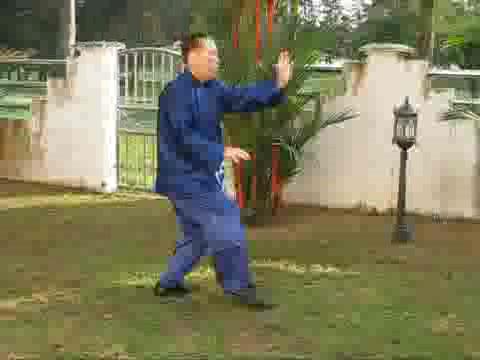
Explode Force of Zhang San Feng

Explode Force of Zhang San Feng

Question 7

What would be the most cost effective force training method for me? I learned the 18 Lohan Arts, our core stances, the Triple Stretch Set, Santi Stance, and the Iron Wire which I learned from two of my sihengs.

Answer

It is simply amazing that we have a very extensive range of internal force training methods, ranging from the very soft Yang Style Taijiquan to the very hard Iron Wire. This is unprecedented in kungfu history. Most schools have only one or two force training methods.

They are not just ordinary force training methods. All the force training methods we have are legacies from great masters.like:

  1. Sinew Metamorphosis of Bodhidharma,
  2. Flowing force of Bai Yi Feng (the founder of Wuzuquan),
  3. Crushing force of Yue Fei (found in Xingyiquan),
  4. Eighteen-Lohan Art of Northern Shaolin,
  5. One-Finger Shooting Zen of Southern Shaolin,
  6. Exploding force of Zhang San Feng,
  7. Double Worshipping of the Buddha of Ng Mui,
  8. Triple stretch of Hoong Hei Khoon
  9. Iron Wire of Thiet Kiew Sam

On top of this, we believe we have followed the training methods correctly. How do we know? We may not know for sure whether the way we train is exactly the way the past masters trained, although the methods are the same, but we know the results are the same, or at lease similar, even though we may not be at their levels. Most importantly, the internal force derived from training these methods gives us good health, vitality, longevity, mental clarity, peak performance and spiritual joys.

You can choose any one of the methods you have learned as the main method, and other methods as secondary. If you intend to specialize in Drunken Eight Immortals, an excellent choice is the flowing force of Wuzuquan. If you have not practiced Wuzuquan, you can substitute with the flowing force of Taijiquan. If you have not practiced Taijiquan too, you can use One-Finger Shooting Zen.

Suppose you are not familiar with One-Finger Shooting Zen. You can then choose an exercise from Sinew Metamorphosis or Eighteen-Lohan Art. Even if you had made what to other students of other schools the worse choice, Iron Wire, your result will still be many times better than other students making their best choice, which often is their only choice.

Other people, as I have often mentioned, may think I am arrogant for making these statements, and that is their business, but I am stating the truth which any member of our Shaolin Wahnam Family can readily verify from his own experience. How many other kungfu students, for example, have your internal force that enables you to enjoy your work and play wholesomely? Indeed, and it is actually sad, most other students would be lucky if they do not suffer silently in pain and anguish from their deviated training and perverted views.

Why is it that even if you had chosen the worst method (to most people in general) in your training, you still have better result than other people who have chosen the best method? It is important to note that “worst” and “best” here are relative.

In this case, using the Iron Wire method to develop internal force for application in Drunken Eight Immortals is a worst method to most other people, but it is still a very good method for us. On the other hand, without meaning to be vain, the “best” methods used by other people are bad methods to us!

Why is this so? Why the “worst” method is still a very good method to us, and why other students’ “best” method are bad?

A “worst” method can still be a very good method to us because of the magic of chi flow. We can readily employ chi flow to convert the consolidated force in Iron Wire training to flowing force in Drunken Eight Immortals application. Most other people can’t do this. The consolidated force they have will be a deterrent in their Drunken Eight Immortals application.

The “best’ method of other students are bad because it brings adverse effects. Even when it works correctly for a small percentage of these students, it takes them a long time to develop some internal force. How many students, for example, have internal force? Many of them have internal injury instead.

One suggestion is to practice your main training method on Monday, Wednesday and Friday. On the other days, practice the other force training methods you have learned on rotation. You can have other arrangement if you like. As long as you train, you will have wonderful benefits.

But don’t over-train. Indeed, a common advice in our school nowadays is not to train more, but to train less. Our training is to enrich our life, not to enslave us. Use the extra time as well as mental clarity and enrgy to get yourself a good wife.

Question 8

May I also ask how I could include in the best way the Small Universe and Big Universe in my training please?

My chi flow usually ends or slows down with Big Universe flowing spontaneously. I was wondering how to include the practice without overtraining. I’ve heard some say it is best to practice the Small Universe every day, and others say it is too powerful to practice it every day.

Answer

The Small Universe and the Big Universe are real treasures, more valuable than gold. The Small Universe will enable you to live beyond a hundred years. The Big Universe will enable you to realize that you never die!

All people never die but most people do not realize this cosmic truth. Our body may change and decay, but our spirit, our real self, lives forever until we return to transcendental Cosmic Reality, called by different names by different peoples.

Most other people may think I talk non-sense. It needs some cosmic wisdom to understand what I say. You and all other members of our Shaolin Wahnam Family understand the truth of my statements. The Big Universe enables us to directly experience, not just read about, our spirit expanding beyond our physical body.

Both statements that the Small Universe should be practiced everyday and that it is too powerful to be practiced everyday, are true. It depends on various factors like the development stage of the practitioner, his needs, his aspirations and sometimes his whims and fancies.

For you and all other students and instructors in our school, it is not necessary to practice the Small Universe everyday, though you can do so if you want to.

It is not necessary because we have so many other arts that give us wonderful benefits. Although the other arts may not have the specific benefit of enabling practitioners to live beyond a hundred years, most of our Family members have not reached 60. When they reach 60 they can reconsider their training schedule.

“Not necessary” does not mean “not beneficial”or “not desirable” . It is not necessary to earn a million euros to live happily, but it is beneficial and desirable to earn a million euros. Obe notable benefit which many students have reported to me, and which is not mentioned in chi kung classics, is that practicing the Small Universe brings good luck in both their personal and professional life. This should be no surprise to us, as the Small Universe is excellent in ensuring a good circulation of energy, and a “good circulation of energy” is “hou yun qi” in Chinese, which means having good luck.

Practicing he Small Universe the way we do may be too powerful to some other people. But for those in our Family who have been invited to learn this art, it is not too powerful even when they practice daily.

A good procedure when you practice various arts is to practice the Small Universe at the end of your training session. Even if you do not practice the Small Universe formally, it is often that your energy will flow in a small universal pathway when you have completed other exercises. The small universal chi flow at normal times without special practice is a clear indication of radiant health and vitality, and promising longevity. If you energy flow takes the big universal pathway, it is even better.
ON FORGIVENESS

(reproduced from http://shaolin.org/discussion-2/christina02.html)

Christina Didyk

Sifu Christina Didyk


Sifu Christina Didyk

Instructor, Shaolin Wahnam USA

23rd December 2012

On Forgiveness

Since our Festival in St Pete, I continue to receive reports from many of my patients and students who attended on how profound their experience was during one of the sessions in which Sifu asked us all to forgive.

I myself have experienced how amazing this can be at many courses but now it seems I am experiencing it from all these new eyes and once again it has touched me deeply.

At the course itself there were multiple folks in tears after the forgiveness exercise, but amazingly as I looked around they were all clearly tears of joy. Many people came up to me to give a hug after – in particular one of my patients and my good friend from Europe. I didn’t know what either of them had forgiven but I did know that they both were radiating love and happiness and a sense of weightlessness that made my heart feel lighter and full of joy.

This post is being written because at least for my patient that single act of forgiveness in class has led to some amazing real life results. She gave me permission to relay the result here.

Mrs M. had a long and incredibly destructive relationship with her long time boss. She felt she had been passed over for promotion many times because her boss disliked her even though her performance was always top notch. She felt angry and unsatisfied every morning going to work and every evening coming home. In retrospect she realized that her relationship at home with her husband suffered because of her anger and her many illnesses may have been a way to get out of going to work.

She told me that during the class with Sifu when he asked her to forgive her boss immediately flew into her mind and for a moment she felt all of her anger and hatred for this man fill her up until she felt like she would throw up. All at once she decided to just follow Sifu’s instructions and let go, forgive, release all that pent up anger. She stated that it was if in a moment she had lost 100 lb weight that had been sitting on her heart. She felt filled with peace.

Mrs M said the last few weeks she has been able to be friendly and cordial with her boss and even enjoyed going to work each day. Just two weeks ago her boss came to her and let her know that she would be up for promotion soon and that he intended to help her get it!!

Perhaps most amazingly Mrs. M has decided to forego her promotion and in fact is resigning from her job to become a full time painter instead. She told me that painting is what saved her time and again from her anger and is her greatest joy in life. She has already landed a large commission for a group of paintings and will be making more from them than her promotion would have given her!!! Astounding!

It never ceases to amaze me how profound the lessons Sifu gives us can be if we relax, don’t worry, don’t intellectualize and just follow his instructions!

Not only did Mrs M forgive, release her potentially illness causing anger and create a better relationship with her boss. She also gained the courage to realize that she is in control of her destiny and there is no one but herself who can stand in her way!

I am constantly amazed at the students of Shaolin Wahnam and eternally grateful to be a part of such a courageous and loving family.

From the Heart.

Christina.


Chris and Christina

Sifu Christina Didyk and her husband, Sifu Chris Didyk


The above discussion is reproduced from the thread On forgiveness in the Shaolin Wahnam Discussion Forum.

THREE LEVELS OF SPIRITUAL FULFILLMENT

(reproduced from http://shaolin.org/general-2/wisdom-of-living-masters/wisdom06.html)

Grandmaster Wong Kiew Kit

Grandmaster Wong


Question

How would you define spiritual fulfillment?

Answer

Spiritual fulfillment is self-explanatory. It is fulfilling spiritual needs.

The difficulty faced by many people in understanding what spiritual fulfilment is, therefore, lies not in its definition but in what actually is meant by spiritual. Spiritual is non-physical, it has no form. Your spirit is the real you. The real you is not your body.

Your spirit may grow and develop, but it does not change. Your body is changing all the time, though the countless changes, like the constantly changing cells that make up your flesh and bones, are so minute that you normally do not see them with your naked eyes.

Indeed, scientists have estimated that the body you have now is totally different from the one you had just seven months ago. Then why do you look the same? It is because the changing cells that constitute you body maintain the same appearance of the previous cells they replace. It is like a flowing river. The water in the river is changing all the time, but it maintains the same appearance.

Depending on various factors, like different education, environment and developmental stage, different people have different spiritual needs to be fulfilled. But all our spiritual needs may be classified into three levels:

  1. To be happy, peaceful and free here and now.
  2. To go to heaven in the afterlife.
  3. To eventually return to our Source, called variously by different peoples as God, Tao, Buddhahood or Supreme Reality.

If these needs are not fulfilled, your spirit, i.e. the real you, will not be at ease, and may be manifested in your physical body. The process works both ways. If your body is dis-ease, you will not be well.

For example, at the fundamental level if a person’s spirit is frustrated, agitated or restricted for a prolonged period of time, he may become unwell and it may be manifested as cancer, cardiovascular disorders and depression. On the other hand, if harmful micro-organisms attack his body, it can also make his spirit unwell, manifested as being gloomy, stressful and depressed.

Hence, to fulfill the needs of his spirit so that he can be happy, peaceful and free again, he has to overcome the causes that bring about the dis-ease of his spirit. If he just removes the symptoms manifested on his body, like taking out the cancerous parts, rectifying the cardiovascular disorders or taking pills to neutralize his depression, he can only succeed in temporary relief. As his spirit is still dis-eased, its symptoms would surface again.

On the other hand, if spiritual dis-ease is caused by physical factors, like harmful bacteria attacking his body, he can regain his spiritual well-being by overcoming the physical cause, like taking appropriate antibiotics.

At the intermediate level, people aspire to go to heaven in their afterlife. This is actually simple, though it may not be easy for some people. Avoid evil and do good. If you avoid evil and do good, you will be sure to go to heaven. This is taught in and guaranteed by all the greatest teachers of all the world’s known religions.

If a person did a lot of evil things in his past in this present life or his previous lives, even he does good now, he may not go to heaven in his immediate afterlife. But as long as he starts to avoid evil and do good, no matter how much evilness he did in the past, he will still inevitably go to heaven.

Is heaven real? It is like asking is the world we now live in real. The answers are the same. Yes, heaven and our phenomenal world are real – relatively real but not absolutely real. Heaven and earth are real relative to our mind. In other words, how that tiny part of Cosmic Reality we currently exist in will appear to us, depends on our mind. At the present stage when we exist in this world, how this world appears to us depends on how we perceive it. That is why it is called our phenomenal world. The adjective “phenomenal” comes from the noun “phenomena” which means “appearances”.

After leaving this world, how the afterlife appears to us, whether it is heaven or hell, also depends on our mind. If a person has avoided evil and done good, he has cultivated his mind with good thoughts, often described as having good karma. He will experience his afterlife as heaven. If he has done a lot of evil, described as having very bad karma, he will experience his afterlife as hell.

Heaven and hell, as well as the world we now live in, are in the phenomenal realm. How we experience our living in it depends on our karma. Its reality is relative to how our mind perceives Cosmic Reality, and is conditioned by karma. If we can break down these conditions and go beyond karma, we go beyond the phenomenal and realize transcendental Cosmic Reality. This is the most supreme and noble of all spiritual cultivation, described differently by different peoples as returning to God, attaining the Tao and seeing the Original Face.

Although our spirit, not our body, is our real self, while our spirit is housed in our body it is important to keep our body healthy and strong. When a person’s body is sick or weak, he may overcome his sickness or weakness by cultivating his spirit, but it is faster and more effective by working on his body directly. An effective way is through the practice of chi kung, spelt as “qigong” in Romanized Chinese. Chi kung is the cultivation of energy, or life force, which links the body and the spirit. In our school, Shaolin Kungfu and Taijiquan is also chi kung, as they also cultivate energy besides the body and spirit.

When a person’s body is healthy and strong, he is more efficient in cultivating his spirit. There are many different methods of spiritual cultivation. The following are some of the methods we use in our school, Shaolin Wahnam, and they have been proven to be very effective.

To be happy, we smile from our heart, which is a skill we practice every time we start an exercise. To be peaceful we stand in meditation and enjoy the stillness and experience inner peace. To be free we expand our spirit using techniques like Separating Water and Flicking Fingers.

A sure way to go to heaven is to avoid evil and do good. We aspire to this high moral living by following our Ten Shaolin Laws, which is an essential requirement for anyone who wants to learn from us. .

We are not in a hurry to return to our Source yet. We know the world we now live in is phenomenal, and we ensure our time here is well spent – for ourselves as well as for other people. We often have a glimpse of our Source while in deep meditation in such advanced arts like Cosmic Breathing and Expanding into the Cosmos. When we are ready, we can cultivate to return to our Source, using methods like Zen and Taoist meditation.

In all the arts practiced in our school, chi kung, Shaolin Kungfu and Taijiquan, we are keenly aware of triple cultivation, namely cultivating jing, qi and shen, which means body, energy and spirit. We do not merely talk about spiritual cultivation, not even just practice spiritual cultivation, but ensure we have spiritual fulfillment, i.e. enjoying the benefits of spiritual cultivation in our daily life.


The above extract is reproduced from “Your True Nature: Wisdom of Living Masters” by Natalie Deane and Damian Lafont.

You can order this book from here or here.