Category Archives: Kung Fu

DECEIVING HEAVEN TO CROSS SEA

(reproduced from http://shaolin.org/discussion/36-strategies/strategy09.html)

Xie Ren Gui

A picture of the famous Tan general, Xie Ren Gui, reproduced from http://people.chinese.cn/en/article/2010-11/23/content_192809.htm


Question Which of the Thirty Six Strategies do you personally find the most beneficial and effective in term of profundity in simplicity, in order to enrich private and business life?

Sifu Roland Mastel


Answer

The strategy I find most beneficial and effective is the first one, Deceive Heaven to Cross Sea. It is simple. Basically it consists of making a feint move to accomplish a desired result. Actually all other strategies are covered in this strategy. All other strategies consist of making feint moves to accomplish desired results. Hence it is very profound.

A special feature of this strategy is that the deception does not appear to be very special. In fact it looks common, so that the enemy will not suspect the deception. Kungfu classics are a good example. A lot of secrets are hidden in the open, but unless they are initiated, people will not realize these secrets.

Hiding secrets in the open is found not just in classics but also in practice. Wuzuquan and Xingyiquan are good examples. When I first learned Wuzuquan more than 40 years ago I did not know how to use its patterns for combat. I believe many Wuzuquan practitioners today, despite having practiced for many years, are in a similar situation. But I am sure those who attended the recent Wuzuquan course in Penang are amazed that the patterns from San Zhan, the fundamental set of Wuzuquan, can be used to counter any attack! It is an excellent example of profundity in simplicity.

Another excellent example of profundity in simplicity is Xingyiquan, known to be the kungfu for generals. I knew for a long time that of all the kungfu styles, Xingyiquan is the closest to Western Boxing, and thus will be very helpful to those who want to win free sparring competitions as most competitors today fight like Boxers and also that most competitions follow rules closely related to Western Boxing.

But in terms of techniques, I did not know what a Xingyiquan practitioner would do if an opponent went beyond the simple techniques found in Boxing and Kick-Boxing and used sophisticated techniques like those found in the Shaolin Seventy Two Chin-Na Techniques or the little know felling techniques of Taijiquan. I reckon that the Xingyiquan practitioner would compensate his lack of extensive techniques with his tremendous force, for which Xingyiqaun as well as Wuzuquan are famous. (In my case, it was not a big concern because I could always fall back on my Shaolin and Taijiquan counters.)

Yet, as in the case of Wuzuquan earlier, when I went deeper in both the practice and philosophy of Xingyiquan in preparation for teaching the course at the UK Summer Camp, I found to my delight that even leaving aside internal force, simple looking Xingyiquan techniques do have counters for sophisticated attacks! Xingyiquan is not just bulldozing into opponents, as many people mistakenly think, but incorporates covering opponents adequately in its apparently straight-in advance. It was an aha experience for me to discover why this simple-looking style is regarded as kungfu for generals.

I am not sure whether the early Wuzuquan and Xingyiquan masters used this strategy of Deceiving Heaven to Cross Sea to hide secrets in the open. Personally I do not think so. The profundity in the apparently simple-looking arts evolved spontaneously. But I am sure that knowing this strategy by reading the answer here, or better still attending the course in Ireland, will enhance our ability to go deeper and obtain more benefits not just in kungfu and chi kung but in whatever we do when most other people merely skim the surface.

There is a lot of depth and benefit in the kungfu and chi kung we practice. For those who have not practiced Wuzuquan or Xingyiquan, let us take an example of Single Tiger Emerges from Cave from Shaolin Kungfu and Immortal Waves Sleeves from Taijiquan, and Lifting the Sky from chi kung.

The form is simple, and most other people merely practice their form. Any benefit they get is incidental. For us in Shaolin Wahnam, not only we know that the form is only a means to obtain benefit, but we get benefit deeper than what its surface suggests.

Single Tiger Emerges from Cave or Immortal Waves Sleeves is not only a counter where we can use minimum force against maximum strength, but is also applicable against any attack, be in striking, kicking, felling or chin-na! Lifting the Sky not only generates an energy flow, but gives us benefit ranging from just being relaxed to expanding into the Cosmos.

The past masters did not use the strategy, Deceiving Heaven to Cross Sea, but understanding the strategy enables us to see depth beyond surface.

An American businessman used this strategy to save a lot of money, as well as make a lot of money – legally. He probably had not heard of Deceive Heaven to Cross Sea, but what he did was applying its philosophy.

To protect local industry, the United States imposed a lot of tax on foreign imports. A lot of American women loved elegant French gloves but they were expensive because of heavy import tax.

A smart American businessman thought of a way to save a lot of tax and also make a lot of sales. He bought 100,000 pairs of these expensive, elegant gloves from France. But he did a strange thing. He unpacked them and sent only the left gloves to the United States, with a clear indication they were left gloves.

When the 100,000 pieces of left gloves arrived at United States, he did not claim them from the customs and therefore did not pay any import tax. As it was the practice, unclaimed items after some time were auctioned away. No one would bid for only left gloves without the right gloves. So this businessman could buy back his left gloves at a very low price.

The customs officials were alerted. They kept a close track on this businessman. They paid special attention to any future consignment of right gloves. Soon a consignment of 50,000 pairs of gloves arrived. They were normal, with left and right gloves. But the custom officials were careful. They still checked the consignment thoroughly to see if any right gloves were hidden. But they found nothing wrong. The businessman dutifully paid the tax and claimed the gloves.

The businessman sold the expensive, elegant French gloves below normal price. As it was a bargain, many people bought the gloves and the businessman made a fortune.

The customs officials continued to look out for any consignment of right gloves. The police and immigration also helped to ensure that no right gloves were smuggled in. But nothing of that sort happened.

Did the businessman get the right gloves, and if so, how did he get them? I would let you have fun working out the answer, which will be provided later.


Xingyiquan, Hsing Yi Kung fu

Xingyiquan looks simple, but is very profound


The above discussion is reproduced from the thread 10 Questions on the 36 Strategies in the Shaolin Wahnam Discussion Forum.

HOW TO PLAN A TRAINING SCHEDULE

(reproduced from http://shaolin.org/answers/sp-issues/training-schedule.html)

Combat Sequence

Students, expecially at beginners’ level, should include stance-training, including moving in stances, in their daily training schedule

Question
I believe I heard somewhere that you prefer to have a structured, daily schedule. Can you please talk about the importance of having a daily schedule and any tips that may help us successfully implement and stick with our own (especially tips for handling disruptions such as travel or unexpectedly having to work late)?
Chris, USA
Answer
Yes, having a structured daily schedule will help to save much time as well as to get maximum benefits from the practice, both in the practice session itself as well as the general programme of training.

Experience has shown that many students waste a lot of time thinking of what to practice next after they have completed one aspect of their training. Because they lack a clear cut schedule, they often practice haphazardly, spending too much time on what is relatively unimportant, neglecting crucial aspects as well as training redundantly.

For example, many students spend years on practicing kungfu sets, without developing force and practicing combat application, which are the two twin pillars of any kungfu training. Yet, after many years of practicing forms, their forms are not correct because they failed to master the basics like how to co-ordinate their body, feet and hands, and how to move with grace and balance.

Having a structured schedule will overcome these setbacks. But before we attempt to work out our schedule, we must have a clear idea of what the art we are going to practice is, what our aims and objectives of practicing are, and what resources we have to work on. Without such preliminary understanding, many people end up with form demonstration or Kick-Boxing though they originally aimed to practice Shaolin Kungfu or Taijiquan. Some of them, including instructors, have invested so much time and effort in their deviated practice that they even think or argue that form demonstration or Kick-Boxing is Shaolin Kungfu or Taijiquan!

Setting aims and objectives are important when constructing a daily practice schedule. It helps to make your practice very cost-effective. To set aims and objectives wisely, you need to be clear of not just what you wish to achieve but also what the art has to offer. Then you select from within the art the relevant resources for practice that best help you to accomplish your aims and objectives. Arranging this material into some systematic ways for practice makes up your daily practice schedule.

Allot time, say half an hour or an hour, for each training session, and give yourself, say, six months as a package to achieve your objectives. Your daily practice schedule may be the same every day if you have sufficient time in the session to complete the chosen material, or you may vary your daily schedule if you have a lot of material to cover.

Naturally, because of different needs and aspiration as well as developmental stage, different practitioners will have different schedules. Let us take an example of a student who attends regular classes from a Shaolin Wahnam instructor. He aims to have good health and vitality as well as combat efficiency. A good daily schedule is as follows.

Start with about 5 minutes of “Lifting the Sky”. Then spend about 10 minutes on stance training, followed by about 5 to 10 minutes of gentle chi flow. Next, spend about 10 minutes on the Art of Flexibility, alternating with the Art of 100 Kicks on different days, followed by about 5 minutes of chi flow.

Then practice a kungfu set. If he has learnt many sets, he may vary the set on different days. Depending on his needs, aspirations and developmental stage, in his set practice he may focus on correctness of form, fluidity of movements, breath control or explosion of force. This will take about 10 to 15 minutes.

For the next 10 or 15 minutes, he should practice his combat sequences. He may go over all the sequences he has learnt or select those he wishes to consolidate. He will practice them at the level he is at, such as merely going over the routine so that he will be very familiar with them, using steps like continuation and internal changes, or varying them in sparring with an imaginary opponent. He will conclude his training session with 5 or 10 minutes of Standing Meditation where he enjoys inner peace or expands into the Cosmos.

Combat Sequence

If your objective is to prepare yourself for an Intensive Shaolin Kungfu Course, you should include combat sequences in your daily schedule

Another student who does not have the advantage of learning from a regional Shaolin Wahnam instructor, may have a very different daily schedule. Suppose he wants to attend my Intensive Shaolin Kungfu Course, but could not learn kungfu, even only outward forms, from a local teacher. So he has to learn the forms from my books, and familiarize himself with the combat sequences from my webpages.

His main aim is to prepare himself so that he can qualify to attend the Intensive Shaolin Kungfu Course. He has three main objectives — to be able to perform basic kungfu forms so that he can follow the course, to be familiar with the routine of the 16 combat sequences so that he can focus on developing combat skills instead of wasting time learning the sequence at the course, and to develop some internal force, especially at his arms, so that he can be fit for a lot of sparring. He allots half an hour a day for three months to achieve these objectives.

He should spend the first month focusing on the basics, i.e. the stances and footwork and basic patterns, and the other two months on familiarizing himself with the 16 combat sequences. Force training, including the Art of Flexibility, should be carried out throughout the three months.

He spends about 5 minutes on “Lifting the Sky” which he can learn from my books. He will probably not have any chi flow. For the first two weeks, he focuses only on the stances. He spends about 20 minutes learning how to perform the various stances correctly. At this stage, he needs not, and should not, remain at each stance for any length of time. In other words, this stage is not for zhan-zhuang, or remain at a stance for some time. His task is to be able to perform a stance, for a few seconds, correctly. Within two weeks he should be able to learn the correct positions of the stances quite well. For the remaining 5 minutes, he practices the Art of Flexibility.

For the next two weeks he focuses on moving in stances and performing basic patterns. By now he should be able to move into any stance correctly, though he may not be able to remain at the stance for long. He begins the session with about 5 minutes of “Lifting the Sky”. Then he spends another 5 minutes on performing all the stances correctly. The emphasis is on correct form, and not on remaining at the stance to develop force. Next, he spends about 15 minutes to learn how to move correctly in stances and to perform basic patterns. He should pay careful attention to waist rotation and body weight distribution so that he can move gracefully and without hurting his knees. He concludes the session with the Art of Flexibility. By the end of the month, he should be able to perform basic patterns in proper stances correctly.

For the next two weeks, he focuses on familiarizing himself with the 16 combat sequences as well as developing some internal force. He starts his session with stance training. Now, as the postures of his stances are correct, he focuses on remaining at a stance for as long as he comfortably can. This will take about 5 to 10 minutes. For the remaining 20 minutes, he practices the 16 combat sequences, starting with one and progress to all the others. He needs not worry about force and speed. His concern is to remember the routine of the sequences and perform the patterns correctly.

If he takes three days to learn and practice one combat sequence, he can complete the 16 sequences in 48 days, giving him a few days for general revision. He should learn and practice the sequences progressively, not individually. In other words, by the sixth day, he should be proficient in sequences 1 and 2, and by the ninth day be proficient in sequences 1, 2 and 3, etc.

Hence, if he follows these schedules for three months, he will be well prepared for the Intensive Shaolin Kungfu Course even though he might not have any kungfu experience before. On the other hand, someone who may have learnt kungfu for many years, where he only learns external kungfu forms, is ill prepared. This is a good example of cost-effectiveness. The smart student knows what he wants and plans his practice accordingly, whereas the mediocre student practices haphazardly without direction.


The above is reproduced from Question and Answer Number 1 of the May 2007 Part 2 issue of the Question-Answer Series.

Please e-mail your questions to Sifu Wong Kiew Kit stating your name, country and this webpage for reference. E-mails without these particulars may not be answered.

SHAOLIN WAHNAM KUNGFU — COMBAT SEQUENCE 6 “DARK DRAGON DRAWS WATER”

(reproduced from http://www.shaolin.org/review/dark.html)

Dark Dragon Draws Water

Dark Dragon Draws Water

Reducing Movements and Increasing Speed

In Combat Sequence 5 all the attacking techniques are the same as in the previous four sequences, namely middle punch, low punch and horn punch. However, the right Bow-Arrow Stance, instead of the left Bow-Arrow Stance, is used in the attacks. This right-leg mode makes a difference.

Besides enjoying some other advantages, being able to use the right-leg mode efficiently enables the combatant to change or continue easily from the previous four combat sequences to other new sequences. Before this, his techniques are limited. Combat Sequence 5 marks the first step whereby he can expand his techniques remarkably.

Combat Application Combat Application
Poise Patterns Fierce Tiger

Before this, he might move into a right-leg mode accidentally, or forced to do so to his disadvantage, often without his conscious knowing. Now he moves into a right-leg mode artfully and purposely, usually to his conscious advantage. Herein lies a crucial difference, and it is one of many points why many students may remain at the same standard after many years of free sparring, whereas you may improve tremendously after a few months of systematic training.

Once you can change artfully and purposely from a left-leg mode to a right-leg mode, and vice versa, even if you do not learn any new techniques, you have expanded your techniques two fold relative to an opponent who, often unconsciously, use only one favoured leg mode.

Combat Application Combat Application
Dark Dragon Big Boss

If you observe exponents of Western Boxing, Karate and Taekwondo spar, for example, you often will notice that they use only either the left-leg mode or the right-leg mode, but seldom both modes equally well. If, for instance, both of you have 25 techniques, now because you can use both modes well and he can’t, you will have 50 techniques whereas he still has 25.

Your advantage does not end here. Not only you can change your leg-mode, you can also change your stances to your best advantage, whereas most other martial artists pay little attention to stances. Moreover, you can change your hand forms, but most others don’t. For example, instead of striking with a level punch, you may change it into a phoenix-eye fist, a willow-leaf palm, a leopard punch or a tiger-claw, but most other martial artists seldom do so. Hence, from your basic 25 techniques, you can have literally hundreds of variations, even without learning new techniques!

Combat Application Combat Application
Enter Well Golden Dragon

But you must not rush into these hundreds of variations. They are mentioned here to remind you of the great variety and potential in store for you when you have mastered your fundamental skills. Now we still have to pay a lot of attention to skill development. If you are not skilful, knowing a lot of techniques is a liability, not an access. This is a main reason why many kungfu and wushu students, despite knowing many techniques, are no match against exponents of Karate, Taekwondo, Kickboxing and Western Boxing

Combat Application Combat Application
Precious Duck Golden Star

Yet, from Combat Sequence 6 onwards, you are going to learn some useful combative techniques. Two attacking techniques are introduced in this sequence — a left hand palm strike in “Dark Dragon Draws Water”, and a top-diagonal palm chop in “Chop the Hua Mountain”.

“Dark Dragon Draws Water” provides a good opportunity for you to practice applying your internal force. Focus your chi at your dan tian, then “sink” down your Bow-Arrow Stance as you channel your force from your dan tian through your left palm into your opponent.

Combat Application Combat Application
Green Dragon Poise Patterns

“Dark Dragon Draws Water” also provides a good opportunity to apply the principle and develop the skill of progression in techniques and speed. At first you use three moves for the attack — tiger-claw, cover elbow, and palm strike. Next, you reduce to two moves — tiger-claw cum cover elbow, and palm strike. Then you perform the same attack in one move — palm strike which includes tiger-claw to cover elbow.

A helpful way to train is to count the moves. At first you count “1 2 3” as you perform the three moves of the attack. After some time of training you count “1 2” for the two moves. Then you just count “1” as you attack. If you train this pattern 50 times a day for six months, you may be able to break the ribs of an average attacker as soon as he moves in to attack with a right punch.

OVERVIEW

Combat Application Combat Application Combat Application
Poise Patterns Fierce Tiger Dark Dragon
Combat Application Combat Application Combat Application
Big Boss Enter Well Golden Dragon
Combat Application Combat Application Combat Application Combat Application
Precious Duck Chop Hua Mountain Green Dragon Poise Patterns

CAN WE LEARN CHI KUNG AND KUNGFU FROM BOOKS, VIDEOS OR AN E-MAIL?

(reproduced from http://shaolin.org/general-2/books.html)

chi kung, qigong

Practicing chi kung is not merely performing chi kung form


Can we learn chi kung and kungfu from books, videos or an e-mail? The answer is yes, no, or yes and no. There is no play of words, but it depends on an interplay of the following three factors:

  1. the type of chi kung or kungfu exercise
  2. the book, video or e-mail
  3. the person learning the art or exercise

If the chi kung or kungfu exercise is just a simple form, it can be readily learnt from a book, a video or even an e-mail. This is what most people have in mind when they think of learning chi kung or kungfu from books or videos.

Interestingly, they do not realize that even when they have learnt these chi kung or kungfu techniques correctly, they have not learnt chi kung or kungfu! For example, they may have learnt the techniques of the “Eighteen Lohan Hands” correctly, but they may still not have good health, which is an inevitable benefit of chi kung. They may have learnt the patterns of a kungfu set correctly, but they may still be unable to use these patterns for combat.

More than 80% of chi kung and kungfu (including Taijiquan) practitioners fall under this category, and most of them do not realize it. Some vehemently, and to them righteously, insist that what they practice is chi kung or kungfu.

All chi kung and kungfu techniques involve skills, though many people may overlook these skills. One may perform the outward form of “Lifting the Sky” correctly, but if he is tensed or intellectualizing, he is not performing it as chi kung. One may perform a kungfu technique beautifully and even theoretically know its application, but if he does not have good spacing and good timing, he would not be able to apply if for combat.

When an exercise involves some specific skills, it is difficult, if not impossible, to learn it from books, videos or an e-mail. For example, in Abdominal Breathing, one needs to breathe energy (not just air) into and out of the abdomen. In One-Finger Shooting Zen, one has to channel energy to his index finger. These skills need to be learnt from and practiced under the supervision of a competent teacher.

The second factor is the book, video or e-mail involved. Obviously, if the instructional medium presents its material clearly and systematically, it is easy for a practitioner to learn it, unless the techniques are complicating or they involve specific skills. But if the instructional medium is concise or arcane, as most chi kung and kungfu classics are, it is difficult, if not impossible, even for seasoned practitioners to learn from it.

Shaolin Kungfu

You may learn kungfu form from books or videos but you may be unable to apply it for combat

Following Dr Damian’s famous rule of three, we may classify instructional media into three categories:

  1. Teaching Manuals
  2. Review Material
  3. Records for Posterity

Please bear in mind that the classification is for convenience; there is often much overlapping.

The videos in my websites showing kungfu sets and combat sequences for students to learn before they attend respective courses are good examples of teaching manuals. Our students would have no difficulty learning them as they have the required skills.

Other people outside Shaolin Wahnam will also be able to learn these sets and sequences if they want to. But, unless they are already masters, they will not be able to attain a similar level as that of our students. It is because not only they are unlikely to appreciate the functional beauty of the sets and sequences as our student do, they also lack skills like energy flow and heightened state of mind that are characteristics of high-level kungfu.

Videos shown after some particular courses, like the Intensive Shaolin Kungfu Course and the Flower Set Course, are good examples of review material. Those who have attended the courses, will find the review material very useful.

Some of the review material, especially videos showing early lessons of the Intensive Shaolin Kungfu Course and Intensive Taijiquan Courses, can also be used as teaching manuals, including by people outside our school. If people can learn from the review videos, does it follow that they do not need to attend the courses?

No, it is not so. If they can learn from the videos or other teaching media, they will have more benefit from their kungfu training. But this benefit is nothing compared to the benefit they would get had they attended the courses. Even leaving aside a lot of material covering close secrets not shown to the public, but focusing only on public videos, other people only learn the form (including the form of combat application), but course participants not only learn but actually practice the skills, application and philosophy. You would have a better idea of the comparison if you consider that despite literally a sea of public material on kungfu application on the internet, most kungfu practitioners today cannot use their kungfu techniques in combat.

Books, videos and other media that are meant to be records for posterity are not suitable material for self-taught training, unless the practitioner is already a master. What many students do not realize is that many chi kung and kungfu classics belong to this category.

Let us take the often-mentioned classic, “Shaolin Seventy Two Arts”, as an example. The first art from my copy (in Chinese, reproduced from the Shaolin Temple) is known as “Art of Six-Word Stance”. I translate the instructions as follows:

  • What are the six words? They are ho, shi, fu, si, chu, hi. Everyday at mid-night and noon, sit in meditation, gently bite teeth and swallow saliva. Say these six words. This can erase illness of the five organs. Strengthen inner membrance. Necessary to say gently. Also necessary to complete in one breath. Results are marvellous.

The instructions are accompanied with a poem, translated literally as follows:

  • Green shu brightens eyes wood the liver
    Summer sun ho heart fire spontaneously lights
    Ho si stabilize and keep gold nourish lungs
    Winter chu water abundance organs at peace
    Triple-warmer long organ hi removes heat
    Four seasons fu spleen nurtures above
    Should not be audible to two ears
    Its benefit superior to nourishing spirit elixir

Please note that the spellings of the sounds are in Cantonese pronunciation, which is closer than Mandarin to Chinese spoken in the past. Even if the sounds are pronounced correctly, which is unlikely, there is the question of tone, which baffles most Westerners.

Hence, learning the “Art of Six-Word Stance” from books is out of the question. On the other hand, unless one has received direct oral transmission from a competent teacher on this ancient art, he should not teach it to others. Worse, bogus masters who have not learnt this art correctly may try to impress others by citing the relationship between these sounds with colours, seasons and internal organs, without actually knowing what it means.

Small Universe

Specific skills, like activating a small universal chi flow, need to be learnt personally from a master

You can also find some records for posterity in my website, such as the list of 72 Shaolin Chin-Na Techniques at http://www.shaolin.org/shaolin/chin-na.html and the poetic couplet of the Flower Set at http://wongkiewkit.com/forum/showthread.php?t=9496&page=10 , which is reproduced below:

  • Blossoming like plum flowers in full gear
    Swift wind rain storm clouds forming here

The third factor in the interplay deciding whether one can learn chi kung and kungfu from books, videos, e-mails and other media is the practitioner himself. Again using Dr Damian’s rule of three, we may conveniently classify practitioners into three categories:

  • Beginners
  • Intermediate Practitioners
  • Advanced Practitioners

It is difficult, if not impossible, for beginners to learn chi kung or kungfu from books, videos and other media. They may, with some effort, learn chi kung or kungfu external forms, but not the real art. In other words, they may know the techniques, and sometimes even perform them beautifully, but they would not obtain the benefits these arts or exercises are meant to give. Even students learning from live instructors miss the essence of chi kung and kungfu, what more will be those who learn from books or videos.

Intermediate students should have no problem learning chi kung or kungfu exercises of basic to intermediate levels from books, videos and other media, but they may have some difficulty learning high-level chi kung or kungfu that require special skills. For example, students in our school can learn most chi kung exercises from books or the internet, and probably perform them better than practitioners of the respective schools themselves.

Other people may think we are boastful making such a statement, but it is true. This is because most other practitioners practice these techniques as gentle physical exercise, but our students practice them as chi kung. Similarly, our students can learn kungfu sets from books or other media, and can apply at least some of the kungfu patterns in these sets for combat, whereas other practitioners who attend regular class may perform the external forms of the sets more beautifully than our students do, but they cannot apply them for combat.

However, if the chi kung exercises or kungfu sets require specific skills, our students may not be able to perform them well, though they may easily learn their outward form. An example in chi kung is the “Eighteen-Lohan Art”. If our students want to use the “Eighteen-Lohan Art” just to generate an energy flow, which is practicing chi kung at the basic level, they can readily learn it from books, videos or other media. But if they want to use the “Eighteen-Lohan Art” to develop internal force or to explode force in various ways, they will have to learn it from a competent teacher.

An example in kungfu is “San Zhan” or “Three Battles” of Wuzu Kungfu. If our students or other people want to learn the external form of the set, they can readily do so from books or videos. But if they want to use the set to develop internal force, or to appreciate the profound secrets hidden in its stark simplicity, they will have to learn it from a competent teacher.

Advanced practitioners, like our instructors, would not have such problems. If the secrets are revealed to them, they would be able to apply the secrets to the chi kung or kungfu exercises which they learn from books, videos or other media, to derive the desired benefits. This was why secrets were greatly sought after and highly valued by masters in the past. Once they knew the secrets, they could practice on their own to derive the desired results.

This also explains why our instructors can much help our students in their selective sets, even when the instructors themselves might not have previously learnt the sets. Because of the instructors’ scope and depth in understanding and practicing chi kung or kungfu, they are able to view the sets in ways their students are unable to.

Does this mean that advanced practitioners do not need to attend special courses? No, by attending special courses, not only they will obtain the results faster but the results are also better. Indeed, the more advanced they are, the more benefits they will get from the courses.

The flow method

From books or videos, one may learn the form, but not the skill in generating internal force

28th May 2011, Sungai Petani.

FOUNDATION OF KUNGFU – ART OF FLEXIBLE LEGS

(reproduced from http://www.shaolin.org/video-clips-5/sabah-kungfu2009/sabah-01/sabah04.html)

Shaolin Kungfu

Grandmaster Wong demonstrating Dancing Crane

The Art of Flexible Legs is part of the Art of Flexibility. In kungfu one should not just be stable but must also be flexible. The five exercises shown here will enable you to be flexible. They are not merely stretching exercises, but chi kung.

Foundation of Kungfu – Art of Flexible Legs

Shaolin Kungfu Shaolin Kungfu
Three Levels to Ground Dancing Crane
Shaolin Kungfu Shaolin Kungfu  
Touching Toes Taking off Shoes
Shaolin Kungfu

Dragon Fly Plays with Water

We wish to thank Mr Godfery Kissey of Ogingo Videography, Penampang, Sabah, Malaysia for kindly provideing us with the videos. Godfery is also a member of our Shaolin Wahnam Family. His telephone number is 60-88-731788, and e-mail address is godfery@pc.jaring.my .

SHAOLIN WAHNAM KUNGFU — COMBAT SEQUENCE 5 “FIERCE TIGER SPEEDS THROUGH VALLEY”

Fierce Tiger Speeds Through Valley

Fierce Tiger Speeds Through Valley

Progressing to the Right Leg Mode for Combat

Combat Sequences 1 to 4 which have been posted in previous vebpages constitiute one stage of combat training, and they form the kungfu set “Black Tiger Steals Heart” in the Shaolin Kungfu programme of our school. The main objective of this stage is to develop fundamental combat skills as follows:

  1. right timing
  2. right spacing
  3. flowing movement and force
  4. right judgement
  5. fast decision
  6. instantaneous change
  7. footwork adjustment
  8. safe coverage
  9. flowing attack
  10. pressing attack

The first two skills, right timing and right spacing, are the most fundamental. Without them the other skills, as well as all techniques and force, lose their significance. An exponent, for example, may have some fantastic techniques and tremendous force, but if his attack or defence cannot reach its target on time, all his techniques and force are quite useless.

Combat Application Combat Application
Poise Patterns Fierce Tiger

All the principles you learn in combat training can be, and should be, transferred to our daily work and play to make our life more rewarding. This is a main reason why we devote our time and effort to kungfu training. The principles of right timing and right spacing are of utmost importance in life. You may be the best computer programmer in the world or have the most advanced marketing skills, but if these skills are not used at the right time and at the right place, they are as good as being useless.

Some people, who may actually have many talents or much knowledge, constantly complain that society or Mother Luck never gives them an opportunity to use their talents and knowledge. What they need is to develop the skills of right timing and right spacing like what we do in our combat training, and transfer these fundamental skills to daily life.

Combat Application Combat Application
Single Tiger Golden Dragon

In the previous set of four combat sequences, besides the fundamental skills you also learned the basic techniques for hand attacks and defence. You should practise these four sequences in stages, as follows:

  1. pre-choice
  2. self-choice
  3. end-point continuation
  4. mid-point continuationM
  5. end-point addition

At the pre-choice stage, the initiator begins with a pre-chosen sequence, and the responder responds accordingly to complete the sequence. At the self-choice stage, the initiator may start with any sequence he likes, but the releasing of control must be gradual so that the responder can respond accordingly too and both partners can complete the sequence smoothly.

At the end-point continuation stage, after completing one sequence the initiator (or sometimes the rsponder) starts another sequence without retreating to poise patterns. For example, after completing Combat Sequence 1, instead of returning to poise patterns, the initiator continues by repeating Combat Sequence 1 or starting Combat Sequence 2. You should continue to the next sequence at the start iof the next sequence, but later you may continue at any suitable point of the next sequence. Hence, at this stage an encounter will consist of five or six exchanges instead of three.

Combat Application Combat Application
Fierce Tiger Golden Dragon

At the mid-point continuation stage, either one of the partner may continue with another sequence at the mid-point of the first sequence. For example, you may start with Combat Sequence 2, but at any suitable point during the sequence you or your partner may continue to Combat Sequence 3. You may enter Combat Sequence 3 at its beginning or at any suitable point of Sequence 3. Hence the exchanges are less although this stage is a progression from the previous stage. But later you may have three instead of two sequences in one encounter.

At the end-point addition stage, you or your partner may add a suitable hand-attack pattern and the other person will respond accordingly. The additional attack pattern need not be any of the patterns found in the four sequences, but it must be a hand attack. For example, instead of a level punch of the “Black Tiger”, you may use a palm strike or a phoenix-fist. You are to add only one pattern, and after the respond both will return to poise patterns.

Combat Application Combat Application
Precious Duck Golden Star

Once you have practised these four combat sequences well, you can defend against all hand attacks — although at this level the range of techniques is limited. Hence, you will soon find that neither you nor your sparring partner can beat the other. No matter what hand attack or counter- attack one uses, the other can defend against it effectively. None has an advantage over the other because now both have the same level of skills and techniques.

To overcome this impasse, you have to find at least one advantage over your partner (or opponent in real fighting). This can be achieved by either improving your skills or expanding your techniques. In other words, although you and your partner are at the same level of techniques, if you are faster or more powerful than him, you can still beat him. Alternatively, although you and your partner are at the same level of skills, if you can use techniques which he is unfamiliar with, you will also beat him. A main objective of the next set of four combat sequences, Sequences 5 to 8, is to expand your hand techniques.

Combat Application Combat Application
Green Dragon Poise Patterns

This sequence, “Fierce Tiger Speeds Through Valley”, introduces the right leg mode in attack. So far, from Combat Sequences 1 to 4 with the exception of the “Precious Duck” pattern, the left leg mode is used. The left leg mode and the right leg mode have their own strong points and weaknesses. Some martial artists, often without their own awareness, favour one mode to the other. Later when you are more skilfull and know more techniques, you can manoevre your opponent to his unaccomstomed leg mode, often without him knowing, thus gaining a tactical advantage.

In the previous four combat sequences, continuing from one sequence to another was easy when you were executing Sequences 1 and 2, but you probably experienced some difficulty if you were executing Sequences 3 or 4. This was because of your leg mode. After completing Sequences 3 and 4, your right leg was in front, and you might not know how to continue your attack as your attack patterns in the right leg mode were limited.

Now this limitation can readily be overcome. For example, after defending against your partner’s Black Tiger or Green Dragon with your right Single Tiger in Sequences 3 or 4, you can “thread” with your left Golden Dragon and continue with your right Fierce Tiger as in Sequence 5. You will find a lot of attack patterns in the right leg mode in subsequent sequences.

OVERVIEW

Combat Application Combat Application Combat Application
Poise Patterns Fierce Tiger Single Tiger
Combat Application Combat Application Combat Application
Golden Dragon Fierce Tiger Golden Dragon
Combat Application Combat Application Combat Application Combat Application
Precious Duck Golden Star Green Dragon Poise Patterns

WHY SHAOLIN KUNGFU IS THE GREATEST MARTIAL ART

(reproduced from http://shaolin.org/shaolin/greatest.html)

Shaolin Kungfu is the greatest martial art in the world because it has produced the largest number of generals and masters in history, has the most extensive techniques, skills and philosophy, enriches people’s life and leads to spiritual fulfilment.

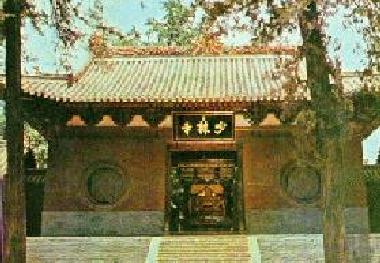
Shaolin Monastery

The Main Gate of the Shaolin Monastery

Shaolin Kungfu is the greatest martial art in the world! Understandably, exponents of other kungfu styles or martial systems will vehemently oppose this claim, but if they care to read on, are prepared to discard provincial prejudice and reason intellectually, they may even agree. I must clarify that I am far from originating the claim of Shaolin Kungfu as the greatest martial art. A statement to this effect has already been popular in China since the Tang Dynasty more than 1000 years ago!

Great Generals and Empire Builders

Generals

Many great generals were trained in the Shaolin tradition

What criteria should we use to measure the greatness of a martial art? Many people would place combat efficiency as the top priority. In this respect, from the perspective of both practical result as well as theoretical reasoning, Shaolin Kungfu can justifiably claim the top place.

The Shaolin school is the single martial art group that has produced the largest number of army generals in Chinese history. Great generals like Yuan Zhong, Yue Fei and Chi Ji Guang, on whom the whole empire depended at their respective times, were Shaolin Kungfu masters.

Since its establishment from the Liang Dynasty, with the exception of the Mongolian and the Manchurian Dynasties, virtually all leading warriors who built or helped the empire founders to build new governments, including the governments of the Kumintang and the Communist in modern time, were trained in the Shaolin tradition. This was related to the Shaolin philosophy of supporting a good government but overthrowing an oppressive one.

Largest number of Masters

The school that has provided the largest group of kungfu masters as well as of kungfu students at any one time during the long history of Chinese martial arts is Shaolin. Considering that one out of four people who existed, lived in China, this claim can reasonably be extended to the world.

An overwhelming number of the masters, like Ku Ru Zhang, Huo Yuan Jia, Wang Tze Ping and Wong Fei Hoong, who convincingly defeated foreign masters such as from Japan, Russia and Europe coming to China to test her martial art, were trained in Shaolin Kungfu.

Considering the glorious record of Shaolin Kungfu, may those who practise it today, irrespective of race, culture and religion, even if they cannot emulate a portion of the past masters, do not degrade a great martial art into a dance.

Enriching Our and Other People’s Lives

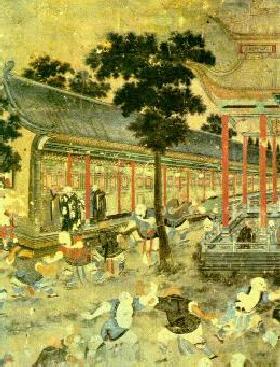
Shaolin Temple Mural

A famous mural in the Shaolin Monastery dipicting monks practicing kungfu

Yet, in line with the Shaolin teaching which actually discourages fighting, although Shaolin disciples will fight well if they must, its claim to greatness can be approached through discursive, non-fighting means. All martial arts may be analyzed through their aspects of form, power, application and philosophy.

From the perspective of form, all the techniques found in all world known martial arts today, such as karate, taekwondo, jujitsu, judo, aikido, Siamese boxing, western boxing, and wrestling, can be found in Shaolin Kungfu! From the perspective of power, the internal force of Shaolin masters, which is not limited by age or physique, is incredible. It is used not just for hurting , but more significantly for healing.

While most other martial arts are principally meant for fighting or as a sport, and sometimes hurting the participants in the training itself but without specifically tending to the injuries, Shaolin Kungfu is a comprehensive programme for physical, emotional, mental and spiritual cultivations, and its benefits enrich our and other people’s lives.

A Shaolin disciple, for example, is trained to be courteous and considerate, brave and righteous, assess problems and situations with calmness and clarity, and attend to duties with zest and loyalty. While the philosophy of many martial arts mainly focuses on how to be stoic and hurt the opponent, Shaolin philosophy teaches gentleness and a love for life. The twin pillars of Shaolin philosophy are compassion and wisdom.

The Spirituality of Shaolin Kungfu

The Buddha

The Buddha

The depth of Shaolin wisdom is bewildering, and is hard for some martial artists to comprehend or believe. At the relatively lower mundane level, Shaolin philosophy explains how we are responsible for our own lives, and why the phenomenal world is a creation of mind.

At the highest level in Zen, its wisdom surpasses the intellect, for its accomplishment depends not on verbalization and speculation but on direct experience, and the highest attainment is the direct experience of enlightenment, called variously by different people because of historical, linguistic, cultural and other differences, such as return to God or unity with the Great Void.

It is this spiritual aspect, which transcends all ritualistic religions, that best justifies Shaolin Kungfu as the greatest martial art. You will be in for a surprise if you think that the philosophy of Shaolin spirituality is merely theoretical. All Shaolin philosophy is geared to practical benefits. Spiritual cultivation in the Shaolin teaching may operate at one or more of the following three levels, depending on the student’s developmental stage.

  • Leading a morally upright and happy life.
  • Enjoying heavenly bliss in the after-life.
  • Attaining enlightenment in Zen.

SHAOLIN WAHNAM KUNGFU — COMBAT SEQUENCE 3 “PRECIOUS DUCK SWIMS THROUGH LOTUS”

(reproduced from http://www.shaolin.org/review/duck.html)

Precious Duck Swims Through Lotus

Precious Duck Swims Through Lotus

Near enough to Strike but Far enough to be Safe

In the first combat sequence in our combat training programme, “Black tiger Steals Heart”, you developed two fundamental combat skills, namely right timing and right spacing. These two are fundamental skills, meaning very important skills that form the foundation of future development.

The third fundamental skill is appropriate force, which is developed in our force training programme like “Golden Bridge” and “One-Finger Shooting Zen”, and which we apply in our combat sequences. It is important that the force must be flowing, and not mechanical or staccato.

Combat Application Combat Application
Poise Patterns Black Tiger

Without these three fundamental skills, a person cannot be combat efficient, even if he knows a lot of techniques. This is a common fault with many kungfu students — they think mistakenly that they can be more combat efficient by learning more techniques.

Skills have to be developed methodically, not merely learnt from a book or even from a master. A master provides you the method, and shows you how to do it, but you have to practice and practice to so that the skills become second-nature to you.

Combat Application Combat Application
Single Tiger White Snake

Free sparring is not a method to develop skills; it is a method to test whether you have developed the necessary skills to apply appropriate techniques in combat. This is a common fault with most martial art students today — they mistakenly think they can be combat efficient by practicing free sparring.

In this combat sequence, “Precious Duck Swims through Lotus”, you consolidate and improve upon the combat skills you have learnt, namely right timing, right spacing, right judgment and instantaneous change. We also have increased the choice of attack and defence from two to three alternatives.

Combat Application Combat Application
Golden Dragon Precious Duck

In the first combat sequence, there is only one choice, which is actually no choice. The initiator attacks with “Black Tiger Steals Heart” and the responder defends with “Single Tiger Emerges from Cave”. Both the initiator and the responder know what the movements will be. The movements are pre-arranged so that being free from worrying what to move next, they can better focus on developing the skills of right timing, right spacing and appropriate force.

In the second combat sequence, the initiator has two choices — he can attack with “Black Tiger Steals Heart” or “White Snake Shoots Venom” — and the responder has to react accordingly. In this third combat sequence, the choice is increased to three, with the addition of “Precious Duck Swims through Lotus”. If the responder makes a wrong judgment, his instantaneous change is more difficult. In the previous two combat sequences, if he judges wrongly, he can still defend against the coming attack — his “Golden Dragon” can still defend against the ”Black Tiger”, and his ”Single Tiger” can still defend against the “White Snake”. But here he has to change his “Golden Dragon” or “Single Tiger” into a “Hand Sweep”.

Combat Application Combat Application
Hand Sweep Single Tiger

Two new skills are introduced in this sequence. One is adjusting footwork. This skill is a development of right spacing. After defending your partner’s “White Snake” with your “Golden Dragon”, you have to bring back your front left leg a small step before moving forward a big step with your right leg for your counter-attack with “Precious Duck Swims through Lotus”. If you do not adjust your footwork, you would give your opponent a free advantage, i.e. an advantage he gains without having to do anything. You would have made it easy for him to strike you or fell you to the ground.

The second skill is covering yourself in your attack. You can do this by “taming” his front left hand, i.e. pushing it aside or “floating” it upward, with your left palm maintaining contact with his left arm, while you strike his side ribs with your right punch. Covering yourself is extremely important in any attack. This is what many other martial artists never do, exposing themselves to serious counter-strikes.

In the previous two combat sequences, the counter-attack mode is “first defend then counter”. Here the mode is “no defend direct counter”. As an opponent attacks you with “Precious Duck”, you need not block or ward off the attack first, then counter-attack. While moving your front left leg backward into a left false-leg stance, you directly strike his attacking arm with your hand-sweep.

“No defend” is a misnomer. It is not ignoring your own safety and go all out to attack, which would be foolish. Here, the defence is already incorporated in your counter-attack. As you move into your false leg stance for your counter-attack, you already have moved your body away from his attack.

OVERVIEW

Combat Application Combat Application Combat Application Combat Application
Poise Patterns Black Tiger Single Tiger White Snake
Combat Application Combat Application Combat Application Combat Application
Golden Dragon Precious Duck Hand Sweep Single Tiger

SHAOLIN WAHNAM KUNGFU — COMBAT SEQUENCE 1 “BLACK TIGER STEALS HEART”

(reproduced from http://www.shaolin.org/review/black.html)

Black Tiger Steals Heart

Black Tiger Steals Heart

The Big Mistake Concerning Free Sparring

Most martial art students today make a big mistake in their combat training. They think mistakenly that practicing free sparring is the way, often the only way, to combat efficiency. To a large extent this came about because many people were disillusioned with kungfu, as much of (so-called) kungfu practiced today is merely performing external forms with little or no combat training.

In genuine traditional kungfu, free sparing is never used to train combat efficiency; it is used to test combat efficiency, to confirm that the students can really fight. In other words, it is not a training tool — it is a testing tool. You engage in free sparing only after you know how to fight, not as a means to train you to fight.

Combat Application Combat Application
Poise Patterns Black Tiger

Practicing combat sequences is an essential link between form training and free sparring. In form training you develop the techniques as well as the skills that you will need for fighting. In combat sequences you methodically apply these techniques and skills in simulated combat. In free sparring you confirm that you can fight efficiently.

There are many stages and sub-stages in combat sequence training. “Black Tiger Steals Heart” is the first of a long series of combat sequences we use in our school, Shaolin Wahnam, to go through these stages and sub-stages systematically.

Combat Application Combat Application
Single Tiger Black Tiger

Most students would under-estimate this combat sequence, thinking it is too simple. This would be a big mistake. The techniques are purposely made simple because the aim of training here is not to learn new techniques but to develop skills. If the techniques are complicated, the students would waste much effort remembering the techniques rather than focusing on developing skills.

Before you even make any move, you must observe the “four modes of preparation” — one, you must be mentally and physically ready; two, you access your opponent; three, you seek an advantage or an opening; and four, when the opportunity arrives you move swiftly.

Combat Application Combat Application
Single Tiger Black Tiger

When you move in to attack, you must “ask the way”, i.e. you access your opponent’s strength and weakness, and you open the way for attack as well as prevent him from suddenly counter-attacking. You must also achieve “three arrivals”, i.e. the arrival of the heart, of the feet and of the hands.

The two fundamental skills developed here are right timing and right spacing. And the skills are applicable to both the initiator (attacker) and the responder (defender). In other words, when you move in to attack, you must move in at a right time, and space yourself at a right distance. A very common weakness is that the initiator is too far from the responder in his attack, in which case the responder can counter-strike immediately, without bothering to defend first.

Combat Application Combat Application
Single Tiger Poise Patterns

On the other hand, when you defend against an attack, you must move at a right time. A very common weakness defenders make is that they move back too soon. A trained attacker would exploit such a weakness. He would skip the first attack, treating it as a feign move, and follow in with a second attack, striking the defender at a time when he is still in the process of defending the first attack.

Nevertheless, now you should not worry about this skill of exploiting the opponent’s weakness. It is practised at an intermediate level. At an elementary level, your focus is to avoid making such weaknesses. If you can just do this, you would have done well. Many combatants today, including those at black-belt level, commit many such mistakes, thus throwing advantages to their opponents without their opponents having to make any effort.

You must also remember that all combat principles in Shaolin Kungfu are applicable to daily living. You should use these principles to enrich your life and the lives of others. For example you should not blame the traffic if you miss an appointment; it just shows you have not developed the skill of correct timing. You should not blame the waiter if you have been seated amidst a cloud of cigarette smoke in a restaurant; you have not developed the skill of correct spacing.

OVERVIEW

Combat Application Combat Application Combat Application Combat Application
Poise Patterns Black Tiger Single Tiger Black Tiger
Combat Application Combat Application Combat Application Combat Application
Single Tiger Black Tiger Single Tiger Poise Patterns