Category Archives: Grandmaster Wong Kiew Kit

LOOKING AT DISEASES FROM THE CHINESE MEDICAL PERSPECTIVE

(reproduced from http://shaolin.org/answers/sp-issues/chinese-perspective.html)

It may sound ridiculous to many people but according to the chi kung perspective all diseases are caused by energy blockage. Hence, when the blockage is cleared the patient will regain health as a matter of course. High-level chi kung is excellent to generate chi flow to clear blockage.

Question

Further tests and detail examination have failed to identify a correctable cause for my patient’s illness. Sifu’s reply is indeed very much welcome and has restored our hope in helping him.

— Dr Lim, Malaysia

Answer

I have many successful cases of helping patients to recover from diseases where conventional medicine could not identify the cause or site. This in fact is common.

If the cause or site of a disease can be identified, and if a remedy is available, conventional medicine is usually more effective, or at least speedier. But when the cause or site is unknown, chi kung provides an excellent alternative.

You would probably have read my explanation on why chi kung can succeed in overcoming such diseases when conventional medicine may not. Nevertheless, I shall explain it again here.

From the Chinese medical perspective, there is only one disease, called yin-yang disharmony. There may be countless symptoms, and conventional medicine names the disease, or its many manifestations, according to its symptoms.

Chinese medicine also names the various manifestations of the one disease, but the names are given not according to its symptoms but to its cause according to Chinese medical philosophy. Hence, while conventional medicine calls such disease manifestations as high blood pressure and bronchitis, traditional Chinese medicine calls them as “rising yang energy from the liver” and “excessive heat in the lungs”.

This difference of perspective gives traditional Chinese medicine a big edge over conventional medicine. When the cause of a disorder cannot be determined, or when there is no known remedy as in the case of viral infections, conventional medicine is quite helpless. It is not a question of conventional medicine being less effective; it is a situation where conventional medicine becomes a victim of its philosophical limitation.

Basically the therapeutic principle in conventional medicine is to define the disorder according to its cause, then prescribe the appropriate remedy. Such a philosophy works well when the cause is known and where a remedy is available. But when the cause is unknown or where a remedy is unavailable, treatment becomes impossible according to this philosophy.

Such problems become irrelevant in traditional Chinese medical philosophy. This is because traditional Chinese medicine (1) defines a disorder by its cause, and (2) all causes are correctable as their reference points involve the known conditions of the patient’s body. The following example may make this philosophical discussion clearer.

Suppose a patient suffering from what in conventional medicine would be referred to as high blood pressure, consults a traditional Chinese physician. After a thorough diagnosis, the physician concludes that his patient suffers from “rising yang energy from the liver”.

Why does he call the disorder “rising yang energy from the liver”? The answer is straight-forward. He finds yang energy rising from his patient’s liver. Had his finding been different, say excessive dampness in his patient’s stomach or insufficient heat in his patient’s gall bladder, he would define the disorder as “excessive dampness in the stomach” or “insufficient heat in the gall bladder”.

Now, when a disorder is defined as high blood pressure, a conventional doctor only knows the symptoms of the disorder; he has no clue to what the cause is or what a possible remedy can be. Hence, he does his best according to his philosophy and training, which is to relieve the high blood pressure.

High blood pressure is actually not the disorder, it is only the symptom of the disorder. The patient therefore has to take medication for life.

When a disorder is defined as “rising yang energy from the liver”, or “excessive dampness in the stomach” or “insufficient heat in the gall bladder”, a traditional Chinese physician knows exactly what the cause of the disorder is and how to remedy it. If he can lower his patient’s rising yang energy at the liver, or reduce dampness at the patient’s stomach, or increase heat at the patient’s gall bladder”, his patient will recover. The physician can achieve these objectives with the use of herbs, acupuncture, massage, chi kung exercises or other means.

Hence there is no such a thing as an incurable disease in traditional Chinese medical philosophy. One major objective in my writing “The Complete Book of Chinese Medicine” is to convey this philosophy to conventional medical scientists, in the hope that it may help them to overcome their present philosophical limitation.

This point is not generally realized. Most conventional doctors today interested in traditional Chinese medicine, only seek to borrow suitable therapeutic techniques from traditional Chinese medicine, such as what herbs, acupuncture points or chi kung exercises may be useful to overcome what disorders. They do not usually appreciate that major break-throughs in conventional medicine can be made by overcoming their philosophical limitation in viewing disease.

There is, however, a big problem traditional Chinese physicians have to face, that is, their diagnosis must be accurate. If their diagnosis is incorrect, such as mistaking “excessive fire in the liver” to be “rising yang energy from the liver”, their treatment logically would be wrong.

Hence, I believe medicine is more of an art than a science. It is the skill of a doctor or therapist in making right judgment and winning the patient’s confidence that are often more crucial than the knowledge of anatomy and pathology he has.

Chi kung does not even have this one big problem. There is no need for diagnosis in chi kung! This is simply because chi kung works on the most fundamental level, the level of energy flow. Other medical or healing systems work on higher levels.

When we define a disorder as high blood pressure or “rising yang energy from the liver”, for example, we operate at the levels of organs or systems. From the chi kung perspective, whatever factors that cause high blood pressure or “rising yang energy from the liver” are intermediate factors. The ultimate factor or cause of disorder is disrupted energy flow.

In other words, to a conventional doctor or a Chinese physician, his patient may have taken too much alcohol or has been exposed to too much anger. Due to his excessive alcohol or anger, he has high blood pressure or “rising yang energy from the liver”.

To a chi kung master, the excessive alcohol or anger may (or may not) have caused the high blood pressure or “rising yang energy from the liver”. But as a result his energy flow is disrupted.

It actually does not matter if the cause of the patient’s disorder may not be alcohol or anger but something else. It is also not relevant, according to this chi kung perspective, whether the patient has high blood pressure, “rising yang energy from his liver”, “excessive dampness in his stomach”, viral attack in his spleen, certain chemicals lacking in his system, or other pathogenic factors. All these are intermediate causes. The crucial point is that one, some or all of these intermediate causes result in his energy flow being disrupted.

In other words, a chi kung master has only one consideration, that is, whether the energy flow in his patients or students is harmonious. Harmonious energy flow is a Chinese medical jargon. In simple language it means the energy that flows to all the cells, tissues, organs and systems is making all the cells, tissues, organs and systems working the way they are supposed to work.

This energy flow may be interrupted by intermediate factors like excessive alcohol, anger, virus, inadequate chemical supplies, etc and the disruption or blockage may occur at the liver, blood system, a minute cell deep inside the body, or anywhere else. But irrespective of the intermediate causes and sites, once the energy flow is restored to be harmonious, all the cells, tissues, organs and systems will work the way they are supposed to work, which means the person will regain his good health.

How does the energy flow know the blockage is at the liver and not at the stomach, or in one particular cell or not in another? It is a natural characteristic of energy flow, like water flow, to flow from high levels to low levels. Areas of energy blockage are areas of low or no energy levels. If one practices chi kung sufficiently and regularly, energy flow will clear all areas of blockage, starting with the most serious areas (lowest or no energy levels), then the next, and so on.

This takes time, and the energy flow generated must be adequate. This explains that chi kung is not suitable for acute illness, but excellent for chronic disorders where the cause or sites may not be known.

Good health

Practicing chi kung and kungfu generates a lot of chi flow. Hence chi kung and kungfu practitioners exemplify good health.

GRANDMASTER WONG KIEW KIT’S SELECTION OF QUESTIONS AND ANSWERS APRIL 2015 PART 3

(reproduced from http://shaolin.org/answers/ans15a/apr15-3.html)

Bodhisattva Guan Yin

A beautiful statue of Bodhisattva Guan Yin, a gift to Grandmaster Wong from Gloria of Madrid

Question 1

You said that past masters took years to attain chi flowing at various levels. Why is it that we could achieve this in just a day?

— David, UK

Answer

It is just ridiculous but true that past masters took years to attain chi flowing at various levels, but our students can achieve the same result in just one day! It is understandable of others do not believe what we way, but there is no doubt that all the students present today (9th June 2014) on this Bone Marrow Cleansing Course know this is true.

How do we know it is true? It is like someone asking you how do you know you are now sitting on a chair. In both cases, you know from direct experience. You know you are sitting on a chair because you are sitting on a chair. You know you can direct chi to flow at the levels of your skin, muscles, meridians, organs and bone marrow, because you can clearly feel chi flowing at all these levels.

Now the question. Why did past masters took years to attain these skills whereas you take only just one day? There are a few reasons, like we understand the underlying philosophy of the art, we are generous to teach it, and our methodology is very cost-effective, but the most important reason is that I transmit the skills to you from heart to heart.

An analogy is becoming a millionaire. If you work to become a millionaire, you will take many years to succeed, if you ever will. But if a benefactor transmits the money to you, you become a millionaire immediately. If you train to have chi flowing at five levels, you will need many years to succeed, if you ever will. But if master transmits the skill to you, you have the ability to have chi flow at the five levels immediately.

On the other hand, when past masters as students learned chi kung they had to practice appropriate techniques for many months or a year or two to develop the necessary skills. Normally they were unaware of the skills though they had developed the skills through dedicated practice. With the skills chi first flowed at their skin level. This development was spontaneous.

As they continued their dedicated practice for many more months or another year or two, chi next flowed at their muscle levels. In the same way, after may years chi flowed at the levels of their meridians, organs and bone marrow.

It should also be noted that these students did not learn these advanced techniques of chi flow at various levels at the start of their learning career. It was only after a few years when they had won the trust of their masters that their masters taught them the appropriate technques.

Secondly, not all those who learned the techniques would developed the skills and eventually succeeded in the art. Only a small percentage, probably less than 10%, would succeed and eventually became masters themselves.

Question 2

I remember reading some years back a Taichiquan book that stated whilst practicing you must concentrate on breathing, body weight, points on the body and the self defence aspect.

— Wiliem, Zimbabwe

Answer

It is helpful to know that different advice is applicable to different people or to the same person at different stages of his development.

If you practice on your own without a teacher’s supervision, it is best for you not to worry about breathing, body weight, points on the body, and self-defence aspects. Just practice whatever you can in a relaxed manner without any intellectualization.

It is unbelievable but students at this one-day Bone Marrow Cleansing course can direct chi to flow at different levels of their body

Question 3

I am from a small town in Zimbabwe, have tried some Karate which is not for me and am looking for some simple, practical exercise to do as my work involved sitting by a computer all day. I found a detailed simple 18 form Shibashi Taichi exercise which I am learning at “Everyday Tai Chi” and was wondering if you have some advice on application. I have included the chart.

Answer

“Taiji Shibashi” means “Taiji 18 Forms”. It is a set of chi kung exercises invented by a modern chi kung master from China, Sifu Lin Hou Sheng, in the 20th century. For a time, it was widely practiced n Southeast Asia. One could find Taiji Shibashi groups in most public parks, and any person could just walk in to join a group to practice. Instructors taught without charging fees.

Despite its name “Taiji”, these exercises are not related to Taijiquan or even to Taiji dance. In fact, Sifu Lin Hou Sheng practiced Shaolin wushu before. I guess that the term “Taiji” is used because the exercises are meant to be performed flowingly in a relaxed manner like what Taijiquan should be performed.

As a type of chi kung, Taiji Shibashi works on a physical level to generate energy flow. Students have to performs many forms for a long time, usually about an hour. However, most students perform Taiji Shibashi as gentle physical exercise, and not as chi kung. Like most other chi kung practitioners, they do not realize this fact because they do not know the difference between chi kung and gentle physical exercise.

Taiji Shibashi was not meant to be a martial art. Hence when Sifu Lin Hou Sheng invented the exercises, he did not have self-defence aspects in mind. It is therefore unwise of you to try to find combat application in these exercises where combat application was not there in the first place. You would have done extremely well if you could perform Taiji Shibashi as chi kung, which would then place you at the top 20% of Taiji Shibashi practitioners anywhere in world, even better than most Taiji Shibashi instructors. You would have a chance to achieve this feat if you follow my advice of performing Taiji Shibashi exercises in a relaxed manner without any intellectuzlization.

However, a genuine kungfu practitioner may still be able to use the Taiji Shibashi exercises for self-defence, although these exercises will not be his first choice for the combat purposes. For example, “Rase Arms” in Exercise 1 may be used to release grips on his wrists, “Open Chest” in Exercise 2 may be used to release a body-lock, and “Paint a Rainbow” in Exercise 3 may be used to deflect a shoot from a arestler.

If you want to learn self-defence, you should learn it from a competent teacher. Like most other people, you will probably be surprised that genuine arts of self-defence are rare today. Most martial artists today, including black belts, do not know how to defend themselves. They just hit and kick each other in free sparring. Worse, and usually without their conscious knowing, their training is detrimental to both their physical and emotional health.

Question 4

Next I am contemplating a 36 sword form to compliment my tonfa katas.

Answer

Frankly I believe you would spend your time better by taking your wife out for a walk, or getting a wife if you haven’t one yet.

But if you still want to learn a sword set, perform it in a flowing and relaxed manner. Remember that performing with a sword is different from performing with a tonfa. They have different nature and characteristics..

Taiji Shibashi

Taiji 18 Forms is not a martial art but a master can use any of its patterns for combat

Question 5

I had an experience today I would be gracious for your feedback. I was riding in a car with a friend and her young child. Upon thinking of the child, I saw in my mind a red energy flow linking us together. This energy flow ran from my lower back and to the child. Upon observing the flow, I became aware that I could use this flow to direct energy from me to the child, or draw energy from the child to me. I could also direct blockages to or from the child in the same way. My initial reaction to this awareness was concern over the ability to potentially cause harm, as the last thing I would want to do is harm the child. So I did my best to let go of my focus on the energy flow.

Shortly after, I was driving home by myself several miles from the child and became aware of the energy flow connecting us again. This time, I felt the energy pressing into my lower back as if it wanted to flow into me. I resisted the flow and did my best to let it go (worried that I might be inadvertently taking his chi), but ultimately felt that I should stop resisting it. When I did this, I sensed energy flowing into me and instantly felt sick. I immediately began coughing out bad chi. However, after absorbing the energy the tension in the flow disappeared and it returned to the usual loving, positive feeling I always have toward the child.

During both moments of sensing this energetic connection with the child, I had a sense that the energy flow was a karmic connection. It felt very similar to when I sense chi blockages in myself; emotionally overwhelming and turbulent. I believe that in my becoming aware of this karmic connection, I may have unknowingly drawn bad chi out of the child and into myself as a sort of karmic balancing/cleansing between the two of us. I have felt the blockage in my lower back periodically throughout the rest of my day, and have also coughed out some more bad chi. But overall I feel fine, and the blockage seems significantly diminished after doing chi kung this evening.

— Ryan, USA

Answer

Chi, or energy, is connecting all of us. Everything is connect is not just poetically but factually true, but most people are unaware of it, and their mind power is not strong enough to cause much difference.

However, some rare people with miraculous abilities, like you having practiced high-level chi kung from our school, may see this connection and have influence on it. As I mentioned in my previous reply, you must also use this miraculous ability with great responsibility. We do so due to righteousness.

Even if we leave out righteousness and consider only self-interest, it is also to your self-interest that this miraculous ability must never be abused. Goodness always bring goodness, and evilness always results in evilness, is a universal truth. Many psychics leading miserable lives is clear evidence of this truth.

On the other hand, there are what are called in metaphysical circles as “heaven secrets”. You should not reveal or interfere with these heaven secrets indiscreetly. For example, at your mortal level, you may think that clearing somebody’s blockage is doing a service for him. But at a cosmic level, which most mortals do not realize or understand, this action may be a big disservice.

Then, what about patients seeking treatment from chi kung healers, who help their patients to clear blockage? Can that be doing a disservice to the patients? This is a different issue, and here heaven secrets are not involved. Here, helping patients clear their blockage and restore good health is certainly a blessing.

Here the patients ask for help. It would be different if the patients did not ask for help but the healers impose their healing on them.

What you did in the case of the child, i.e. to let go, was correct. When you feel some bad energy entering you, like in the case of the child, you can direct it to a plant or tree instead of taking it in. What is bad energy to the child or to you, is good energy to the plant or tree. Similarly, when you enter a cave and feel the energy there detrimental to you, the same energy is beneficial to other creatures like bats and insects.

Question 6

I had one other experience similar to this several weeks ago with our family pet dog. I had a sense of “something wrong” with the dog (which was sitting near me as I practiced chi kung), then felt negative chi pushing into me from the dog which in that case I resisted the entire time. I also had a sense that it was a karmic connection between myself and the dog, and that the experience was somehow related to karmic cleansing. I have spent many, many hours with the dog since and have not had any other experiences like this.

Answer

Yes, like in the case of the child above, you have some karmic connection with the dog. And like the child too, if you feel the energy from the dog that enters you is negative, you can direct it away to plants or trees instead of taking the negative enrgy in. This negative energy to you and the doy will be positive energy to plants and trees.

chi connects everything

Chi connects everythiung. The snow in Alaska is connected to the sunny beaches at the Equator

Question 7

Is it possible in rare cases to sense karmic blockages between two beings, and for my chi to cleanse these blockages by momentarily linking my energy flow with them? This is what these experiences have felt like. It was just like when my chi works on blockages in me, except I had another being momentarily as an extension of myself that was also a part of the cleansing.

Answer

Yes, it is possible to sense karmic blockages between tow beings. The connection is there all the time but most people are unaware of it.

When you emphasize on the link of energy between you and another being, you may cleanse blockages or cause them. Healing others by cleansing their blockages, or alternatively hurting them by causing blockages in them, require special skills. As you are not trained in these matters, it is unethical to do so. Even when you are trained as a healer, it is also unethical to impose the healing on a person if he does not ask for it.

Question 8

I have prayed to Gaun Yin on what I should do about these experiences, and the answer was clearly “Let it go” so that’s what I will do However, any input you have on how to best handle these experiences in the future would be most appreciated.

Answer

Praying to and asking advice from Guan Yin Bodhidattva is excellent.

My supplement to Guan Yin Bodhidattva’s advice is described above, and may be summarized as follows.

Heaven secrets are not to be disclosed indiscreetly. What mortals think is a service may be a disserve at a cosmic level. Healing another person by clearing his blockage requires specialized skills, and should be performed only when one is properly trained, and when it is requested by the patient.

SHAOLIN WAHNAM KUNGFU — COMBAT SEQUENCE 6 “DARK DRAGON DRAWS WATER”

(reproduced from http://www.shaolin.org/review/dark.html)

Dark Dragon Draws Water

Dark Dragon Draws Water

Reducing Movements and Increasing Speed

In Combat Sequence 5 all the attacking techniques are the same as in the previous four sequences, namely middle punch, low punch and horn punch. However, the right Bow-Arrow Stance, instead of the left Bow-Arrow Stance, is used in the attacks. This right-leg mode makes a difference.

Besides enjoying some other advantages, being able to use the right-leg mode efficiently enables the combatant to change or continue easily from the previous four combat sequences to other new sequences. Before this, his techniques are limited. Combat Sequence 5 marks the first step whereby he can expand his techniques remarkably.

Combat Application Combat Application
Poise Patterns Fierce Tiger

Before this, he might move into a right-leg mode accidentally, or forced to do so to his disadvantage, often without his conscious knowing. Now he moves into a right-leg mode artfully and purposely, usually to his conscious advantage. Herein lies a crucial difference, and it is one of many points why many students may remain at the same standard after many years of free sparring, whereas you may improve tremendously after a few months of systematic training.

Once you can change artfully and purposely from a left-leg mode to a right-leg mode, and vice versa, even if you do not learn any new techniques, you have expanded your techniques two fold relative to an opponent who, often unconsciously, use only one favoured leg mode.

Combat Application Combat Application
Dark Dragon Big Boss

If you observe exponents of Western Boxing, Karate and Taekwondo spar, for example, you often will notice that they use only either the left-leg mode or the right-leg mode, but seldom both modes equally well. If, for instance, both of you have 25 techniques, now because you can use both modes well and he can’t, you will have 50 techniques whereas he still has 25.

Your advantage does not end here. Not only you can change your leg-mode, you can also change your stances to your best advantage, whereas most other martial artists pay little attention to stances. Moreover, you can change your hand forms, but most others don’t. For example, instead of striking with a level punch, you may change it into a phoenix-eye fist, a willow-leaf palm, a leopard punch or a tiger-claw, but most other martial artists seldom do so. Hence, from your basic 25 techniques, you can have literally hundreds of variations, even without learning new techniques!

Combat Application Combat Application
Enter Well Golden Dragon

But you must not rush into these hundreds of variations. They are mentioned here to remind you of the great variety and potential in store for you when you have mastered your fundamental skills. Now we still have to pay a lot of attention to skill development. If you are not skilful, knowing a lot of techniques is a liability, not an access. This is a main reason why many kungfu and wushu students, despite knowing many techniques, are no match against exponents of Karate, Taekwondo, Kickboxing and Western Boxing

Combat Application Combat Application
Precious Duck Golden Star

Yet, from Combat Sequence 6 onwards, you are going to learn some useful combative techniques. Two attacking techniques are introduced in this sequence — a left hand palm strike in “Dark Dragon Draws Water”, and a top-diagonal palm chop in “Chop the Hua Mountain”.

“Dark Dragon Draws Water” provides a good opportunity for you to practice applying your internal force. Focus your chi at your dan tian, then “sink” down your Bow-Arrow Stance as you channel your force from your dan tian through your left palm into your opponent.

Combat Application Combat Application
Green Dragon Poise Patterns

“Dark Dragon Draws Water” also provides a good opportunity to apply the principle and develop the skill of progression in techniques and speed. At first you use three moves for the attack — tiger-claw, cover elbow, and palm strike. Next, you reduce to two moves — tiger-claw cum cover elbow, and palm strike. Then you perform the same attack in one move — palm strike which includes tiger-claw to cover elbow.

A helpful way to train is to count the moves. At first you count “1 2 3” as you perform the three moves of the attack. After some time of training you count “1 2” for the two moves. Then you just count “1” as you attack. If you train this pattern 50 times a day for six months, you may be able to break the ribs of an average attacker as soon as he moves in to attack with a right punch.

OVERVIEW

Combat Application Combat Application Combat Application
Poise Patterns Fierce Tiger Dark Dragon
Combat Application Combat Application Combat Application
Big Boss Enter Well Golden Dragon
Combat Application Combat Application Combat Application Combat Application
Precious Duck Chop Hua Mountain Green Dragon Poise Patterns

CAN WE LEARN CHI KUNG AND KUNGFU FROM BOOKS, VIDEOS OR AN E-MAIL?

(reproduced from http://shaolin.org/general-2/books.html)

chi kung, qigong

Practicing chi kung is not merely performing chi kung form


Can we learn chi kung and kungfu from books, videos or an e-mail? The answer is yes, no, or yes and no. There is no play of words, but it depends on an interplay of the following three factors:

  1. the type of chi kung or kungfu exercise
  2. the book, video or e-mail
  3. the person learning the art or exercise

If the chi kung or kungfu exercise is just a simple form, it can be readily learnt from a book, a video or even an e-mail. This is what most people have in mind when they think of learning chi kung or kungfu from books or videos.

Interestingly, they do not realize that even when they have learnt these chi kung or kungfu techniques correctly, they have not learnt chi kung or kungfu! For example, they may have learnt the techniques of the “Eighteen Lohan Hands” correctly, but they may still not have good health, which is an inevitable benefit of chi kung. They may have learnt the patterns of a kungfu set correctly, but they may still be unable to use these patterns for combat.

More than 80% of chi kung and kungfu (including Taijiquan) practitioners fall under this category, and most of them do not realize it. Some vehemently, and to them righteously, insist that what they practice is chi kung or kungfu.

All chi kung and kungfu techniques involve skills, though many people may overlook these skills. One may perform the outward form of “Lifting the Sky” correctly, but if he is tensed or intellectualizing, he is not performing it as chi kung. One may perform a kungfu technique beautifully and even theoretically know its application, but if he does not have good spacing and good timing, he would not be able to apply if for combat.

When an exercise involves some specific skills, it is difficult, if not impossible, to learn it from books, videos or an e-mail. For example, in Abdominal Breathing, one needs to breathe energy (not just air) into and out of the abdomen. In One-Finger Shooting Zen, one has to channel energy to his index finger. These skills need to be learnt from and practiced under the supervision of a competent teacher.

The second factor is the book, video or e-mail involved. Obviously, if the instructional medium presents its material clearly and systematically, it is easy for a practitioner to learn it, unless the techniques are complicating or they involve specific skills. But if the instructional medium is concise or arcane, as most chi kung and kungfu classics are, it is difficult, if not impossible, even for seasoned practitioners to learn from it.

Shaolin Kungfu

You may learn kungfu form from books or videos but you may be unable to apply it for combat

Following Dr Damian’s famous rule of three, we may classify instructional media into three categories:

  1. Teaching Manuals
  2. Review Material
  3. Records for Posterity

Please bear in mind that the classification is for convenience; there is often much overlapping.

The videos in my websites showing kungfu sets and combat sequences for students to learn before they attend respective courses are good examples of teaching manuals. Our students would have no difficulty learning them as they have the required skills.

Other people outside Shaolin Wahnam will also be able to learn these sets and sequences if they want to. But, unless they are already masters, they will not be able to attain a similar level as that of our students. It is because not only they are unlikely to appreciate the functional beauty of the sets and sequences as our student do, they also lack skills like energy flow and heightened state of mind that are characteristics of high-level kungfu.

Videos shown after some particular courses, like the Intensive Shaolin Kungfu Course and the Flower Set Course, are good examples of review material. Those who have attended the courses, will find the review material very useful.

Some of the review material, especially videos showing early lessons of the Intensive Shaolin Kungfu Course and Intensive Taijiquan Courses, can also be used as teaching manuals, including by people outside our school. If people can learn from the review videos, does it follow that they do not need to attend the courses?

No, it is not so. If they can learn from the videos or other teaching media, they will have more benefit from their kungfu training. But this benefit is nothing compared to the benefit they would get had they attended the courses. Even leaving aside a lot of material covering close secrets not shown to the public, but focusing only on public videos, other people only learn the form (including the form of combat application), but course participants not only learn but actually practice the skills, application and philosophy. You would have a better idea of the comparison if you consider that despite literally a sea of public material on kungfu application on the internet, most kungfu practitioners today cannot use their kungfu techniques in combat.

Books, videos and other media that are meant to be records for posterity are not suitable material for self-taught training, unless the practitioner is already a master. What many students do not realize is that many chi kung and kungfu classics belong to this category.

Let us take the often-mentioned classic, “Shaolin Seventy Two Arts”, as an example. The first art from my copy (in Chinese, reproduced from the Shaolin Temple) is known as “Art of Six-Word Stance”. I translate the instructions as follows:

  • What are the six words? They are ho, shi, fu, si, chu, hi. Everyday at mid-night and noon, sit in meditation, gently bite teeth and swallow saliva. Say these six words. This can erase illness of the five organs. Strengthen inner membrance. Necessary to say gently. Also necessary to complete in one breath. Results are marvellous.

The instructions are accompanied with a poem, translated literally as follows:

  • Green shu brightens eyes wood the liver
    Summer sun ho heart fire spontaneously lights
    Ho si stabilize and keep gold nourish lungs
    Winter chu water abundance organs at peace
    Triple-warmer long organ hi removes heat
    Four seasons fu spleen nurtures above
    Should not be audible to two ears
    Its benefit superior to nourishing spirit elixir

Please note that the spellings of the sounds are in Cantonese pronunciation, which is closer than Mandarin to Chinese spoken in the past. Even if the sounds are pronounced correctly, which is unlikely, there is the question of tone, which baffles most Westerners.

Hence, learning the “Art of Six-Word Stance” from books is out of the question. On the other hand, unless one has received direct oral transmission from a competent teacher on this ancient art, he should not teach it to others. Worse, bogus masters who have not learnt this art correctly may try to impress others by citing the relationship between these sounds with colours, seasons and internal organs, without actually knowing what it means.

Small Universe

Specific skills, like activating a small universal chi flow, need to be learnt personally from a master

You can also find some records for posterity in my website, such as the list of 72 Shaolin Chin-Na Techniques at http://www.shaolin.org/shaolin/chin-na.html and the poetic couplet of the Flower Set at http://wongkiewkit.com/forum/showthread.php?t=9496&page=10 , which is reproduced below:

  • Blossoming like plum flowers in full gear
    Swift wind rain storm clouds forming here

The third factor in the interplay deciding whether one can learn chi kung and kungfu from books, videos, e-mails and other media is the practitioner himself. Again using Dr Damian’s rule of three, we may conveniently classify practitioners into three categories:

  • Beginners
  • Intermediate Practitioners
  • Advanced Practitioners

It is difficult, if not impossible, for beginners to learn chi kung or kungfu from books, videos and other media. They may, with some effort, learn chi kung or kungfu external forms, but not the real art. In other words, they may know the techniques, and sometimes even perform them beautifully, but they would not obtain the benefits these arts or exercises are meant to give. Even students learning from live instructors miss the essence of chi kung and kungfu, what more will be those who learn from books or videos.

Intermediate students should have no problem learning chi kung or kungfu exercises of basic to intermediate levels from books, videos and other media, but they may have some difficulty learning high-level chi kung or kungfu that require special skills. For example, students in our school can learn most chi kung exercises from books or the internet, and probably perform them better than practitioners of the respective schools themselves.

Other people may think we are boastful making such a statement, but it is true. This is because most other practitioners practice these techniques as gentle physical exercise, but our students practice them as chi kung. Similarly, our students can learn kungfu sets from books or other media, and can apply at least some of the kungfu patterns in these sets for combat, whereas other practitioners who attend regular class may perform the external forms of the sets more beautifully than our students do, but they cannot apply them for combat.

However, if the chi kung exercises or kungfu sets require specific skills, our students may not be able to perform them well, though they may easily learn their outward form. An example in chi kung is the “Eighteen-Lohan Art”. If our students want to use the “Eighteen-Lohan Art” just to generate an energy flow, which is practicing chi kung at the basic level, they can readily learn it from books, videos or other media. But if they want to use the “Eighteen-Lohan Art” to develop internal force or to explode force in various ways, they will have to learn it from a competent teacher.

An example in kungfu is “San Zhan” or “Three Battles” of Wuzu Kungfu. If our students or other people want to learn the external form of the set, they can readily do so from books or videos. But if they want to use the set to develop internal force, or to appreciate the profound secrets hidden in its stark simplicity, they will have to learn it from a competent teacher.

Advanced practitioners, like our instructors, would not have such problems. If the secrets are revealed to them, they would be able to apply the secrets to the chi kung or kungfu exercises which they learn from books, videos or other media, to derive the desired benefits. This was why secrets were greatly sought after and highly valued by masters in the past. Once they knew the secrets, they could practice on their own to derive the desired results.

This also explains why our instructors can much help our students in their selective sets, even when the instructors themselves might not have previously learnt the sets. Because of the instructors’ scope and depth in understanding and practicing chi kung or kungfu, they are able to view the sets in ways their students are unable to.

Does this mean that advanced practitioners do not need to attend special courses? No, by attending special courses, not only they will obtain the results faster but the results are also better. Indeed, the more advanced they are, the more benefits they will get from the courses.

The flow method

From books or videos, one may learn the form, but not the skill in generating internal force

28th May 2011, Sungai Petani.

DISTANT CHI TRANSMISSION

(reproduced from http://shaolin.org/general-2/wisdom-of-living-masters/wisdom04.html)

Grandmaster Wong Kiew Kit

A newspaper report on distant chi transmission


Question

Can you tell us a bit more about distant chi transmission and how we as a society can utilize these principles in our daily awareness? What benefits are provided for humanity if we utilize its practice in our daily practice?

Answer

In 1989 I did the “impossible”. I transmitted chi or vital energy from Sungai Petani to Kuala Lumpur about 500 kilometres away to members of the public selected by a national Chinese language newspaper to prove that distant chi transmission was possible.

Earlier I made an announcement that it was possible to transmit chi over great distances. This statement was made in support of a great chi kung master in China, Sifu Yang Xin. who conducted experiments on distant chi transmission, but many people did not believe it was true.

My statement immediately started a great controversy. Many people, including established masters, attacked me. In response I offered myself for a public experience. A national Chinese newspaper in Malaysia took up the offer.

The newspaper invited the public to volunteer to receive chi from me. A lot of people volunteered, and the newspaper selected a few groups for the experiment over a month. At appointed times, I transmitted chi from my chi kung centre in Sungai Petani to different groups of people in appointed places in Kuala Lumpur with prominent members of the public, including some kungfu and chi kung masters, chosen by the newspaper to act as witnesses in both the transmitting and the receiving centres.

The experiment was a resounding success showing that distant chi transmission is real. All the volunteers, many of whom have not practiced chi kung before and most of whom I have not met, moved in chi flow as a result of my distant chi transmission. On many occasions I could correctly describe how the volunteers moved, and this was immediately confirmed by witnesses in Sungai Petani and Kuala Lumpur over telephone.

In private I transmitted chi over great distance on many occasions to save lives. Someone, usually a student or a family member or close friend of a student, was dying, and it was not in time for me to arrive in person to help him or her with chi kung healing. So I transmitted chi over great distance to help. In all cases the recipients clearly felt that they received my chi. I am happy and proud to say the majority survived, learned chi kung from me later on and lived well. A few, unfortunately, die but they reported a better quality of life after receiving distant chi transmission.

A few occasions were very interesting. On one occasion when I transmitted chi from Barcelona, two of my disciples, Sifu Rama Roberto and Sifu Jeffrey Segal, who are Shaolin Wahnam Chief Instructors of Latin America and of Australia respectively, were with me. Sifu Jeffrey later reported that he saw a huge column of energy white in colour rising from my head like a huge hat. Sifu Rama reported that he felt tremendous heat radiating from my body.

On another occasion my students took me for supper after a chi kung class in Alor Setar in Malaysia at a time when I was supposed to transmit chi. I told my students to carry on with their food and leave me alone. I sat at the same table with them, closed my eyes, entered into a meditative state of mind and transmitted chi.

Later the recipient told me that he smelt a very funny aroma. At first we could not make out what that aroma was. Then suddenly I realized that at the time of chi transmission, a hawker was frying noodles over a huge fire and all of us at the table could smell the aroma. The molecular structure of the surrounding energy, not the energy itself, was transmitted across space to the recipient!

On another occasion I was in Toronto transmitting chi to a recipient in Rotterdam. I was a guest at the house of Sifu Jean Kay, the Shaolin Wahnam Chief Instructor of Canada, and her husband, Dr Kay. Later the father of the recipient telephoned to say that her daughter did not receive chi at the appointed time, but at another time. Sifu Jean told me that her clock had stopped, and when we worked back the time, we found that the recipient received chi the time I sent it.

It is also interesting to point out that the father who was monitoring his daughter reported that each time she received chi, the deadly viruses infecting her dropped tremendously. After a few distant chi transmissions she was free from the viruses.

How does distant chi transmission work?

The Cosmos is a body of chi or energy. In other words, the space between me and a chi recipient, regardless of the distance in between, is not empty but full of chi. In my meditative state of mind, I can send energy impulses along this body of chi to the recipient.

It is not my chi that is being sent from me to the recipient, but the impulses that pass along, in the same way that why you speak to a friend over telephone it is not your voice that it transmitted but the impulses made by your voice. When your friend receives these impulse he interprets it as your voice. When the chi recipient receives my chi transmission, it is the impulses that are transmitted, and he receives them as the chi that I send.

Hence the chi reception is immediate. The recipient receives the impulses which he interprets as my chi the instant I send it. It is faster than sending chi physically to a person in front of me. Indeed I did an experiment with some students who were senior executives of an international corporation.

They arranged with some friends in the United States who received my chi sent by distant chi transmission from Malaysia and simultaneously I sent chi physically to them standing a short distance in front of me. Both parties used very sensitive instruments to measure the reception of chi the moment they felt it. It was proven again and again the recipients in the United States received chi an instance faster than those standing in front of me

Distant chi transmission is a very advanced skills available only to masters. It is also very draining. Therefore a master using distant chi transmission must have a lot of chi in him.

Even if I were to mention the exact instructions for distant chi transmission, most people would be unable to follow them. For the sake of theoretical discussion, even if they could follow the instructions, they would not have the tremendous amount of chi to do so. If they did so, they would drain themselves of chi and become weak or sick.

Hence, while distant chi transmission has great benefit for humanity in saving life when there is insufficient time for face-to-face treatment, it is not cost-effective for ordinary people to learn it for practical benefits, because it demands a lot of time and effort in its training. In the same way, if a person is sick, he sees a doctor. He does not have to study medicine to have the benefit of curing himself.

Nevertheless, we can utilize these principles of distant chi transmission in our daily awareness and for our practical benefits.

One important and useful principle is that many things the public consider ridiculous and impossible can be possible and scientific except that science in its present state of development has not researched into them and utilize their benefits. Actually distant chi transmission would be less ridiculous than television and fax machines to people a few hundred years ago.

Am immediate benefit that affects countless people if specialists condescend and patients are brave enough to accept that what they consider impossible can actually be possible is that many so-called incurable diseases like cancer, cardiovascular disorders and clinical depression can be cured using methods other than what the specialists insist as the only means.

Indeed, the specialists could gain financially besides the joy of seeing their patients recover if they successfully employ this principle into their practice. Personally I have helped many students overcome so-called incurable diseases. Western doctors need not use the same techniques I use, i.e. chi kung healing and chi kung practice. They can use their own methods to implement the same principle of restoring energy flow which will then result in good health.

I would believe that Western technology would be more efficient in implementing the same principle than traditional manual methods. As an analogy to give witnesses a picture of how chi recipient moved after receiving chi transmitted by me over a distance, I had to see their movements in my mediation and then describe the movements to the witnesses. They would confirm the movements over telephone with other witnesses at the scene of chi reception. It would be faster and more effective if Western technology of television networking was used.

One does not have to be sick to benefit from this accepting that the so-called impossible may be possible. I have come across many people, usually not my students, who are in the habit of saying it is impossible, even relating to simple tasks. Usually what they mean is that they do not want to do it.

For example, some people asked me how I could have so much energy, despite my age, to do so many things. I told them to practice chi kung. They said they had no time. I told them to wake up 15 minutes earlier. They said it was impossible. They couldn’t even wake up in time to eat their breakfast. I am now wiser. I do not want to waste my time arguing with such people; I rather spend time helping those who want to help themselves.

Let us take some more serious examples. Some people complained that they did not earn enough to have a comfortable life, or that they were not happy with their wife or husband. I told them to get another job with more income, or make their wife or husband happy. They would answer that it was impossible.

On the other hand, we must also guard against the extreme, claiming that everything is possible. Even if a particular course of action is possible, it may not be feasible or beneficial to do it. For example, even if learning an advanced internal art on one’s own is possible, it is not feasible. It is more cost-effective and beneficial to learn from a competent teacher.

Stealing money or someone’s wife (or husband) may be possible but it is not a right thing to do. Even if he ignores moral values, it is not beneficial – it brings harm to himself, to the woman and the woman’s husband. It is more beneficial to earn money or a wife in an honourable way.

Grandmaster Wong Kiew Kit

Grandmaster Wong explaining the theory of distant chi transmission to the public


The above extract is reproduced from “Your True Nature: Wisdom of Living Masters” by Natalie Deane and Damian Lafont.

You can order this book from here or here.

WE ARE NOW LIVING IN A GOLDEN AGE

Wong Wei Foong

The beautiful smile of our Shaolin Wahnam Secretary reflects the joy with which our Shaolin Wahnam Family members look at the world today, and the hope we have for the world in the future

Question

This question is a broad one and may not be responded to if it is considered superfluous. My question is simply what does Master Wong Kiew Kit see for the future of this entire planet and how does he think that his life and life for people in the future will be.

— Yaroslav, Canada

Answer

Your questions are interesting and important for the future of humanity. Our training has made me and those in our school very optimistic. Not only we wholesomlely enjoy the present, we forgive the wrongs that others may have done to us in the past and look towards the future with hopes and aspirations. If we feel we have wronged oursellves, we forgive ourselves It is not that we are irresponsible with our past, licencious with our present or uncaring with our future. In fact we hold high moral valuses, as guided by our Ten Shaolin Laws , and cultivate spiritually every time we train, and we train conscienciously every day. The wonderful benefits that we get are not just extrinsic, due to verbal or written teaching. More significantly they are intrinsic, due to our dedicated training that results in a purification of our body, intellect and soul. It is pertinent to mention that these are no empty words. These words accurately describe the benefits our students are getting. Many schools also say that their training purifies the body, intellect and soul. Even some schools teaching the most brutal form of martial art where students seem to take pride in causing hurt to their opponents or sparring partners also say that their training is spiritual. But an intelligent observation of the students’ results will tell whether the claims of the schools are true. If the students become more unhealthy as a result of their training, then it is obviously not true that their training purifies the body. If the students do not even realize that they are not getting the benefits their arts are purported to give despite having trained for a long time, it is obvious their training does not purify their intellect. If the students become more dull and depressed, it is obvious their training does not purify their soul. These conclusions are obvious, yet it is shocking that thousands of students all over the world are getting unhealthier and depressed as a result of their training, and are unaware of it. How do we justify our claim that our training purifies the body, the intellect and the soul. After practicing for some time our students overcome their pain and illness and attain good health. This justifies our claim that our training purifies our body, as a pure body is naturally healthy. When the body is chocked with impurities, like toxic waste, viruses and locked emotions, it fails in its natural functions and become sick or in pain. After practicing for some time our students have much mental clarity. They are clear about the aims and objectives of their training, and how well their training helps them to attain their aims and objectives. If you examine how and what they write in our Shaolin Wahnam Discussion Forum, their mental clarity is quite obvious. This justifies our claim that our training purifies the intellect, as a purified intellect results in mental clarity. The writings of our students in our Discussion Forum also show that they are happy and peaceful with themselves and with other people. In fact, many of our students often expressed how grateful they are for having practiced our arts which make them find life and the world so beautiful. This shows that their practice has purified their soul, for a purified soul will find beauty in life and the world. What has this explanation of purifying the body, intellect and soul to do with your question. It has everything to do with the question. Firstly, it explains how members of our Shaolin Wahnam Family and I look at the world now and in the future. We are grateful for the many good things in our world now. And we are confident that the world in future will be even better. We are living in a golden age. Many people may be surprised at this statement. They think the golden age was a few hundred years ago. No, a few hundred years ago you didn’t even have electricity or tap water, things that we take for granted now but forget how important they are in making life comfortable. A few hundred years ago most people did not have a chance to go to school. Now you can assess amazing information via the internet at the tips of your fingers! More significantly the above explanation will affect how you and many other people see our world in future — whether you will see it as a beautiful home or a doomed place where resources run out. This will become clear as I answer your other questions.

Grandmaster Wong and Sifu Riccardo

Despite over 60, Grandmaster Wong and Dr Riccardo Salvetore examplify good health, mental clarity and spirtual joy as a result of purifying body, intellect and soul

FOUNDATION OF KUNGFU – ART OF FLEXIBLE LEGS

(reproduced from http://www.shaolin.org/video-clips-5/sabah-kungfu2009/sabah-01/sabah04.html)

Shaolin Kungfu

Grandmaster Wong demonstrating Dancing Crane

The Art of Flexible Legs is part of the Art of Flexibility. In kungfu one should not just be stable but must also be flexible. The five exercises shown here will enable you to be flexible. They are not merely stretching exercises, but chi kung.

Foundation of Kungfu – Art of Flexible Legs

Shaolin Kungfu Shaolin Kungfu
Three Levels to Ground Dancing Crane
Shaolin Kungfu Shaolin Kungfu  
Touching Toes Taking off Shoes
Shaolin Kungfu

Dragon Fly Plays with Water

We wish to thank Mr Godfery Kissey of Ogingo Videography, Penampang, Sabah, Malaysia for kindly provideing us with the videos. Godfery is also a member of our Shaolin Wahnam Family. His telephone number is 60-88-731788, and e-mail address is godfery@pc.jaring.my .

SHAOLIN WAHNAM KUNGFU — COMBAT SEQUENCE 5 “FIERCE TIGER SPEEDS THROUGH VALLEY”

Fierce Tiger Speeds Through Valley

Fierce Tiger Speeds Through Valley

Progressing to the Right Leg Mode for Combat

Combat Sequences 1 to 4 which have been posted in previous vebpages constitiute one stage of combat training, and they form the kungfu set “Black Tiger Steals Heart” in the Shaolin Kungfu programme of our school. The main objective of this stage is to develop fundamental combat skills as follows:

  1. right timing
  2. right spacing
  3. flowing movement and force
  4. right judgement
  5. fast decision
  6. instantaneous change
  7. footwork adjustment
  8. safe coverage
  9. flowing attack
  10. pressing attack

The first two skills, right timing and right spacing, are the most fundamental. Without them the other skills, as well as all techniques and force, lose their significance. An exponent, for example, may have some fantastic techniques and tremendous force, but if his attack or defence cannot reach its target on time, all his techniques and force are quite useless.

Combat Application Combat Application
Poise Patterns Fierce Tiger

All the principles you learn in combat training can be, and should be, transferred to our daily work and play to make our life more rewarding. This is a main reason why we devote our time and effort to kungfu training. The principles of right timing and right spacing are of utmost importance in life. You may be the best computer programmer in the world or have the most advanced marketing skills, but if these skills are not used at the right time and at the right place, they are as good as being useless.

Some people, who may actually have many talents or much knowledge, constantly complain that society or Mother Luck never gives them an opportunity to use their talents and knowledge. What they need is to develop the skills of right timing and right spacing like what we do in our combat training, and transfer these fundamental skills to daily life.

Combat Application Combat Application
Single Tiger Golden Dragon

In the previous set of four combat sequences, besides the fundamental skills you also learned the basic techniques for hand attacks and defence. You should practise these four sequences in stages, as follows:

  1. pre-choice
  2. self-choice
  3. end-point continuation
  4. mid-point continuationM
  5. end-point addition

At the pre-choice stage, the initiator begins with a pre-chosen sequence, and the responder responds accordingly to complete the sequence. At the self-choice stage, the initiator may start with any sequence he likes, but the releasing of control must be gradual so that the responder can respond accordingly too and both partners can complete the sequence smoothly.

At the end-point continuation stage, after completing one sequence the initiator (or sometimes the rsponder) starts another sequence without retreating to poise patterns. For example, after completing Combat Sequence 1, instead of returning to poise patterns, the initiator continues by repeating Combat Sequence 1 or starting Combat Sequence 2. You should continue to the next sequence at the start iof the next sequence, but later you may continue at any suitable point of the next sequence. Hence, at this stage an encounter will consist of five or six exchanges instead of three.

Combat Application Combat Application
Fierce Tiger Golden Dragon

At the mid-point continuation stage, either one of the partner may continue with another sequence at the mid-point of the first sequence. For example, you may start with Combat Sequence 2, but at any suitable point during the sequence you or your partner may continue to Combat Sequence 3. You may enter Combat Sequence 3 at its beginning or at any suitable point of Sequence 3. Hence the exchanges are less although this stage is a progression from the previous stage. But later you may have three instead of two sequences in one encounter.

At the end-point addition stage, you or your partner may add a suitable hand-attack pattern and the other person will respond accordingly. The additional attack pattern need not be any of the patterns found in the four sequences, but it must be a hand attack. For example, instead of a level punch of the “Black Tiger”, you may use a palm strike or a phoenix-fist. You are to add only one pattern, and after the respond both will return to poise patterns.

Combat Application Combat Application
Precious Duck Golden Star

Once you have practised these four combat sequences well, you can defend against all hand attacks — although at this level the range of techniques is limited. Hence, you will soon find that neither you nor your sparring partner can beat the other. No matter what hand attack or counter- attack one uses, the other can defend against it effectively. None has an advantage over the other because now both have the same level of skills and techniques.

To overcome this impasse, you have to find at least one advantage over your partner (or opponent in real fighting). This can be achieved by either improving your skills or expanding your techniques. In other words, although you and your partner are at the same level of techniques, if you are faster or more powerful than him, you can still beat him. Alternatively, although you and your partner are at the same level of skills, if you can use techniques which he is unfamiliar with, you will also beat him. A main objective of the next set of four combat sequences, Sequences 5 to 8, is to expand your hand techniques.

Combat Application Combat Application
Green Dragon Poise Patterns

This sequence, “Fierce Tiger Speeds Through Valley”, introduces the right leg mode in attack. So far, from Combat Sequences 1 to 4 with the exception of the “Precious Duck” pattern, the left leg mode is used. The left leg mode and the right leg mode have their own strong points and weaknesses. Some martial artists, often without their own awareness, favour one mode to the other. Later when you are more skilfull and know more techniques, you can manoevre your opponent to his unaccomstomed leg mode, often without him knowing, thus gaining a tactical advantage.

In the previous four combat sequences, continuing from one sequence to another was easy when you were executing Sequences 1 and 2, but you probably experienced some difficulty if you were executing Sequences 3 or 4. This was because of your leg mode. After completing Sequences 3 and 4, your right leg was in front, and you might not know how to continue your attack as your attack patterns in the right leg mode were limited.

Now this limitation can readily be overcome. For example, after defending against your partner’s Black Tiger or Green Dragon with your right Single Tiger in Sequences 3 or 4, you can “thread” with your left Golden Dragon and continue with your right Fierce Tiger as in Sequence 5. You will find a lot of attack patterns in the right leg mode in subsequent sequences.

OVERVIEW

Combat Application Combat Application Combat Application
Poise Patterns Fierce Tiger Single Tiger
Combat Application Combat Application Combat Application
Golden Dragon Fierce Tiger Golden Dragon
Combat Application Combat Application Combat Application Combat Application
Precious Duck Golden Star Green Dragon Poise Patterns

WHY SHAOLIN KUNGFU IS THE GREATEST MARTIAL ART

(reproduced from http://shaolin.org/shaolin/greatest.html)

Shaolin Kungfu is the greatest martial art in the world because it has produced the largest number of generals and masters in history, has the most extensive techniques, skills and philosophy, enriches people’s life and leads to spiritual fulfilment.

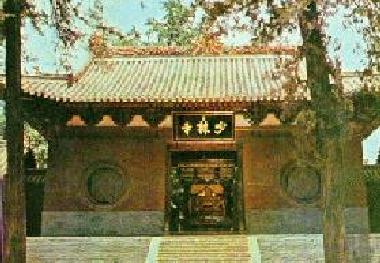
Shaolin Monastery

The Main Gate of the Shaolin Monastery

Shaolin Kungfu is the greatest martial art in the world! Understandably, exponents of other kungfu styles or martial systems will vehemently oppose this claim, but if they care to read on, are prepared to discard provincial prejudice and reason intellectually, they may even agree. I must clarify that I am far from originating the claim of Shaolin Kungfu as the greatest martial art. A statement to this effect has already been popular in China since the Tang Dynasty more than 1000 years ago!

Great Generals and Empire Builders

Generals

Many great generals were trained in the Shaolin tradition

What criteria should we use to measure the greatness of a martial art? Many people would place combat efficiency as the top priority. In this respect, from the perspective of both practical result as well as theoretical reasoning, Shaolin Kungfu can justifiably claim the top place.

The Shaolin school is the single martial art group that has produced the largest number of army generals in Chinese history. Great generals like Yuan Zhong, Yue Fei and Chi Ji Guang, on whom the whole empire depended at their respective times, were Shaolin Kungfu masters.

Since its establishment from the Liang Dynasty, with the exception of the Mongolian and the Manchurian Dynasties, virtually all leading warriors who built or helped the empire founders to build new governments, including the governments of the Kumintang and the Communist in modern time, were trained in the Shaolin tradition. This was related to the Shaolin philosophy of supporting a good government but overthrowing an oppressive one.

Largest number of Masters

The school that has provided the largest group of kungfu masters as well as of kungfu students at any one time during the long history of Chinese martial arts is Shaolin. Considering that one out of four people who existed, lived in China, this claim can reasonably be extended to the world.

An overwhelming number of the masters, like Ku Ru Zhang, Huo Yuan Jia, Wang Tze Ping and Wong Fei Hoong, who convincingly defeated foreign masters such as from Japan, Russia and Europe coming to China to test her martial art, were trained in Shaolin Kungfu.

Considering the glorious record of Shaolin Kungfu, may those who practise it today, irrespective of race, culture and religion, even if they cannot emulate a portion of the past masters, do not degrade a great martial art into a dance.

Enriching Our and Other People’s Lives

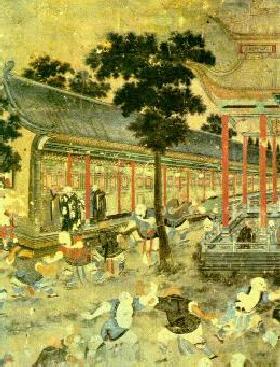
Shaolin Temple Mural

A famous mural in the Shaolin Monastery dipicting monks practicing kungfu

Yet, in line with the Shaolin teaching which actually discourages fighting, although Shaolin disciples will fight well if they must, its claim to greatness can be approached through discursive, non-fighting means. All martial arts may be analyzed through their aspects of form, power, application and philosophy.

From the perspective of form, all the techniques found in all world known martial arts today, such as karate, taekwondo, jujitsu, judo, aikido, Siamese boxing, western boxing, and wrestling, can be found in Shaolin Kungfu! From the perspective of power, the internal force of Shaolin masters, which is not limited by age or physique, is incredible. It is used not just for hurting , but more significantly for healing.

While most other martial arts are principally meant for fighting or as a sport, and sometimes hurting the participants in the training itself but without specifically tending to the injuries, Shaolin Kungfu is a comprehensive programme for physical, emotional, mental and spiritual cultivations, and its benefits enrich our and other people’s lives.

A Shaolin disciple, for example, is trained to be courteous and considerate, brave and righteous, assess problems and situations with calmness and clarity, and attend to duties with zest and loyalty. While the philosophy of many martial arts mainly focuses on how to be stoic and hurt the opponent, Shaolin philosophy teaches gentleness and a love for life. The twin pillars of Shaolin philosophy are compassion and wisdom.

The Spirituality of Shaolin Kungfu

The Buddha

The Buddha

The depth of Shaolin wisdom is bewildering, and is hard for some martial artists to comprehend or believe. At the relatively lower mundane level, Shaolin philosophy explains how we are responsible for our own lives, and why the phenomenal world is a creation of mind.

At the highest level in Zen, its wisdom surpasses the intellect, for its accomplishment depends not on verbalization and speculation but on direct experience, and the highest attainment is the direct experience of enlightenment, called variously by different people because of historical, linguistic, cultural and other differences, such as return to God or unity with the Great Void.

It is this spiritual aspect, which transcends all ritualistic religions, that best justifies Shaolin Kungfu as the greatest martial art. You will be in for a surprise if you think that the philosophy of Shaolin spirituality is merely theoretical. All Shaolin philosophy is geared to practical benefits. Spiritual cultivation in the Shaolin teaching may operate at one or more of the following three levels, depending on the student’s developmental stage.

  • Leading a morally upright and happy life.
  • Enjoying heavenly bliss in the after-life.
  • Attaining enlightenment in Zen.

SHAOLIN WAHNAM KUNGFU — COMBAT SEQUENCE 3 “PRECIOUS DUCK SWIMS THROUGH LOTUS”

(reproduced from http://www.shaolin.org/review/duck.html)

Precious Duck Swims Through Lotus

Precious Duck Swims Through Lotus

Near enough to Strike but Far enough to be Safe

In the first combat sequence in our combat training programme, “Black tiger Steals Heart”, you developed two fundamental combat skills, namely right timing and right spacing. These two are fundamental skills, meaning very important skills that form the foundation of future development.

The third fundamental skill is appropriate force, which is developed in our force training programme like “Golden Bridge” and “One-Finger Shooting Zen”, and which we apply in our combat sequences. It is important that the force must be flowing, and not mechanical or staccato.

Combat Application Combat Application
Poise Patterns Black Tiger

Without these three fundamental skills, a person cannot be combat efficient, even if he knows a lot of techniques. This is a common fault with many kungfu students — they think mistakenly that they can be more combat efficient by learning more techniques.

Skills have to be developed methodically, not merely learnt from a book or even from a master. A master provides you the method, and shows you how to do it, but you have to practice and practice to so that the skills become second-nature to you.

Combat Application Combat Application
Single Tiger White Snake

Free sparring is not a method to develop skills; it is a method to test whether you have developed the necessary skills to apply appropriate techniques in combat. This is a common fault with most martial art students today — they mistakenly think they can be combat efficient by practicing free sparring.

In this combat sequence, “Precious Duck Swims through Lotus”, you consolidate and improve upon the combat skills you have learnt, namely right timing, right spacing, right judgment and instantaneous change. We also have increased the choice of attack and defence from two to three alternatives.

Combat Application Combat Application
Golden Dragon Precious Duck

In the first combat sequence, there is only one choice, which is actually no choice. The initiator attacks with “Black Tiger Steals Heart” and the responder defends with “Single Tiger Emerges from Cave”. Both the initiator and the responder know what the movements will be. The movements are pre-arranged so that being free from worrying what to move next, they can better focus on developing the skills of right timing, right spacing and appropriate force.

In the second combat sequence, the initiator has two choices — he can attack with “Black Tiger Steals Heart” or “White Snake Shoots Venom” — and the responder has to react accordingly. In this third combat sequence, the choice is increased to three, with the addition of “Precious Duck Swims through Lotus”. If the responder makes a wrong judgment, his instantaneous change is more difficult. In the previous two combat sequences, if he judges wrongly, he can still defend against the coming attack — his “Golden Dragon” can still defend against the ”Black Tiger”, and his ”Single Tiger” can still defend against the “White Snake”. But here he has to change his “Golden Dragon” or “Single Tiger” into a “Hand Sweep”.

Combat Application Combat Application
Hand Sweep Single Tiger

Two new skills are introduced in this sequence. One is adjusting footwork. This skill is a development of right spacing. After defending your partner’s “White Snake” with your “Golden Dragon”, you have to bring back your front left leg a small step before moving forward a big step with your right leg for your counter-attack with “Precious Duck Swims through Lotus”. If you do not adjust your footwork, you would give your opponent a free advantage, i.e. an advantage he gains without having to do anything. You would have made it easy for him to strike you or fell you to the ground.

The second skill is covering yourself in your attack. You can do this by “taming” his front left hand, i.e. pushing it aside or “floating” it upward, with your left palm maintaining contact with his left arm, while you strike his side ribs with your right punch. Covering yourself is extremely important in any attack. This is what many other martial artists never do, exposing themselves to serious counter-strikes.

In the previous two combat sequences, the counter-attack mode is “first defend then counter”. Here the mode is “no defend direct counter”. As an opponent attacks you with “Precious Duck”, you need not block or ward off the attack first, then counter-attack. While moving your front left leg backward into a left false-leg stance, you directly strike his attacking arm with your hand-sweep.

“No defend” is a misnomer. It is not ignoring your own safety and go all out to attack, which would be foolish. Here, the defence is already incorporated in your counter-attack. As you move into your false leg stance for your counter-attack, you already have moved your body away from his attack.

OVERVIEW

Combat Application Combat Application Combat Application Combat Application
Poise Patterns Black Tiger Single Tiger White Snake
Combat Application Combat Application Combat Application Combat Application
Golden Dragon Precious Duck Hand Sweep Single Tiger