Category Archives: Shaolin Wahnam Insight

Cancer Can Be Cured!


Qigong Master of the YearThe Qigong Master of the Year explaining to the Second World Qigong Congress that Cancer Can Be Cured


Editorial Note:Sifu Wong Kiew Kit presented a paper on “Qigong, a Cure for Cancer and Chronic, Degenerative Diseases? A Global Interest” at the Second World Congress on Qigong, held in San Francisco, USA from 21st to 23rd November 1997. At the Congress, Sifu Wong was awarded “Qigong Master of the Year”.


There is No such a Disease as Cancer!

The question of cancer illustrates an interesting difference of perspective between conventional western medicine and traditional Chinese medicine in viewing disease and health.

If we take the western perspective and call a disease cancer, it brings forth a feeling of fear and anxiety. But if we take the Chinese perspective, there is no such a disease as cancer!

That does not mean people suffering from an illness with symptoms which the west would identify as cancer, did not exist in China. They did but they were never identified as cancer patients, and many of them might have recovered without ever knowing that their disease would be called cancer by western doctors.


Treat the Cause, not the Symptom

Then how did traditional Chinese physicians identify their illness?

Unlike in conventional western medicine where a disease is identified by its symptoms, in traditional Chinese medicine it is identified by the pathogenic conditions of the patient.

Hence, three patients diagnosed by western doctors as suffering from the same disease such as stomach cancer, would be described differently by Chinese physicians, because the pathogenic conditions that cause the same symptoms can be different.

One patient may be described by the Chinese physicians as suffering from energy blockage of the spleen meridian, another from poisonous heat in the stomach system, and the third from accumulation of fire evil at the intermediate level.

While these diagnostic descriptions may sound funny to western audience, mainly because of cultural and linguistic differences, they are both meaningful and poetic to the Chinese.

To the patients themselves, it can be a difference of hope or resignation, recovery or suffering.

While western medicine uses such treatment methods as chemotherapy, radiation and surgery, which attempt to eliminate the symptoms, Chinese medicine seeks to remove the causes.

Hence, Chinese physicians would not be so concerned as the spread and level of malignant growth, as, in the case of the three patients, clearing energy blockage of the spleen system, eliminating poisonous heat at the stomach system, and dispersing fire evil at the intermediate level. When the pathogenetic causes are removed, the patients will recover as a matter of course.


Ocean of Carcinogens

It is a fallacy to say that cancer is incurable.

Cancer experts know that every person has cancer not just once or twice but thousands of times in his (or her) lifetime, and the same thousands of times he recovers from cancer without his knowing.

It is only when his systems fail to function as they should function, that cancer surfaces as a clinical disease.

Statistics show that one out five persons in the United States has cancer as a clinical disease. The situation in other parts of the world is equally disturbing.

But if we are aware of the environmental conditions we are in, we would probably revise our thinking. According to cancer experts, the two main causes of cancer in human are chemical carcinogens and radiation.

You may be alarmed, or heartened — depending on your perspective — to know that we are literally living in an ocean of carcinogens, or cancer-causing substances.

The following are only some of the common carcinogens: arsenic, asbestos, benzidine, benzpyrene, carbon tetrachloride, chromium compounds, lead, nickel compounds, oils, petroleum products, cigarette smoke, pitch, hydrocarbons, cobalt, soot and tar.

Thus, the moment you step onto a tar road, you expose yourself to a carcinogen.


Radiation In and Out

You may, with tremendous effort and extreme discomfort, avoid chemical carcinogens, but you simply cannot avoid radiation.

Not only we are constantly exposed to powerful radiation from outer space, we are also constantly exposed to radiation inside out body. Our free radicals, which are essential for our immune system, are radio-active. Radiation causes cells to mutate.

An adult has about 100 trillion cells, and each day he produces 300 billion cells to replace cell loss and damage. If just only one cell mutates, if left unchecked, it would lead to cancer.


Everyone Cures Himself or Herself of Cancer

With this awareness, we should ask not why does one out of five persons have cancer, but why four out of five do not.

The answer is actually simple: we have wonderful systems ourselves to overcome not only cancer but all diseases.

For example, millions of cells mutate every day, but they are checked and balanced by our own wonderful body systems. Good health is our birth-right. We are by nature healthy. Illness occurs only if one or more of our body systems fail to function naturally. Illness is unnatural and temporary, and therefore can be rectified.

In Chinese medical philosophy the way to maintain or regain health is to restore the natural functions of our body systems. The Chinese figuratively call it restoring yin-yang harmony, yin representing the natural workings of the body and yang all disease causing agents.


Life is a Meaningful Flow of Energy

There are many approaches in restoring yin-yang harmony, such as acupuncture, herbalism, massage therapy and external medicine, but the most direct and natural is chi kung.

Chi kung, also spelt as “qigong” in Romanized Chinese, is the art of energy. Life, most life scientists today agree, is a meaningful flow of energy. If the flow is disrupted, illness or even death may occur. The forte of chi kung training is to increase energy level and ensure its harmonious flow.

This meaningful flow of energy occurs at all levels of life. For example, at the organic level when radiation becomes stronger, such as when we go into the sun, numerous mechanisms will trigger off the right responses to adjust to the changing environment.

At the cellular level when carcinogens seeps into cells, just the right amount of hormones (many of which are still unknown to modern science) will be produced to neutralize the adverse effect of the cancer-causing chemicals. In Chinese medical terms, this is known as harmonious chi flow.


Effects of Chi Kung on Body Cells

Recent research using modern scientific methods and instruments has shown some encouraging facts about the effect of chi or energy on body cells.

It has been discovered that 50% of cancer cells in a cultured dish were killed after a chi kung master has transmitted chi into them after 5 minutes — without affecting other healthy cells.

It is also discovered that the DNA pattern of a sick person is slightly different from that when he is healthy, and harmonizing energy flow through chi kung training can restore the healthy DNA pattern.

If medical researchers place the interest of cancer patients above pride and prejudice, vested interest and group pressure, they should at least conduct further tests to honestly investigate if these claims are true.


Benefits of Chi Kung for Cancer Patients

It may be assuring to some cancer patients to know that practising chi kung, even if it does not bring the desired cure, cannot make their illness any worse. Even if total recovery is not achieved, their quality of life is almost certain to improve.

They will, amongst other benefits, be able to eat and sleep better, experience less pain, have more energy, and most important of all regain their hope and will to live.

But they should aim for complete cure, for to be healthy is their birth-right.

They should also realize that they need to practise chi kung, and not just some gentle exercises mistakenly regarded as chi kung.

A crucial criterion is that they should be able to purposefully improve their energy flow.

Better still, they should enter into what is known as a chi kung state of mind whereby in this heightened state of consciousness, they can subconsciously instruct the millions of new cells born every moment to be healthy and wholesome, and not automatically follow the cancer pattern of their predecessors. All these can be achieved, for good health is our natural birth-right.

A Shaolin disciple, for example, is trained to be courteous and considerate, brave and righteous, assess problems and situations with calmness and clarity, and attend to duties with zest and loyalty. While the philosophy of many martial arts mainly focuses on how to be stoic and hurt the opponent, Shaolin philosophy teaches gentleness and a love for life. The twin pillars of Shaolin philosophy are compassion and wisdom.

— Grandmaster Wong Kiew Kit

INSTRUCTOR-STUDENT RELATIONSHIP By Dr Kissey Damian, Senior Disciple of Grandmaster Wong


This is a reproduction of a discussion Dr. Damian Kissey had with some Shaolin Wahnam Instructors.

Dr Damian and Grandmaster WongDr Damian Kissey and Grandmaster Wong Kiew Kit


About Teacher and Students of Shaolin Arts

Teacher’s Role : The aim is to be a good teacher, as defined in Sifu’s website : Skillful, Exemplary-courageous, Knowledgeable, Systematic, Inspiring, Generous-compassionate and Morally upright and righteous ), aspire for the highest Shaolin ideals if he or she is not yet a Buddha , decides who, what, when and how to teach (not for the student to decide)

Student’s Role : To be clear about the aim (eg combat efficiency), search for a teacher to fulfill aim, obey instruction once accepted as student, review results after certain duration of practice .

If a student cannot find the ideal best teacher, he should choose at least a qualified sincere teacher or continue searching.

The teacher’s attainment level must be higher than the student’s but it is not morally wrong if they eventually become husband & wife, or if the teacher treats the student (not the other way round) as an equal (e.g Sigung Choe Hoong Choy treated Sifu as equal).

If the student’s aim is achieved, the teaching is considered successful, regardless of whether the teacher is a eunuch, sometimes gets angry, sometimes intoxicated or is gay .

If wearing a mask means a teacher deliberately withholding or hiding a fact, then it is a matter of strategy and severity on a moral scale.

It is not the student’s business to not follow instruction just because the qualified teacher is not perfect in some ways. A student’s business is as outlined above. But a teacher may wear a mask sometimes if doing so helps students achieve their aims.

For example if a student has a phobia for eunuchs then a castrated teacher needs not tell, as the student may run away even before practice begins (i.e. a good strategy and a small lie). However a teacher should not pretend to students that he is a famous teetotaler, vegetarian Shaolin monk when in private he eats hamburger and gets intoxicated with alcohol/opium (i.e. evil strategy and a big lie) even though he is a good fighter.

How do we reconcile the Shaolin Buddhist precepts like Not Lying and Not Being Intoxicated with the two above scenarios? To me, it is a question of choosing the lesser evil from the spectrum of moral scale (Shaolin Laws). If the aims/ends (i.e. bringing good to the student and the teacher ) justify the means (i.e. wearing a mask), then it is net good action .

Respect (from student to teacher) is very important in Internal Arts as it creates the best condition for the student to achieve his aims .There is a saying “Familiarity breeds contempt” related to the general human tendency to perceive another person negatively after gradually knowing of his human shortcomings (even if some or all of them are imagined) .

But High Level Internal Arts are not for everyone and becoming Sifus is not for average persons. Novice students may fall into the trap of the above saying, start to intellectualize/judge their Sifus as if they stand at a same level, take special things for granted, when they should focus more in experiencing the depth and breadth of the Arts. These explain why, in history, even very great internal arts masters were persecuted, tortured and even crucified by the ignorant public or deviated followers .

If a Sifu rubs shoulders with all without discrimination and does not know how to keep some distance from students who do not deserve it yet or not mature enough to handle familiarity, it may lead to loss of respect for the teacher, and students’ progress will be affected and the school as a whole suffers consequences .

Sifus do not need to tell students everything that the students are not psychologically ready to hear as it may cause negative emotions/confusion and impede the students’ progress. That is why there are ordinary students and inner chamber disciples, open and closed/top secret.

Sabah Intensive Chi Kung CourseSabah Intensive Chi Kung Course, June 2009
Students should respect their Sifu. Sifus should keep a healthy distance (wear a mask sometimes) from students. School hierarchy is a necessity and Sifus should aim to continuously improve and aspire to the highest Enlightenment, not because of arbitrary Shaolin fancies but because it is in line with “Avoid Evil, Do Good, Purify the Mind”, because Buddhas and Great Masters have discovered through actual experience the nature of the ignorant human mind, the nature of inter-personal human relations, the nature of human societies on earth and the potential of all sentient beings.

__________________
Damian Kissey
Shaolin Wahnam Sabah, Malaysia
www.shaolinwahnamsabah.com
3rd February 2011

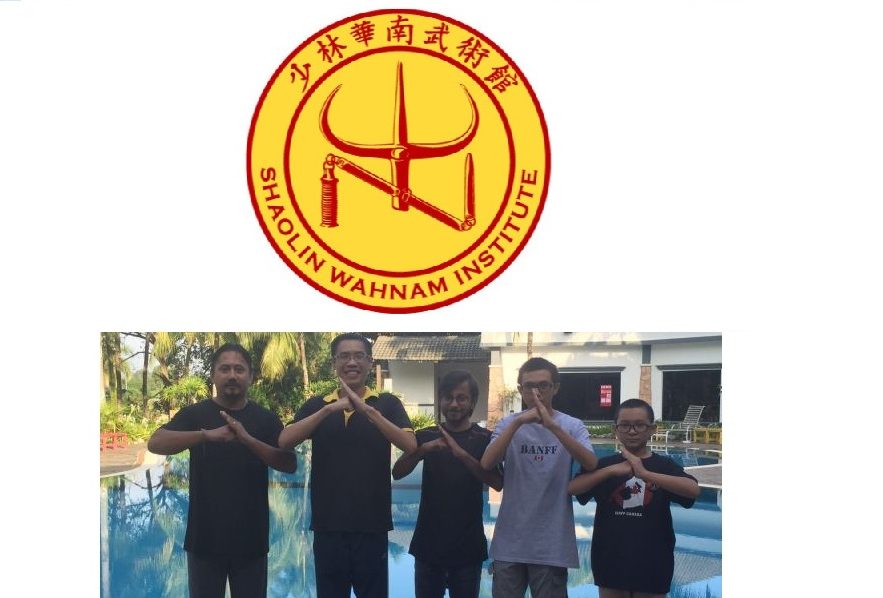
The Shaolin Wahnam Logo

by Grandmaster Wong Kiew Kit

Shaolin Wahnam Institute

The design of the logo is red in colour and the background yellow. These are the colours of our school. Red represents courage and righteousness, and yellow represents compassion and wisdom, manifesting the ideals of a scholar-warrior as well as the ideals of a warrior-monk.

The design of the trident and three-sectional soft-whip makes the letter W and N, indicating “Wah Nam”, named after Grandmaster Lai Chin Wah and Grandmaster Ho Fatt Nam, the two sources from which our school developed.

The trident and soft-whip also represent “kong” (“gang” in Mandarine) and “yow” (“rou”), indicating both the “hard” and “soft” dimensions of our training.

The inner and the outer circles represent both the internal and external approaches of our cultivation, and also signify that we pay importance to both our mind as well as our body. The inner circle reminds us of the importance of internal unity, and the outer circle our universality, i.e. we spread our arts to deserving people irrespective of their race, culture and religion.

In addition,, note that “Shaolin” is a Mandarin translation, whereas “Wahnam” is Cantonese. “Shaolin” was chosen over “Siu Lam” (which is in Cantonese) because it is universally known, whereas “Wahnam” was chosen over “Huanan” (in Mandarin) because the names of our grandmasters, “Lai Chin Wah” and “Ho Fatt Nam” are generally known in Cantonese.

This shows we can be both idealistic and practical at the same time — the non-dualistic characteristic of Zen. We are idealistic in our aspiration, but practical in our application. It also reflects that while our origin (Shaolin) was from the northern Shaolin Temple, our development (Wahnam) was from the Shaolin Temple in the south.

Sifu Joan Browne of Shaolin Wahnam Ireland also points out that the number three, as suggested by the trident and the three sectional whip, is important. It reminds us of the three treasures of Shaolin, namely chi kung, kungfu and Zen, and that our training involves all the three dimensions of form, energy and mind.

Showing Respect to the Master

SHOWING RESPECT TO THE MASTER

Creating the right mental frame for the best learning

By Grandmaster Wong Kiew Kit

Sifu Wong and Uncle Righteousness

An old photograph showing Sifu Wong (in his teens) performing a Hoong Ka kungfu set with his master, Sifu Lai Chin Wah, popularly known as Uncle Righteousness (middle behind in white T-shirt), looking on.

An art is best learnt in its culture. One remarkable difference between the culture of the East and the West is the respect shown to a master. In this connection I have little complaint because my students, from both the East and the West, generally show much respect to me. But I have met many Eastern masters commenting on the lack of respect, sometimes utter disrespect, shown to them.

Often it is because of the Western students’ ignorance of Eastern ways rather than their wilful discourtesy that their Eastern masters of chi kung or kungfu (including taijiquan) regard as disrespect. The following are some simple and helpful points both Eastern and Western students may follow to show the respect deservedly due to their masters.

Addressing the Master Correctly

Sifu Wong and Sifu Ho Fatt Nam
Sifu Wong (in his 40’s) with his master, Sifu Ho Fatt Nam, the third generation successor from the Shaolin Monastery

First of all you must know how to address your master correctly, something which many Western students are ignorant of. Never, never, never call your master by his name, especially if he comes from a Eastern culture. In some Western societies it may be considered personal and desirable to call your senior or even your boss by his first name, but in chi kung or kungfu culture it is considered extremely rude.

It is worthwhile to remember that your master is not your peer or equal. Your master is at least one, but usually many levels above you, otherwise he cannot and should not be your master. The proper way to address your chi kung or kungfu master is “Sifu”, which is the Cantonese dialect of the Chinese language for “Master”. The Mandarin pronunciation is “Shifu”.

Actually if a great master answers you when you call him “Sifu”, you are, not he is, honoured; it shows he accepts you as a student. I always felt greatly honoured whenever I called my masters Lai Chin Wah and Ho Fatt Nam “Sifu”, because they were two of the greatest masters I had found.

If your master’s surname is Chen, you should call him “Sifu”, or “Master” if you want to sound Western, but strictly speaking not “Sifu Chen” or “Master Chen” for that is the address the public, not his students, would call him. If you call him “Sifu Chen” or “Master Chen” you are distancing yourself from him.

Showing Propriety

Besides showing propriety in your address, you should also show propriety in your behaviour. Do not, for example, put your hand around him, pat him on his shoulder, or hug him — leave that to his wife, which following Eastern social etiquette is also only done in private.

When you stand or sit in front of or near him, hold yourself upright. You need not stand at attention like a private in front of his sergeant major, but you should not stand sloppily, with arms akimbo or hands in your pockets. When you sit do not cross your legs with a foot pointing at him, or expose your groins to him even though they are hidden by your pants.

It is only sensible that you should listen when your master speaks, especially if he is explaining some points. Yet, it is not uncommon to find some adult students (male as well as female) lying on the floor, sometimes with their hands folded at the back of their head, their eyes close and their legs open in an inviting position! This shows not so much a disrespect to the master, but an utter lack of good manners on the part of the students.

Entering and leaving a class

It is also bad manners to arrive at your class late. In the past in the East, late students would be asked to go home, or to leave permanently if they were late habitually. The logic is simple: the master has something invaluable to offer; if you come late you tacitly show that you do not value his teaching. But if there is a valid reason for your being late, you should first greet him from the door, walk quietly but briskly to him, respectfully wait if he is pre-occupied, then explain your reason and apologize.

On the other hand, you should wait patiently if the master is late — even for hours! If you think this is unfair, you are probably not ripe for great arts. There are stories of great masters who purposely arrived late, not for hours but for days, and then passed on their secrets to the few wise, patient students. Although it seldom happens nowadays, it will reflect a splendid grasp of chi kung and kungfu culture if you and your classmates stop whatever you are doing, stand up respectfully, bow and greet your master as he comes in.

Do not leave your class half-way. But if you have to leave early for some reason, explain that to your master before-hand and politely ask his permission. At the appointed time, ask his permission again, then bow and thank him before leaving. At the end of a class, the students should leave after the master, not before he does. However, if the master stays back for a considerable length of time, such as explaining some points to some students who stay behind to ask him, other students may leave first, after bowing to the master.

In the East, it is customary for the teacher to arrive last and leave first. Interestingly, it is often the reverse in the West. The teacher, Western in culture if not in race, often arrives the earliest, sweeps the floor and prepares cookies and drinks which he will serve during recess to his students, who will joke and laugh. At the end of the class, the teacher will stand at the door, shake the students’ hands and thank them for their attendance. He will then throw away the garbage his students have left behind if he still has energy left, and check that everyone has gone home before he closes the door.

Offering a Cup of Tea

In Eastern culture it is always the students who offer drinks to the teacher. When you offer your master a cup of tea, it is preferable to do so with two hands. In Eastern societies, accepting a cup of tea and drinking it has deeper significance than merely quenching thirst.

In the past, even if someone had done you great wrong, if he or she offered you a cup of tea, usually while kneeling down and then knocking his or her head on the ground, and you, sitting down in front of other witnesses, accepted and drank it, it meant that you accepted his or her apology, were ready to forgive all the wrong, and would not take any action whatsoever in future.

The students should also offer a seat to the master, and the seat chosen is usually the best one available. If the master is not seated, the students should remain standing, unless the master asks them to sit down. If they dine together, the students would wait until the master has made his first move to eat or drink.

Don’t be Insulting

When your master is explaining or demonstrating something to you, listen attentively and respectfully. Do not bluntly say you already know what he is teaching, even if you really know. In chi kung and kungfu culture, doing so is not being straight-forward, it is being insulting — you are implying that the master does not know what he is doing.

I recall some occasions when my masters taught me something that I already had learnt quite well. Thanks to my training in Eastern culture, I followed their instructions faithfully although they appeared very simple and below my level then. Only much later did I realize that had I not follow these apparently simple instructions I would not have acquired the foundation necessary for advanced development.

Do not ever make the fatal mistake of telling a master what or how to teach you. This is not only unbecoming, it is also very foolish, for you will be denying yourself the very purpose why you need him. If he is a master, he knows best what and how to help you attain your best results; he is able to see your needs and development in ways far beyond your limited perspective.

For the Students’ Interest

Some westerners may find the above-described master-student relationship odd, just as those accustomed to Eastern culture would find the behaviour of some western students unbelievable. It may be more surprising, especially for those who think they are doing the master a favour by paying him a fee to learn, to know that all these customs of respect for the master are actually for the students’, not the master’s, interest.

Someone who teaches kungfu dance or gentle exercise for a living will probably care more for your fees than your respect, but a master whose art gives you good health, vitality, mental freshness and spiritual joy actually does not care whether you respect him more or your dog. But those students who have experienced the wonderful benefits of genuine kungfu and chi kung will understand that the respect given to the master is not only a sincere token of appreciation to the master for sharing his art, but also constitutes an ideal psychological state for the training to take place.

Cosmos Chi Kung – Cleansing at Many Levels

Cosmos Chi Kung – Cleansing at many levels
by Sifu Barry Smale – Instructor,  Shaolin Wahnam England

Cosmos Chi Kung is a high-level form of Chi Kung. One effect of this is that cleansing takes place at a number of levels – physical, emotional, mental and spiritual.

Recently, having been teaching a number of beginner students, I have noticed something interesting. Even though people can hear and understand the concept, they can have trouble understanding the implications.

One thing Sifu often says is that if you have an old physical injury then, when you are in chi flow, you may notice “good pain” in that area. This is the Chi moving and cleansing blockages. When I explain that to early students they are nearly always happy and reassured if any discomfort arises during their practice as they see it as a sign of cleansing.

However, they are often less happy if they notice old thoughts or emotions arise or if physical or other discomfort comes up that seems to have no origin.

Really, there is no need for surprise or disturbance. The principle at the emotional, mental or spiritual level is the same as at the physical. If there is a blockage, you may notice some “pushing through” occuring. With physical injury you may notice that at the original site. So, the same is true at the emotional, mental and spiritual levels.

If you find that things arise in chi flow – emotions of any kind (from joy through to sadness and despair), thoughts of any kind (from “good” to “bad” or “disturbing”), or any strange mind/body manifestation – then the best way of handling them is to just “let go”. Maybe even at some point be grateful an unhelpful blockage is being cleared. You don’t need to worry or intellectualise about what it is.

Many of you will have heard Sifu or your instructor say “very good, carry on”. It means what is says. You don’t need to worry or intellectualise about what arises during chi flow. I found these words to be invaluable during some stages of my practice. To be able to accept that sometimes there would be “good discomfort” during my practice but that it was doing me good. Remember, at the end of every session you come to stillnes and then get on with the rest of your day.

Obviously, if something difficult persists, or you feel cloudy or troubled at the end of practice, then check with Sifu or your instructor. But don’t be surprised if they suggest you are holding onto an unhelpful idea or unnecessary intellectualistion.

So, really a simple idea. When cleansing is taking place it might “wake up” the site of blockage/injury. That happens at the level of emotions, thought and spirit, not just physical. So, allow what comes to come, trust in the art and your teacher, and do your best to enjoy the process.

With metta,

Barry